

The gap between the two sides in the conflict within the Anglican Church of Canada (ACC) just become much wider.
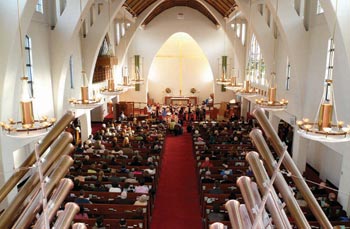
At their annual vestry meeting February 13, members of the congregation of St. John’s Shaughnessy Church in Vancouver voted overwhelmingly to leave the ACC.
By February 24, a number of other B.C. churches, as well as several in Ontario, had followed suit.
The B.C. churches are St. Matthew’s, Abbotsford; Church of the Good Shepherd, Vancouver; St Matthias and St Luke Vancouver; and St. Mary of the Incarnation (Metchosin), Victoria. All of them, except for St. Mary’s, are members of the Anglican Network in Canada (ANiC). The ANiC was formed after Bishop Michael Ingham approved the Diocese of New Westminster’s 2002 decision to bless same-sex unions.
As Canada’s largest Anglican church, St. John’s drew most of the media coverage for its actions. It was the first ANiC church to leave both the diocese and the ACC.
The St. John’s motion read, in part:
“In order to remain in full Communion with the Church of England throughout the world, this parish hereby requests, on an emergency and pastoral basis, the Episcopal oversight of Bishop Donald Harvey, under the primatial oversight of Archbishop Gregory Venables of the Province of the Southern Cone.” The Southern Cone includes countries such as Bolivia, Chile, Paraguay, Argentina and Peru.
“St John’s has shown true leadership both now and over the past difficult years,” said Harvey in a news release.
He added: “I look forward to ministering with them and moving forward together in mission and in full communion with the tens of millions of orthodox Anglicans worldwide who have been so supportive of us.”
On February 22, Ingham sent a letter to the clergy of St. John’s and St. Matthew’s, asking them to inform him whether or not they have officially left the ACC. The diocese said Ingham’s letter represented a “notice of presumption of abandonment of the exercise of ministry.”
“In our church, we have due process,” said George Cadman, chancellor of the Diocese of New Westminster.
“Under our Canon law, the priests have two months to come in and show the bishop that they wish to remain with the Anglican Church of Canada.”
If he receives no word from the clergy, Ingham can officially declare they have abandoned the ACC. If that happens, the clergy can appeal that declaration.
“It’s regrettable when anyone leaves the church,” said Cadman, “but we do need to get clarity on these matters and get on with the larger work and mission of the diocese, caring for people.”
Property
Asked if she thought the diocese might try to claim it had a legitimate right to the church’s property, St. John’s spokesperson Lesley Bentley said: “I think they have said they will make that claim.”
If the church’s personnel were dismissed by Ingham, she said, “I presume our clergy will become licensed by Don Harvey.”
She said the church has access to a legal fund of $1 million. However, she noted, “Our anticipation is that we shouldn’t have need to use it.”
While she said the split with the diocese and the ACC was unavoidable, she observed: “We are sorrowful about it.”
“We regret it when any person leaves the fellowship of the ACC, and we’re saddened,” concurred Peter Elliott, the bishop’s commissary, or acting bishop.

He said diocesan officials have “a duty to protect the assets of the diocese. The parish was set up as part of the ACC; the heritage of St. John’s is to be a parish of the ACC. The Diocese of New Westminster is the local manifestation of the ACC; parishes of the diocese are within this structure.”
The church’s disengagement from the ACC, he said, was illogical. “It’s like if the city of Burnaby decided it didn’t like the policies of the government of BC, and wanted to move to Alberta.” While they couldn’t declare the municipality a part of Alberta, “they are free to move to Alberta” as individuals.
Both sides in the conflict made unusual use of media options leading up to the vote. The bishop videotaped a talk he gave to members of parishes in his diocese.
According to a news release, Ingham “stressed that Anglicans belong to a diocesan Church. Dioceses establish parishes – and not the other way round. There is no legal precedent which would allow members of a congregation who choose to leave the diocese . . . to take parish lands, buildings or other assets with them.”
Further, “Ingham insisted that the disputes, though prominent in secular media, have not diverted the Anglicans in the Diocese of New Westminster from continuing their Christian mission of community outreach and care of parishioners.” The Ingham videos were posted on YouTube.
Crossroads
St. John’s created ‘A Crossroads,’ a DVD featuring St. John’s rector David Short, and scholar James Packer, who serves as honorary assistant at the church.”
Short characterized the church’s proposed ‘realignment’ as a “rescue operation” on the part of the Southern Cone. He likened the conflict to a natural disaster.
“It’s a little like an undersea earthquake has happened offshore – and the earthquake is high on the Richter scale. And you don’t see immediate results from the earthquake, until sometime later – when a tsunami wave washes onto shore, with devastating effect.”
Same-sex blessings, he said, were “the tip of the iceberg.” The key concerns, he insisted, were “the uniqueness of the Lord Jesus Christ [and] the authority of scripture.”
He elaborated: “When a province or diocese officially votes to overturn part of the gospel, and to say [that] something that the church has declared will keep us out of salvation . . . is something that is good and holy . . . [then] it’s no longer biblical.”
Asked if his church’s proposed realignment was “highly irregular,” he responded bluntly: “It is. It’s also highly irregular to change the gospel.”
Packer expressed concerns that children going to Sunday school at churches promoting same-sex blessings “will inevitably be nurtured on a way of understanding the Bible that is misguided from the start . . . What’s being denied is the doctrine of salvation through Christ.” Referring to 1 Corinthians 6, he said: “Don’t be deceived. Those who follow certain lifestyles will not inherit the kingdom of God.”
Regarding the Diocese of New Westminster, Packer said: “This church body has forfeited the right to be treated as a church with which to have fellowship. It’s a church very much out of order – a church that’s sick and needs to be healed. It’s a church, therefore, which calls for protest and therapy.”
Meanwhile, he said, the bishop of New Westminster “is seeking to starve us out.”
Stern warnings
Ingham, however, is not the only official taking a hard line. Diocese of B.C. Bishop Jim Cowan, in a January 30 letter to member churches, stated: “No parish or congregation . . . has any legal existence except as part of the diocese, and any attempt by any person to remove a parish from the jurisdiction of the bishop and synod is schismatic.”
Two clergy at St. Mary’s in Victoria have already been subject to chastisement. Days before the church was gearing up to vote on whether to leave the ACC, Rector Sharon Hayton and assistant priest Andrew Hewlett were summoned before Archdeacon Bruce Bryant-Scott. They were told to make sure no motion was put forth which would affect the church’s status as an ACC member. On February 15, the archdeacon sent a letter to the pair, which read in part:
“I am inhibiting you from performing the duties of your office . . . This means that you may not function as an ordained priest . . . You are not to discuss this matter with any parishioner. . . Further, I direct that you stay away from the premises of the parish.”
“To see such appalling heavy-handed bullying is incredibly disappointing,” said Bud Boomer, a member of the church.
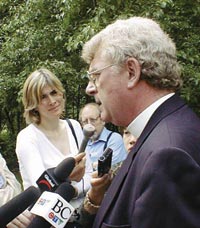
The St. Mary’s vote happened without the participation of the two disciplined priests. “There was a strong will among the people of the congregation that they wanted to have a vote and discuss their future,” Hewlett told the Times-Colonist.
Bryant-Scott issued a statement February 21, saying he had met the two clergy and agreed to a 12-day “period of grace . . . to explore a variety of options to resolve the issues.”
He noted, however, that the Diocese “has not actually conceded anything. We still hold title to the land, buildings, and their contents. The clergy still have disciplinary action proceeding against them.”
‘Devil’s playground’
Bentley said St. John’s hopes to avoid civil litigation, terming it “the playground of the devil.” However, she noted: “No diocesan money was used to build the church. Our legal team is convinced we will be able to keep the building.”
She added: “[The ACC]has shrunk across Canada by 30 percent over the last 40 years. They don’t need our space.”
Asked to comment on the fact that ANiC congregations have frequently been described as “dissidents” in various media reports, Bentley retorted: “I think the true dissident here is Bishop Ingham. Basically, to advocate same-sex unions is to bless a sin.”
Ingham issued a warning in a February 6 letter to officials of the four ANiC churches: “Clergy, wardens and trustees have a fiduciary responsibility to preserve and protect the assets of the church . . . Any attempt to betray that trust through schismatic action is a ground for immediate termination of license or removal from office, and may well subject those same individuals to civil proceedings also.”
Elliott noted that Ingham’s letter was “clear” regarding possible punishment for disobedient church personnel.
However, he said, dismissal might be irrelevant, as “these clergy seem to be leaving the ACC.” Regarding St. John’s buildings, he said: “The question of property is speculative at this point.”
The diocese and the Canadian church, he said, would hold firm to its position. “General Synod of the ACC supported a resolution saying the blessing of same-sex unions was not against the core doctrine of the church. It is considered a secondary issue.”
Citing continuing divisions on the ordination of women, he said there are “a variety of views on a variety of subjects within the ACC.”
The blessing of same-sex unions, and the ordination of an openly gay bishop in the American communion, are points of ongoing tension as Anglicans prepare for the Lambeth Conference in England later this year.
Asked whether the St. John’s vote would add notably to the strife, Elliott said: “Bishop Ingham has been invited to Lambeth. Most of the bishops in Canada plan to go to Lambeth; they are in communion with the Archbishop of Canterbury.”
Bentley, however, said the current situation “only inflames the fires. This would be a great time for grace.”
Spiritual drift
Asked why more Canadian churches have not taken a public stance in support of ANiC churches, Bentley asserted: “There’s been a lot of spiritual drift within the ACC over the past 40 years.” She said she believed many ACC clergy, and some parishioners, were out of touch with scripture. This struggle, she said, has “forced us to become better educated, scripturally. The one thing we don’t want to be is disobedient to scripture.”
Elliott said he thought the conflict had strengthened the ACC. “I travel frequently, and I hear most Anglicans saying they are proud of the way our church has handled a difficult matter. Some say they are disappointed that people have walked away from the church.”
Both agreed that reconciliation between the ACC and ANiC was still possible. “The diocese’s door is always open to those who disagree with some of our decisions,” said Elliott.
“We’re still Anglicans,” said Bentley. “We’re still in communion with the worldwide communion. I absolutely see hope for reconciliation. With God, everything is possible.”