|
By Emily Wierenga
“THERE’S a saying: ‘The blood of the
martyrs is the seed of the church,’” says 71 year old Ray
Barnett. He is referring to an incident which helped inspire him to found
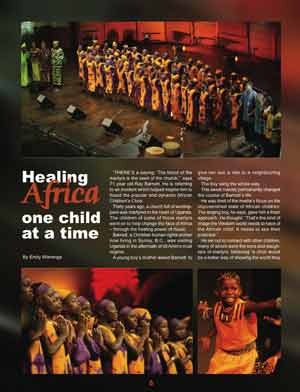
the popular and dynamic African Children’s Choir.
Thirty years ago, a church full of worshippers was
martyred in the heart of Uganda. The children of some of those martyrs went
on to help change the face of Africa – through the healing power of
music.
Barnett, a Christian human rights worker now living in
Surrey, B.C., was visiting Uganda in the aftermath of Idi Amin’s
cruel regime.
A young boy’s mother asked Barnett to give
her son a ride to a neighbouring village.
The boy sang the whole way.
This sweet melody permanently changed the course
of Barnett’s life.
He was tired of the media’s focus on the
impoverished state of African children. The singing boy, he says, gave him
a fresh approach. He thought: “That’s the kind of image the
Western world needs to have of the African child. It needs to see their
potential.”
He set out to connect with other children, many of
whom were the sons and daughters of martyrs, believing “a choir would
be a better way of showing the world they are worth investing in.”
By September of 1984, Barnett had his first African
Children’s Choir.
One of the biggest challenges, he recalls, was trying
to acquire passports for the 31 children in the middle of a civil war.
“It was all done under gunfire every single
night in the neighbourhoods.”
Eventually, the paperwork was signed – opening
the way to worldwide exposure for many of the songs of Africa.
“We started this as a six-month experiment
– and now it’s gone on for 25 years!” exclaims Barnett,
an Irish minister who immigrated to Canada in 1956 to study theology.
Ironically, Barnett himself has no official musical
training. He quips: “I wasn’t even allowed to play in the
marching band as a child, because I couldn’t keep time!”
Nevertheless, he fully appreciates the healing power
embedded in a song.
Continue article >>
|
“I know it’s good therapy, especially for
children who’ve had trauma in their lives. I think we’ve proven
that over the years.”
Healing, he says, has occurred within the choir
– and in the lives of some listeners.
“The children touch lives wherever they go. As
they get more practice, it becomes better,” says the grandfather of
four.
Although the choir has achieved prominent status
through venues like Live 8 and American Idol, Barnett is proudest of choir
members “who have gone on to lead professional lives. They’re
now helping their own communities. That’s the greatest
success.”
As examples, Barnett notes 15 schools which have been
built in southern Sudan; Music for Life Centres across Africa, helping
thousands of orphans; and the recent Hope and Healing concert in Kenya
– which, he believes, will “lead to a grassroots movement to
try and bring people together.”
Ultimately, Barnett says, the goal of the choir is to
redeem the voice of Africa.
“My dream is to see them represent
Africa’s 12 million AIDS orphans, and see them get into school and
have a better life.
“If 12 million AIDS orphans are helped now, what
a difference it would make towards making a new Africa.”
Despite being eligible to retire, Barnett has no such
intentions. After all, there’s a whole world which needs healing.
“A woman once wrote me, and said: ‘You
move a mountain one shovelful at a time,’” he recalls, adding:
“We translate that into ‘one child at a time.’”
Summer/Fall 2008
|