|
By Janelle Visser
You’re such a nerd.
This was one of the most shameful insults in
elementary, middle and high school. It was equivalent to saying:
“you’re not one of us” or “you’re not
cool.” It meant one was doomed to be an outcast, a loner –
looked down on by everyone except the teacher.
Today, however, it’s no longer a bad thing to be
a nerd. Nerds everywhere are emerging from their crevasses and challenging
the hostile, popularity-obsessed social world. The rise of the nerds is
unfolding before our very eyes.
The word ‘nerd’ was first seen in the 1950
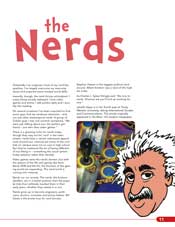
story If I ran the Zoo, by Dr. Seuss. The nerd was a fictional animal, an unkempt
creature with a disproportionately large head. One can see how the
connection can be made to a person with a curious appearance and seemingly
giant brain.
According to the Oxford
English Dictionary, a nerd is “an
insignificant, foolish or socially inept person; a person who is boringly
conventional or studious . . . . a person who pursues an unfashionable or
highly technical interest with obsessive or exclusive
dedication.”
These days, nerds are neither boring nor
unfashionable. Whether due to a lot of pro-nerd pride, or to the current
fascination with being subversive and anti-cool, nerds have found the ideal
ecosystem in which to thrive.
I was that kid in school. I had the thick-framed
glasses, the braces complete with multicolored elastics, the pizza-face
acne, and the grades to prove it. All this, combined with my natural
shyness, led to all kinds of self-esteem issues and social bloopers.
One day in grade seven, the boy I liked asked me,
quite seriously and in front of all his friends: “Want to go out with
me?” Naïve and flustered, I answered: “Where?”
Laughter ensued, my face flushed as red as Steve Urkel’s suspenders,
and any chance for a budding romance dissolved instantaneously.
Outwardly, I’ve outgrown most of my nerd-like
qualities; I’ve largely overcome my insecurity issues and acquired
some modest social skills.
Inwardly, though, the nerd thrives unhindered. I enjoy
being socially awkward, I love video games and anime, I talk politics daily
and I actually like reading.
Continue article >>
|
On several occasions I’ve been surprised to find
some guys find my nerdiness attractive – and not just other
stereotypical nerds. A group of Turkish guys I met one summer exclaimed,
“We were just talking about you: the perfect girlfriend – one
who likes video games.”
There is a growing niche for nerds today; though they
may not be ‘cool’ in the mainstream, nerds have a certain
subversive appeal. Look around you: chances are many of the cool kids on
campus were not so cool in high school. But they’ve mastered the art
of being different, of not fitting in – something the social sphere
today esteems rather than derides.
Video games were the nerd’s domain; but with the
advent of the Wii and games like Rock Band, DDR and Wii-Fit, the frontiers
of the gaming world are expanding. The nerd world is coming into maturity.
Nerds run our society. The nerds, the bottom-dwellers,
are in a better position than the popular kids that ruthlessly insulted
them in their early years, whether they realize it or not.
Nerds grow up to become engineers, politicians,
doctors, scientists and policy-makers. Bill Gates is the poster boy for
nerd success. Stephen Harper is the biggest political nerd around. Albert
Einstein was a nerd of the highest order.
As Charles J. Sykes fittingly said: “Be nice to
nerds. Chances are you’ll end up working for one.”
Janelle Visser is in her fourth year at Trinity
Western University, taking International Studies and Communications. This
article originally appeared in the Mars’
Hill student newspaper.
Options Spring 2009
|