|
By Daina Doucet
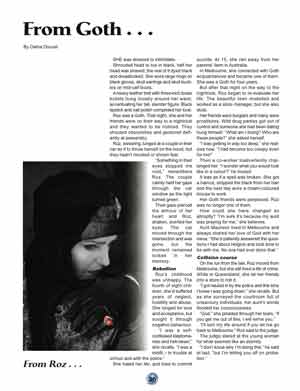
SHE was dressed to intimidate.
Shrouded head to toe in black, half her head was
shaved, the rest of it dyed black and dreadlocked. She wore large rings on
black gloves, skull earrings and skull buckles on mid-calf boots.
A heavy leather belt with three-inch brass bullets
hung loosely around her waist, accentuating her tall, slender figure. Black
lipstick and nail polish completed her look.
Roz was a Goth. That night, she and her friends were
on their way to a nightclub and they wanted to be noticed. They shouted
obscenities and gestured defiantly at passersby.
Roz, swearing, lunged at a couple in their car as if
to throw herself on the hood, but they hadn’t recoiled or shown fear.
“Something in their eyes stopped me cold,”
remembers Roz. The couple calmly held her gaze through the car window as
the light turned green.
Their gaze pierced the armour of her heart and Roz,
shaken, averted her eyes. The car moved through the intersection and was
gone, but the moment remained locked in her memory.
Rebellion
Roz’s childhood was unhappy. The fourth of eight
children, she’d suffered years of neglect, hostility and abuse. She
longed for love and acceptance, but sought it through negative behaviour.
“I was a self-confessed kleptomaniac and
hell-raiser,” she recalls. “I was a misfit – in trouble
at school and with the police.”
She hated her life, and tried to commit suicide. At
15, she ran away from her parents’ farm in Australia.
In Melbourne, she connected with Goth acquaintances
and became one of them. She was a Goth for four years.
But after that night on the way to the nightclub, Roz
began to re-evaluate her life. The beautiful teen modelled and worked as a
store manager, but she also stole.
Her friends were burglars and many were prostitutes.
Wild drug parties got out of control and someone she had been dating hung
himself. “What am I doing? Who are these people?” she asked
herself.
“I was getting in way too deep,” she
realizes now. “I had become too creepy even for me!”
Then a co-worker inadvertently challenged her.
“I wonder what you would look like in a colour?” he mused.
It was as if a spell was broken. She got a haircut,
stripped the black from her hair and the next day wore a cream-coloured
blouse to work.
Her Goth friends were perplexed. Roz was no longer one
of them.
How could she have changed so abruptly?
“I’m sure it’s because my aunt was praying for me,”
she believes.
Aunt Maureen lived in Melbourne and always shared her
love of God with her niece. “She’d patiently answered the
questions I had about religion and took time to be with me. No one had ever
done that.”
Collision course
On the run from the law, Roz moved from Melbourne, but
she still lived a life of crime. While in Queensland, she let her friends
into a store to rob it.
“I got hauled in by the police and this time I
knew I was going down,” she recalls. But as she surveyed the
courtroom full of unsavoury individuals, her aunt’s words flooded her
consciousness.
“God,” she pleaded through her tears,
“if you get me out of this, I will serve you.”
“I’ll turn my life around if you let me go
back to Melbourne,” Roz said to the judge.
The judge stared at the young woman for what seemed
like an eternity.
“I don’t know why I’m doing
this,” he said at last, “but I’m letting you off on
probation.”
Roz kept her word. She travelled to Melbourne and
called her Aunt Maureen, who picked her up.
“That day, something amazing happened,”
says Roz. “I felt something terrible and evil lift off me. I knew
right away I had to leave Australia and go where I could start
over.”
Continue article >>
|
A new life
That was late in 1989. Roz arrived in Canada a year
later.
Prior to leaving, she had noticed the name of a
Christian religious organization, Kenneth Copeland Ministries (KCM), while
browsing through some literature at her aunt’s house. It was her only
Canadian contact, so she called them.
An employee from KCM’s Vancouver office met Roz
at the airport and took her to church.
Roz had never attended a church service before, and
she was overwhelmed. She loved worship and for the first time in her life
sensed God’s presence. The sermon answered questions she had had
since childhood.
After the service, she was offered place to stay and
Henry Hinn, the pastor, invited her to enrol in Bible school. “I went
from zero to a hundred, just like that!” she says.
Through a church youth group, Roz met Carsten Schwarm.
“When I met him, I had so much ‘baggage’ that the whole
baggage claim at the terminal was mine,” she laughs.
They soon fell in love. “Before I married him, I
told Carsten about my criminal record,” says Roz. “In order to
marry me, he would have to be my sponsor, and you can’t sponsor a
criminal.”
Roz and Carsten married in Germany in 1991; but the
Department of Immigration needed to validate their marriage and her
fingerprints had to be cleared through Australia. Roz was apprehensive, but
when the report came back, it stated: “No criminal record.”
It was a miracle that defied understanding. “I
believe it’s because I trusted God and spoke the truth,” she
explains.
“I knew he would help me because he gave me his
word. In the Bible, God says, ‘Do not fear, for I am with you; do not
be dismayed, for I am your God’ (Isaiah 41:10). That passage
sustained me.
“God says to those who don’t know him yet,
‘I make all things new.’ He renewed me, cut off my past and
gave me a new life.”
Grace
Today, Roz – now known as Rosalie – is the
co-founder of Lighthouse Church in Waterdown, Ontario, along with her
husband and pastor, Carsten Schwarm.
Rosalie travels internationally, conducting speaking
engagements with youth and women’s groups, where she speaks with ease
about her former life.
“I’m honoured when people tell me,
‘You don’t look like you’ve been through
anything,’” she says, smiling.
“I’ve prayed to God and asked him why he
saved me,” Rosalie continues.
“Besides my aunt, I now think the people in the
car were also Christians who prayed for me the evening I confronted them on
my way to the nightclub.”
One day Rosalie asked her son, Josh, “Do you
know what grace is?”
He contemplated the question. “I think I
do,” replied the eight year old.
“Remember when you were bad, and Jesus made you
good?
“Now that you’re good, you point other bad
people to Jesus, who makes them good, too. That’s grace.”
Rosalie can be contacted at the Lighthouse
Church’s website at www.gotlight.org. Daina Doucet is a writer and
editor based in Hamilton, Ontario, and edits The Evangelical Fellowship of
Canada’s website, www.Christianity.ca.
- Courtesy of Faith & Friends
Summer/Fall 2008
|