|
By Angelika Dawson
WHEN you travel halfway around the world to talk about
your work, you expect to find some differences in the way you and those
doing similar work function.
But when Catherine Bargen traveled to Ukraine to meet
with those involved in restorative justice work there, she was struck more
by the similarities.
Bargen is currently working on her MA in conflict
transformation. She works with Community Justice Initiatives in Langley as
a trainer and practitioner of restorative justice in criminal and school
settings.
She was recently part of a trip sponsored by Mennonite
Central Committee Canada’s Peace Ministries program.
She and another educator from Ontario met with
MCC’s partners in Odessa: the Odessa Regional Mediation Group (ORMG).
ORMG partners with schools providing restorative peer mediation training,
exactly the kind of work Bargen has been involved with in Langley.
“We had the opportunity to meet with staff at a
local school, including a principal, teachers, psychologists and
students,” she says. “We were consistently amazed to hear how
similar their approaches to mediation and peacemaking were in their schools
as in our own Canadian schools.”
This was confirmed as they watched students perform a
role-play of a conflict.
“We could have pasted our Canadian students right
on top of them, it was exactly the kind of role-playing model we see in
Canada,” she said. “Without much communication between schools
in Ukraine and Canada, they developed an approach that’s almost
identical to what we are doing in Langley, B.C.”
Continue article >>
|
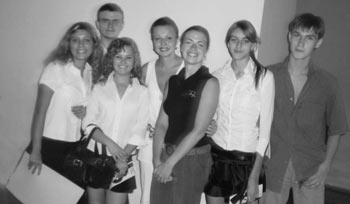 | | Catherine Bargen (in the black shirt) with Ukrainian students. Photo: Brian Enns. |
Restorative peer mediation focuses on the relationship
between those in conflict as much as on the solution. Bargen describes it
as an opportunity for those involved to reflect back on the situation in
order to gain a better understanding of it, to address harm done and to
figure out a healthy way to relate in their school context.
One difference Bargen took note of was the context out
of which teachers and administrative staff were working.
“These people are working in a post-Soviet
context, which was an extremely authoritarian environment,” she says.
“The fact that they are coming out from under that, to see peer
mediation as an effective way to resolve conflict – my admiration for
them just increased 10-fold.”
The opportunity to be an encouragement to staff there
was one of the highlights of the experience for her, and Bargen hopes
educators here are also encouraged by what is happening in Ukraine.
“Reminding people that they’re part of a
bigger, global movement is important,” she says. “We have to
educate our students in these practices and find new ways to think about
discipline. That others around the world are seeing the importance and the
success of this is encouraging.”
January 2008
|