|
Golden Compass inspires
spirited debate about God
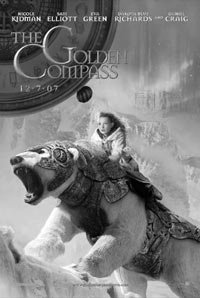 BCCN’s December
editorial, ‘Dark materials: How the Grinch stole God,’
generated many responses – especially on the Christian Info
website, at CanadianChristianity.com. BCCN’s December
editorial, ‘Dark materials: How the Grinch stole God,’
generated many responses – especially on the Christian Info
website, at CanadianChristianity.com.
I read Peter T. Chattaway’s article about The Golden Compass, and I was
mortified.
Are Christians so lukewarm these days, that they are
unable to take a stand against a film based on books which are clearly
anti-Christian – books which eventually culminate in the demise of
God himself?
If you don’t think there is an
‘agenda,’ behind the film, my friend, you are very naive
indeed. The agenda is clearly to provide a watered down version of the book
so the masses will see it – and in turn, purchase the books in this
trilogy. What a travesty!
I, for one, will not support this film or the books,
with money God has granted me, for the purpose of ‘engaging’
with this film.
I don’t care how powerful a writer Philip Pullman is, or how vivid his
imagination. If I were to see this movie, I would be supporting the author
and his beliefs, and the books the film is based on. In my opinion, this is
not a grey issue at
all; it is black as
Satan himself.
Philippians 4:8 tells us to think about things which
are true, noble, right, pure, lovely, admirable, excellent and
praiseworthy. This film does not fit those criteria!
Wanda Callaghan
I’ve read the Dark
Materials trilogy – and
I’m still a follower of Christ.
As the previous writer says, the message of Philippians
4:8 is strong and clear. That’s fine – but if we take that
passage to its logical end, we should also avoid any accounts of the
Holocaust, the Crusades or many historical things, because they
aren’t lovely and pure.
It’s not fine that Pullman is an atheist, or
whatever he says he is – especially if his decisions are made based
on believers who refuse to show him grace and love, as Jesus commanded us
too. Pullman is not a devil. He is a person loved by Christ, who loves all.
Erik
What, really, is the problem? The portrayal of God as a
doddering old fool? Was there not a Beatle song titled ‘The Fool on
the Hill,’ which rankled Christian sensibilities once the inherent
meaning was explained?
I don’t hear anyone carping about the portrayal
of God as a cigar chewing, wisecracking senior in Oh,God.
The portrayal of Christianity by Hollywood has long
been a sore point with the evangelical right and mainstream churches, who
wince at seeing their peccadilloes thrown up on the silver screen for all
to see.
Are the portrayals always accurate? Decidedly not. But
what does accuracy have to do with telling a story? Why is a story judged
with the same standard as a documentary?
I will see the film, and I know I will enjoy it,
regardless of whether or not I agree with Pullman’s view of the
universe. It seems to me the furor over the release is greater than the
impact of such a movie.
Libraries are filled to overflowing with anti-religious
polemic. So many have eloquently disavowed God’s existence –
yet the world keeps turning and God is still in his heaven.
Oddly enough, there is much to be gleaned from
partaking of – ‘engaging’ – opposing views, as
Peter Chattaway states.
Christians whose faith hangs by a fundamentalist thread
– without the imagination to understand that Pullman is entitled to write about his
opinion – should stay away.
If their world lives or dies based on the
machinations of the entertainment world, then it is a fragile and small
world indeed.
Jon Ochsendorf, Surrey
It’s because we raised such a ruckus over The Da Vinci Code that anyone
even watched the thing! It was one of the worst movies I’ve ever
seen. Boring. Weak. Not creative.
Let’s not create more press for The Demonic Compass. Bad news
travels faster than good news – and people love to see why Christians are
upset. Find a balance between boycotting it and creating more viewers for
it!
Wayne
The purpose of this movie is to get people interested
in the rest of Pullman’s work.
Let him be an atheist all he wants. But he will not push it over on my
generation. I am a teenager, and I think this man is totally out of line.
All the controversy is giving him pleasure, and the publicity he needs to
get people interested in his work.
He is also using this to try and change our beliefs.
Please don’t let your kids’ views of God be altered by this
movie!
Ashton
People will see the movie and read the books, if
they’re interested.
They might even change religions, if they’re interested.
Why can’t Christians, and all members of other
extreme religions, let your choice be your choice, and let mine be mine?
No one will “push it over on my
generation,” as Ashton said, because individuals of that generation
will make their own choice – no pushing involved.
Your views will only be changed if you let them be.
If you can’t accept other points of view, then
leave the free world and start your own oppressive regime somewhere else.
Calvin
Calvin is right. People are going to see this movie
– whether we like it or not. This, however, doesn’t mean we
have to agree with
people supporting it.
Tolerance is important, but why does it have to come
down to the point that we bend or break our beliefs, just to be tolerant?
The fact that this movie tries to speak against God in any way should make you angry!
We’re supposed to be acknowledging God’s
greatness; we cannot
tolerate this movie doing just the opposite. You’re either for God or against him.
It’s that simple.
Why has this world raised a bunch of pushover,
lukewarm, ‘I need to fit in’ people? It’s sad.
Maxwell
Continue article >>
|
Being a Christian is not about tolerance; it is about
love. Since we love one another, we want people to know the truth –
and so we affirm it, even to those who desire to kill God.
You will not find real Christians calling for anyone to
be killed. What does that say about this author, versus the Christian faith
he is attacking?
Jack O’Neill
Some people are fine with films and books that
‘slam’ the Judeo-Christian God. But racism and intolerance are
the key words, if someone publishes something against Islam – or
calls a teddy bear Muhammad.
How do you think Pullman’s material would be
presented in the media – and received by the general public –
if his slurs were directed at Islam?
Ira C
Does no one see Pullman’s use of ‘spirit
guides’ as wrong? They are New Age, and strongly condemned in the
Christian world.
For me, the film is evil on that basis alone, and I do
not think any true Christian should watch or ‘engage’ in any
way with this film.
Dennis
This is just another film – either see it or
don’t. Exercise judgment on whether your children should see it. But
banning the books, or calling the film ‘evil’ or
‘demonic,’ is the typical ‘Christian right’
response.
Why do we so stridently trumpet the morality of others
while ignoring our own?
Remember what Jesus said in Luke 6:37.
Andy
I am a believer, and I love fantasy adventures –
so I will probably see this film.
I understand the argument about not using the money God
gives us to support things that seem to go against him. But we are
“in the world, but not of the world.” If this writer’s
work is going to potentially impact children, then I want to know about it.
Many will think the movie’s great, and will not
have an understanding of Pullman’s beliefs or agenda. This is an
opportunity for educating those people. I am a firm believer in planting a
seed whenever possible.
If that can be done while having a conversation about
an anti-God movie, so be it.
Charlene
Bible clearly celebrates Christmas
Most people who glanced at ‘Jesus Never Asked for
Christmas’ (Readers’ Forum, December) would likely describe it
as ‘grinch-like.’ It could equally be characterized as
nonsense.
Earl Banks argues that “Christmas has nothing to
do with Jesus’ birth,” and that the Christmas “holiday
isn’t Christian” because Christ “wasn’t in it in
the first place.”
He comes to these odd conclusions because his reading
of the New Testament yields no texts telling Christians to celebrate
Christ’s birth. “Even Jesus himself instructed the church to
celebrate his death,” says Banks, because “his birth
doesn’t help anyone. It’s his death which dealt with our
sin.”
Where did Jesus ever tell his disciples (or anyone
else) to celebrate his death? Banks is just wrong on this point. I
don’t mean to imply Christ’s death is not important – but
it is his resurrection that is most important, and has been the central
focus of Christian celebration since the beginning.
How can one say Christ’s birth doesn’t help
anyone? Jesus obviously could not have died on our behalf had he not
first been born.
Banks’ claim that scripture nowhere tells us to
celebrate Christmas is a classic argument from silence. There are a
million things scripture does not address. You might as well say Christians
shouldn’t drive cars because Jesus walked everywhere, and no
scripture tells us we are allowed to operate vehicles.
We have to decide on issues based on what scripture
says, not what it doesn’t say. I don’t see how
celebrating Christ’s birth violates any scriptural principles.
Banks is right about the secularization of
Christmas. But this has happened not because it was not sanctioned by
God, but because Christianity has lost cultural influence.
Cam Ludwig, Langley
In an otherwise good letter, one statement is not true:
“Search your New Testament, you won’t find one scripture
telling us to celebrate Jesus birth.”
Matthew 2:11 says the wise men “presented gifts
to him: gold, frankincense and myrrh.” Those sound like birthday
presents to me!
Luke 2:13-14 declares: “And suddenly there was
with the angel a multitude of the heavenly host, praising God and saying:
‘Glory to God in the highest, and on earth peace, good will toward
men.’”
It was, indeed, quite a celebration.
Cherryl Katnich, Maple
Ridge
I applaud Earl Banks’ recognition of the
increasing commercialism of Christmas.
But his approach – throwing out the baby with the
bath water – doesn’t present Christmas in historical,
traditional or theological fairness.
Biblically grounded Christians can utilize Christmas
customs, anchoring them to the miraculous event of the incarnation, to
encourage the spirit of love and reconciliation which honours Christ.
If people could focus on the fact that the eternal Word
left the courts of heaven and took on human form – knowing this
eventually would take him to his death on the cross for the redemption of
humanity – then our Christmas season would surely become more joyful.
It is the message of the cradle which proclaims the
mission of the cross. You can’t have one without the other.
Therefore, Christmas should have everything to do with
Jesus’ birth, because it proclaims the most precious gift of all: our
Saviour came for us.
Stephen Treller, Abbotsford
January 2008
|