|
By Lloyd Mackey
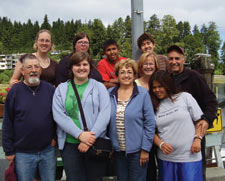 | | One of the Mission Boat short term mission terms. |
EACH SUMMER, an organization from B.C., with volunteers
from throughout North America leases a 46-foot cabin cruiser for the
season.
They use the cruiser to take teams of people, in the
name of Christ, to teach and learn, build relationships and work with
residents – in Vancouver Island and B.C. mainland coastal
communities which are a bit off the beaten track.
But the team work continues throughout the rest of the
year as well. B. C. Mission Boat Society has been working the coast since
2000. Today, only about 20 percent of the ministry is involved with
the boat. The rest is focused on short mission teams and year round
volunteers.
The late Robert Koebernick, a Lutheran minister
affectionately known as ‘Pastor Bob,’ envisioned the idea of
reaching less accessible coastal communities during his tenure at Our
Saviour Lutheran Church in Parksville.
One of his congregants introduced the concept to him
and he helped give feet to it, and encouraged other churches to pick up on
it.
In a sense, it was natural for Lutherans to work at
this idea. Many of the fishers on the coast were Scandinavian descendants
or immigrants, and thus often linked to Lutheran church by faith and/or
heritage.
But Kathy Bender, the Mission Boat society executive
director, a former bank executive, wants to get the word out to the broader
community of Christians.
Much of the support for the Mission Boat – that
is what they call it, no matter the licensed name of the leased vessel
– comes from Lutheran Church-Canada congregations – the second
largest Lutheran denomination in Canada, with 325 congregations and more
than 100,000 members and adherents throughout Canada.
Most supporters are from B.C. and Alberta. But an
increasing number of other Christians from across the continent are hearing
about the ministry and becoming interested in connecting with it, Bender
says.
Mission Boat has made many new friends beyond the
original support base by being at Missions Fest Vancouver, and through
volunteers who have spread the word, Bender points out.
Continue article >>
|
She says: “We encourage churches to do a mission
trip as a project, to go into a community for five days to two weeks. It is
a means to show the grace of God to people, not in a confrontational way,
but walking along beside them. Sometimes it can be a wonderful project for
a family.”
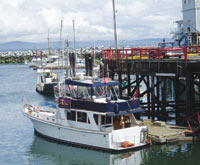 | | Mission Boat at the dock. |
Most years, recently, Mission Boat has visited 30
communities, among them 16 First Nations groups. Of those, the society
maintains year round contact with seven.
The vision of the ministry is “people transformed
by the grace and love of God, transforming community.” The goals are:
• Sharing the love of Christ.
• Identifying and helping in the needs of people
including hammer-and-nail activities.
• Sharing in visits with lonely people.
• Outreach through vacation Bible schools.
• Participating in youth ministry and fellowship
activities.
• Sharing in times of prayer, Bible study and
music.
• Identifying and supporting Christian contact
and/or lay persons willing to share in lay ministry training in coastal
communities.
Mission boats have been long traditions on the coast,
with the United and Anglican churches and the Shantymen and others involved
over the years.
But there has been a decline more recently, as aircraft
and road access have helped to reduce the isolation of the old fishing and
logging camps, as well as the First Nation communities.
So, in that sense, says Bender, “the opportunity
to serve is there,” even if the romance of the boat is less of a
reality.
When Mission Boat first started, it was a “voyage
of discovery. In many of the remote areas, churches were in disrepair, but
there was still a desire on the part of the people to connect
spiritually.”
Those wanting to check out Mission Boat are encouraged
to go to bcmissionboat.org, or call 250-248-5300.
January 2008
|