|
By Jan Biggs
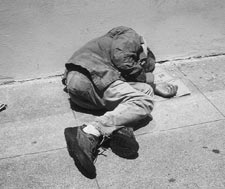 | | Inn from the Cold hopes to make sights such as this a thing of the past in Kelowna. |
IT’S NOT UNCOMMON for homeless people to be
rebuffed and even abused – but mostly it goes on without becoming
newsworthy.
All that changed in Kelowna several weeks ago, when
three people parked their SUV under the surveillance camera of a local
retailer at 1 am.
They then proceeded to dump four large pails of white
paint on a couple sleeping huddled in the alley.
While the investigation by the RCMP continues, there
are people whose compassion and kindness erupt over this kind of cruelty,
and cover it like a soft blanket.
Inn from the Cold is a volunteer project which provides
emergency shelter to people living on the streets during the coldest months
of the year.
It is modeled on programs from eastern Canada and
Calgary where, in a similar desire to soften the effects of extreme
weather, church groups offer volunteers and resources for the benefit of
those without homes.
People looking for a place for the night come to a
central meeting place, where the volunteers meet them and bus them to a
local church; there, they are given some food and a simple bed on the
floor. Last year, there were more than 1,700 overnight stays over 83
nights; and nearly 100 volunteers helped to make this happen.
Few shelters in Kelowna accommodate women or couples,
and some do not allow access to anyone who has been using alcohol or drugs.
Inn from the Cold maintains a flexible policy, which
helps as many as possible to find a warm bed.
President of the Kelowna Inn from the Cold Society,
Heather Karabelas, explains: “We are what we call a
‘low-barrier’ program. Most people just want a safe, warm
place to sleep for the night.”
The basic rules are to treat other guests and
volunteers with respect, as well as being respectful of the facilities.
This approach seems to be working.
“We often see guests volunteering to help with
shoveling snow or cleaning up. One of our guests donated $60 for pizza
because she had started a job and appreciated the program. She said
she wanted to give something back.”
Continue article >>
|
Volunteers are recruited from churches and the general
public. The organization sees these volunteers as the primary vehicle that
can convey a message of care and respect for those who use this service.
“The individuals who come forward for this
program are remarkable people,” Karabelas says, They take ownership
of the program and are creative with limited resources. They feel the
freedom and the onus to problem solve in difficult situations. Volunteers
sacrifice their own physical comfort willingly and with good humour.
“They often venture beyond their comfort zone
because they believe in the value of the work they are doing and the people
they are serving. In many cases they contribute substantially from
their private resources – either money or goods – as well as
their time.” Some volunteers experience significant attitude
adjustments.
One volunteer reports such a change. “Now when I
go downtown I recognize some of our guests and I can say hello, whereas
before I didn’t know who they were.”
Another talks about the need for more public awareness
of the problems of homelessness: “These people are members of our
society and should be included, not marginalized. Any one of us could be in
their situations.”
While most volunteers note the benefits, the work
isn’t always easy. And even though there are two volunteers at
a time to spell each other off during overnight shifts, it can be arduous
and demanding.
This season the Inn is expecting to be as busy as ever.
One full time shelter and volunteer coordinator as well as four part time
staff have been added this year. And more volunteers are giving their time
to help make our community more compassionate and humane.
“The special effect of this shelter situation is
that it brings cultures together in a very intimate way,” says
Karabelas. “Most profoundly, the privileged and the
marginalized converse, eat, resolve conflicts together, laugh, cry, worry
about one another and embrace.
“It is also a matter of pride to our volunteers
that people from different denominations or with no religious affiliation
seek out similarities in their beliefs and work together from a common
ground for a common cause – service.”
January 2008
|










