|
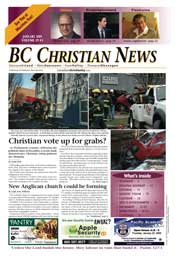
As Parliament resumes, following the political chaos of
December, a recent study demonstrates Christian voting patterns are
changing.
By Frank Stirk
NEW polling data shows that, in the last two federal
elections, more and more Christians have voted Conservative, largely at the
expense of the Liberals.
But at least some observers are unsure how long this
realignment will continue.
Voting Conservative “is kind of the lesser of the
two evils,” says Andrew Grenville, chief research officer for Angus
Reid Strategies, who compiled the data.
“It’s not as if [Prime Minister Stephen]
Harper has pushed an agenda that would actually appeal to a social
conservative.”
The shift to the Conservatives has been especially
evident among Catholics in Quebec. Since at least the 1950s, they were more
likely to vote Liberal, says Grenville, because they felt that party best
reflected the “communitarian” nature of Catholicism – the
importance of social cohesion over and above individual interests.
In the 2004 election, the Liberals won 56 percent of
the votes cast by Quebec Catholics who attended church once a week. But by
the 2006 election, that share had fallen to just 29 percent. “It was
just around the time of the [Adscam] scandal. People were really kind of
disgusted,” says Grenville. “Plus there was the same-sex
marriage issue going on.
By the 2008 election, that support had slipped even
further to 22 percent – creating a tie with the Conservatives in
Quebec – thanks to what Grenville calls the “poor image”
of then-Liberal leader Stephane Dion.
“It was a gravitation to a leader rather than
necessarily to a party,” says Trinity Western University political
studies professor John Dyck, “because the Conservative Party
isn’t that strong in Quebec and Harper has certainly run on his own
image.”
Conservatives also increased their support among
Catholic weekly attenders outside Quebec, going from 38 percent in 2004 to
49 percent in 2008. Protestant weekly attenders also began moving in the
party’s direction, going from 51 percent support in 2004 to 64
percent in 2008.
And among the weekly attenders of theologically
conservative churches, 74 percent voted Conservative in 2008.
Continue article >>
|
As a result, it is perhaps no surprise that the
Liberals received the lowest share of the vote in the history of their
party in 2008.
“Liberals have been abysmal at tapping into the
whole cohesive social thinking that’s available to Catholics,”
says practicing Catholic Michael Markwick, a communications professor at
Simon Fraser University. “They’ve taken the Catholic vote for
granted.”
But Dyck warns that if the Conservatives are not
careful, their gains among Christian voters could be “very easily
lost.”
“Speaking from my own Mennonite background, I
would say that Mennonites would vote Conservative overwhelmingly,” he
says. “At the same time, [they are] very unhappy with some of the
things the Conservatives are doing. It’s just that they don’t
see any option.”
Dyck believes the Conservatives are more interested in
winning a majority in Parliament “than remaining with their core
group. And I think the core group really doesn’t know where to go
right now.” Markwick even accuses the party of trying to
“capitalize on a false connection” with Christians.
Grenville predicts that if the Liberals had a leader
who “had some shared values” with Catholic voters, “then
absolutely” some would return to the fold. But he does not see in
Michael Ignatieff, the new Liberal leader, that kind of person.
Dyck, on the other hand, views Ignatieff more
favourably.
“One thing that keeps coming up from all the
different sides is that he’s a very strong man of integrity,”
he says. “And if that’s what people want in a leader, they may
find that to be rather attractive at this point.”
January 2009
|