|
From 1954 to 1961, Garry
Wickett spent seven summers and one winter
working at the R.W. Large Memorial Hospital, a United Church mission
located on the Indian reserve at Bella Bella (now Waglisla). He worked with
George Darby, a
medical missionary who served Bella Bella for more than four decades. He
offers a glimpse of mission shipboard life – as seen by the teenage
skipper.
IT’S Wednesday on a mid-summer day in the late
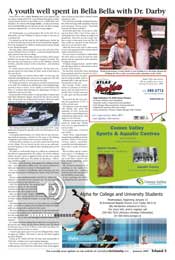
50s at Bella Bella, and the William H. Pierce is ready to set out on a
medical trip.
I’ve picked up all the mail for the lighthouses,
fueled up for the four-day trip, stowed the food and medical supplies. Now
I’m waiting for Dr. Darby to finish up last-minute details in the
28-bed hospital.
His wife, Edna, will accompany us as cook, and one of
the nurses will take a turn on board – a welcome break from the
daily grind in this remote village.
We set out for the busy fish cannery at Namu, where
many families are living in the crowded company housing. The first aid man
has lined up a roster of sick children, injured workers, prenatal exams,
tooth extractions – and pressing questions.
Dr. Darby knows most of the patients. He has been
serving this region for more than 40 years, most of that time as the sole
doctor.
Leaving Namu, we head for Rivers Inlet. On the way, the
Addenbrooke lightkeeper rows out as we approach. His wife is depressed, and
he is worried about the kids.
Dr. Darby goes ashore, and I stay on board to tend the
boat as we drift. The children are all lined up on the landing stage,
excited to have a visitor. As Dr. Darby is rowed back to the Pierce, I
overhear him advising the lightkeeper of ways to make life easier for his
wife.
In the mouth of Rivers Inlet, we sail up Darby Channel
and past Edna Matthews Island, named for the doctor and his wife. We
pass the site of Brunswick Cannery, where an earlier summer hospital set up
by Dr. Darby stands derelict.
The fishing industry workers can now reach R.W. Large
Memorial Hospital by speedier boats and float planes in an emergency.
As hospital administrator, Dr. Darby has set up a
pioneering medical insurance scheme for the area, so the fishing companies
and workers have access to medical care.
At Rivers Inlet Cannery we are told a baby has been
born in the village. We are ferried up the river in an outboard-powered
dugout, to six or eight homes standing alone in the wilderness.
The baby is contentedly lying on a pillow in a
hammock-like fishnet suspended from the ceiling. The child’s siblings
cluster around, and it is apparent they are the ones caring for the infant
right now. The adults are all asleep – following a drinking
party.
Dr. Darby checks the baby, then gathers the children
around him – and tells them a Bible story. He leaves
instructions with our boat driver, to check on the family later.
Now we’re down to Wadhams, after weaving our way
through the myriad of fishing nets, boats, rocks and channels.
Here is a senior medical student, hired by Dr. Darby
for the summer to provide on-site medical care. He has lined up several
patients for the doctor to see.
Only the week before, the student had to accompany a
woman in labour to the hospital on board a fishing boat, with the result
that one of his first deliveries took place on a fish boat bunk. He is glad
to see Dr. Darby.
After another of Mrs. Darby’s delicious meals, we
anchor in a quiet bay – surrounded by fish boats which have come in
from Queen Charlotte Sound, to escape an oncoming storm.
One fisherman rows over to us. I am called on to hold
his head – as he sits in a chair in the wheelhouse while Dr. Darby
pulls an aching tooth, assisted by the nurse.
The next morning we awake to fog, so we set out
cautiously to round the headland into Smiths Inlet. The water is calm, but
the surge from the open ocean sweeps up on the rocks as we take a local
short cut through a narrow rock-studded channel.
Continue article >>
|
Dr. Darby has been sailing these waters for so long
that he knows the safe routes. He also knows all the rocks. He claims he
has been up on most of them, as his early travelling was done without the
benefit of charts.
A narrow gap opens up as we nose into Margaret Bay,
where we again go calling – this time to visit an old chief crippled
up with arthritis.
I listen as Dr. Darby and the old man chat animatedly
in Chinook, a simple west coast trading language.
The doctor chuckles as we walk away, telling me how a
nearby group of Seventh Day Adventists, float camp loggers, have convinced
the chief to drink Postum instead of coffee.
The chief was excitedly extolling the benefits of the
beverage with a familiar Chinook term meaning ‘strong, great’:
“Skookum Postum! Skookum Postum!”
In another quiet bay, we tie up at a sinking log float
with a tiny house atop it, surrounded by boxes ablaze in bright red
geraniums. Here live an old couple who have come to hide away from city
life. He was a cable car operator in San Francisco, and she is a local
native lady.
After the doctor has seen to their needs, we are each
presented with a hand-crafted, shell-covered flower pot.
Now it’s time to head back to Bella Bella. We
have kept in touch all week by radio phone, and are expected to arrive
Saturday evening as usual.
At Namu, we again stop in – and Dr. Darby sets
off, bag in hand, to call around on those in need of his services.
He has been doing this since graduating from medical
school in Toronto in 1914 – where his professors, recognizing his
surgical skills, tried to persuade him to take up a lucrative practice in
the city.
But George Darby, determined to minister in
Christ’s name, and out of his love for a people who needed someone to
care, gave up that possibility.
He poured his life into serving the population of
B.C.’s north central coast.
He helped to stem the death toll during the great flu
epidemic of 1919, preserved some native communities from extinction by
tuberculosis – and stayed on for 40 years.
Whenever we prayed over our meals, Dr. Darby said:
“Thank you, God, for opportunities of service today.”
As a young man, I stood in awe of this.
I knew those ‘opportunities’ meant being
available as doctor, mariner, justice of the peace, coroner, pastor,
researcher, counsellor and administrator – seven days a week, 24
hours a day.
But as Darby said at a retirement party in Wadhams, in
1959: “I hope no one will ever say to me that I ‘stuck it
out’ here. It was a privilege, and I thank you.”
My warmest memory is of standing at the helm, the
doctor beside me – chatting with the man who became for me the father
I never had.
It was a privilege, Dr. Darby; you shaped my life, and
I thank you.
January 2009
|