|
By Frank Stirk
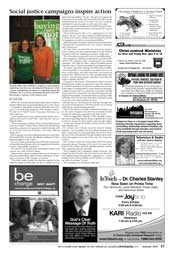
WHEN the Christian group Resist Exploitation, Embrace Dignity (REED) last year
launched Buying Sex is Not a Sport – a campaign to raise public awareness and reduce the occurrence of sex
trafficking during the 2010 Olympic Games – the plan was to keep it local to Vancouver. But that is not what happened.
“It has actually gone viral, and has spread all the way to Halifax and down to
New York,” says executive director Michelle Miller.
“We’ve had people ordering t-shirts and materials from all across the country. We
also went to Edmonton and did a big speak there, and got a lot of great press.
And it looks like we’ll go to Toronto at the end of January, to do some really big speaks there.”
REED’s partner in its anti-trafficking initiatives is the More Than Gold (MTG)
network, the official coordinator of Christian participation in the Games.
It is one of three partnerships that MTG has formed with existing faith-based
groups, aimed at engaging local churches in three “sustainability initiatives.”
The other two are homelessness, with Shalom Seekers; and creation care, with A
Rocha Canada.
Shalom Seekers director Jonathan Bird says the decision to forge these
partnerships marks an historic milestone of Christian involvement in the
Olympics movement.
“They didn’t want to gather the churches together for just relatively simple hosting tasks,
but also to address poverty and social vulnerability,” he says. “Because if you ignore the lower portions of society, then eventually that will
wind up undermining the society at its heart. You can’t continue indefinitely to ignore people in need and on the edge.”
It is also a depth of commitment that MTG executive director Karen Reed trusts
will extend well beyond the Games’ closing ceremonies.
“We’re believing for this to be a tipping-point for the church,” she says, “not only to mature in really learning how to bend in love and be unified toward
doing good, but also for engagement around our social responsibilities.”
And as the public’s awareness of these issues has been raised, Christians have responded well to
the unique challenges each of them pose.
“It’s clear when we speak that you can just see people’s brains clicking, and then understanding how the demand for paid sex fuels the
trafficking in women,” Miller says.
“It is of enormous proportions and it is incredible abuse.”
Also engaged in combating sexual slavery is another MTG partner, the Salvation Army. It launched its own media campaign – The Truth isn’t Sexy – and in November opened Deborah’s Gate, a 10-bed rescue facility for prostituted women.
“It’s a place,” says Army spokesperson Major Brian Venables, “where hopefully we can rekindle some spark in the eyes of these young ladies,
and offer immediate and long-term medical care, addiction services, detox
programming, legal services – but most importantly, a safe place where they can begin to rebuild a new life.”
Continue article >>
|
Compared to the urgency of blunting the spike in sex trafficking that the Games
are expected to cause, the initiatives to combat homelessness and promote
creation care are more in the realm of ongoing efforts to make changes for the
better.
Shalom Seekers will soon unveil the non-profit CEDARS Group, short for Community
Economic Development and Regional Sustainability. Its mandate will be to
purchase, build and finance the 120,000 units that Metro Vancouver needs for
people on low and moderate incomes.
Bird says they are “far and away the majority of people who are at risk of homelessness,” but whose needs “are not being addressed by current funding priorities.”
And yet the region’s growing homelessness problem has its own sense of urgency that churches are
already heavily invested in addressing, especially at this time of year.
“With no exaggeration,” Bird says, “if the Christian community were to stop doing what it’s doing or significantly cut back in what it’s doing, the whole shelter system would collapse – not just the emergency-weather system, but the permanent infrastructure.”
By contrast, says A Rocha executive director Markku Kostamo, “we’re probably kind of an awkward partner with MTG. I think they love the
partnership, but we don’t fit in like a lot of the other partners, because creation care is something
that happens every day of the year. It’s a long-term journey.”
Still, Kostamo credits the partnership with both raising awareness among
Christians of the need to be good stewards of God’s creation, and with “partially birthing” a project that is garnering interest nationally.
“We’re calling it the Community Garden Network – the simple idea that churches who have land can use that land, and volunteer
labour through their congregations – to grow healthy food locally for families on low income, or to partner with a
food bank,” he says.
“We’re finding a lot of interest in that area.”
January 2010
|