|
By Steve Weatherbe
RUTH Newlove heard her son whispering conspiratorially to his sister in the next
room: “We’ll be able to buy them lots of fruits and vegetables.”
At that moment, she knew the Feed-Em 5-5 project had borne fruit. Maybe, as her
son hoped, literal fruit (and vegetables) for the Ministry of Mercy Orphanage
in Nigeria.
But certainly the family’s five days on rice and beans, followed by five weeks of buying nothing but
necessities, had also borne fruit in her children – giving them “a heart for the needs in the world,” like lectures on the missions never had.
Here were her kids, putting off dinner so they could make bookmarks to sell to
their grandparents to raise money for African orphans.
Nor were the Newloves alone: 75 members of Friendship Community Church in Sydney
joined in what they called the Feed-Em 5-5 project recently, as a concerted
response to the struggles of Nigeria’s largest orphanage – the 18 year old creation of native Daniel Edeh.
The idea was to live a life of subsistence as close as possible to that of
Ministry of Mercy’s 300 orphans – first with five days on a typical Nigerian diet; and then with five weeks of
buying only necessities. Each family would then donate whatever money it saved.
“That definitely made it more understandable for my four year old,” says Newlove. She says the family gave up their weekly outing, and when
shopping together began to measure buying impulses against a new standard: “Is it a want or a need?”
Eating beans and rice proved more of a chore. “I hated it a first. I was hungry all the time, thinking about what I could be
eating. But after three days I thought, ‘I could do this.’”
For her husband it worked in reverse: “He was okay at first but by day three he didn’t want to come home to dinner.”
The Newloves figured they saved $100 a week for the orphanage.
Friendship’s connection with the orphanage is personal.
Church members Paul and Pam Welle had already decided, a decade ago, to spend a
year working in the African missions when a visiting mission worker told them
about Ministry of Mercy.
What they like about it from the start was that its founder was a Nigerian
pastor who had sold his own home to start it.
“We know that if there’s no support from Europeans or North Americans it will keep going,” says Paul, a mechanical engineer-turned-home builder and renovator.
Edeh told them they could certainly be of use. He would build them a brick house
to live in with a flush toilet.
“That was a big thing for me,” admits Pam.
The Welles took their four children, aged 12 to 2. Pam recalls a year she spent
in Bolivia as a child,with Wycliffe.
“It made me uncomfortable with our affluence. Because I learned there – and the same in Nigeria – that it is just an accident that we are so much better off. The people in those
places are just as smart as we are. They just don’t know as much.”
Later, her father Jack Krayenhoff was supposed to temporarily replace a local doctor in Nigeria until the Nigerian
civil war intervened.
Continue article >>
|
Pam would later realize the orphanage and her father’s erstwhile practice were only a few miles apart.
When things got unpleasant in Africa, Pam took comfort from the thought this
sign she and her family were meant to be there.
Their year in Africa was often unpleasant and sometimes frightening – when, for example, armed men robbed Daniel Edeh’s next door compound one night.
“It’s a dangerous place,” says Pam, issuing a warning to prospective mission workers.
“And God won’t create a bubble of protection around you. It’s not romantic.”
Pam also warns would-be mission helpers to work only with people they can trust.
In Nigeria, at least, lying is a part of life, as is feathering one’s nest with foreign aid.
Daniel Edeh is a happy exception, she says, “who spends nothing on himself.”
Paul Welle says the benefits of short-term efforts like his family’s to the Third World are felt mainly by the visiting family.
They come away much more aware of the disparities and needs of the Third World.
Welle’s contact with the Nigerian mission sparked other funding drives before this one
and a visit by a group of church members, including pastor Spencer Stadler.
Welle himself has returned several times to work on specific projects. Last May
he went again to install a solar-powered pump to bring water to a storage tank
at the orphanage.
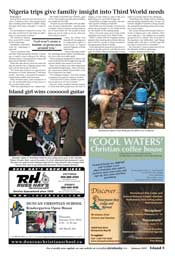
“Something very simple, with no batteries, that just pumps during the day,” he says. He took his daughter Genevieve along, because she remembered nothing of her year in Nigeria 10 years earlier.
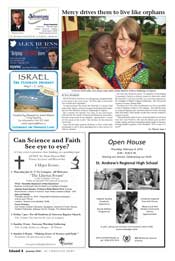
The 12 year old says the best part of her two weeks in Nigeria were “the children. They were really nice.” The children live in family groups led by an “aunty.” The worst part of the experience was “all the flies,” and “taking malaria pills every days. I would forget but my father would seem to
remember.”
The Feed-Em 5-5 project raised $40,000 for the Ministry of Mercy orphanage.
Contact: ministryofmercy.org.
January 2010
|