|
By David F. Dawes
“IS THIS Milton for
Dummies?”
Dennis Danielson takes the question with good humour,
but gives a thoughtful answer. “There’s all sorts of very
bright people who don’t read 17th century English. What a shame these
people should miss out on this magnificent poem.”
The discussion is focused on Paradise Lost: Parallel Prose Edition (Regent
College, 2008), which Danielson published late last year. Head of the
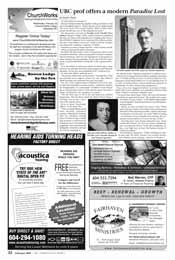
Department of English at the University of British Columbia, he is a
long-time John Milton scholar, who also wrote Milton’s
Good God: A Study in Literary Theodicy; and
edited The Cambridge Companion to Milton.
Danielson is a man of many interests – some of
them esoteric – which go beyond the field of literature.
He edited The Book of the
Cosmos: Imagining the Universe from Heraclitus to Hawking – which incorporated extensive commentary by Danielson, with
his own translations of documents in Latin, German, French and Italian. He
also wrote The First Copernican: Georg Joachim
Rheticus and the Rise of the Copernican Revolution.
He is the author of numerous articles on many
topics, ranging from free will and Aristotle to trigonometry and Protestant
literature. He has also been published in BC
Christian News.
So: why John Milton, and why now?
“The nature of this story, and its
themes,” he responds. “They are universal, and as urgent as
they ever were. Also, Milton’s 400th birthday was celebrated this
past December.”
The text of the original poem is featured in the book,
side-by-side with Danielson’s modern version – which he
considers an “interpretation” or “commentary” on
Milton’s work. Presenting a contemporary version of this massive poem
has been a dream of Danielson’s for a quarter of a century.
“The idea first came to me on the way back from a
Milton symposium. The taxi driver asked me what I’d been doing. I
told him, and he said: ‘I can’t read 17th century
poetry.’”
So he set about ‘translating’ Milton
– in his spare time.
“There are great debates about what, precisely,
translation exactly is. What kind of freedom does the translator actually
have? I’ve tried to chart a middle path between a word-for-word
translation and a freewheeling paraphrase. Some text has poetic ambiguity;
a translator can’t get all of those meanings in.”
Continue article >>
|
He calls his work a “dynamic equivalent” to
Milton’s text.
Asked what he hopes his book will accomplish, Danielson
says: “I’d really just like to have a lot more people have the
experience of enjoying Paradise Lost. It’s an amazing story. It is, itself, an
interpretation of the foundational materials of Christianity. It’s
also a feast for the imagination.”
Some critics have suggested Milton’s portrayal of
Satan makes him a more dynamic and appealing character than Christ. Asked
to comment, Danielson says:
“I’ve heard that many times. Often, the
joys and beauties of goodness are quiet and internal.” This is
reflected in popular culture, he says, noting: “A bloodbath makes
greater cinematography” than the portrayal of something representing
virtue.
Milton, he says, was likely well aware of this.
“What kind of poem would it be if Satan wasn’t portrayed as
attractive? Evil is real and powerful – and in some ways it
is attractive and enticing.” He extols “Milton’s daring
– in showing evil as powerful and enticing. He also portrays the
providence of God in the face of that.”
As for the poet’s view of Jesus, Danielson says:
“Some would call it heresy. He does not observe trinitarianism,
according the Nicene Creed. But nevertheless, he has a very high view of
Jesus. His hymns of praise to Christ are exalted.”
He ends with a comparison. “Think of Paradise Lost side-by-side with The Shack. Paradise Lost is better written,
more timeless, more inspiring – and more orthodox.”
February 2009
|