|
AFTER years of acrimony and painful revelations
involving the church-run Native residential schools, some form of
resolution may finally be at hand.
Sacred Walk is the blanket term for a series of events
in early March, to be held in various Canadian cities. The tour is aimed at
introducing the Truth and Reconciliation Commission (TRC), which will
explore the history of Canada’s residential schools.
The ‘walk’ will consist of both symbolic
and educational events, involving participants from the Anglican,
United and Presbyterian churches, and members of the Assembly of First
Nations (AFN).
A ceremonial walk will take place March 5, beginning at
the Vancouver School of Theology and ending at the Museum of Anthropology
at UBC.
In preparation for the Commission, seven Catholic
bishops met for the first time with the head of the AFN January 29.
Sylvain Lavoie, Archbishop for Keewatin-The Pas, said he hopes the TRC
hearings will be “balanced.” He elaborated, saying the
hearings should include not only the experiences of aboriginal victims of
abuse, but also the stories of the religious sisters, brothers and priests
who gave their lives to working in the schools.
“There was a lot of good intentions,”
Lavoie told a news conference following the meeting. “Sometimes the
very people staffing the schools were perhaps in some ways victims
themselves of a flawed system, of unreal expectations and certainly perhaps
very unjust working hours.”
Lavoie added: “I think we’ll be able to
tell the full story, which I think Canada needs to hear.”
AFN National Chief Phil Fontaine said he recognized
thousands of Catholic congregation members worked in the schools “in
what they sincerely believed to be in the best interest of Indian
Residential School students.”
However, he cautioned, “it is important for these
religious communities to both openly acknowledge their role in Indian
Residential Schools and to hear directly from First Nations regarding their
experiences. The assistance and participation of the Catholic organizations
are integral in the healing and reconciliation process.”
“Certainly, mistakes were made and we’re
open to acknowledging that and being responsible but, most of all,
we’re hoping the story is . . . balanced,” Lavoie said.
Continue article >>
|
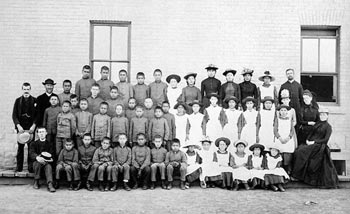 | | A 1901 photo of students and staff at St. Paul's Indian Industrial School, in Middlechurch, Manitoba. |
The TRC, part of the $2.2 billion Residential Schools
Settlement Agreement, will begin hearing testimony this year from victims
of sexual and physical abuse at schools run by various religious
denominations and more than 40 Catholic entities – dioceses and
religious orders.
This is not the first time a bishop has talked
publicly about participation in the TRC. Last October, Winnipeg Archbishop
James Weisgerber, who was then president of the Canadian Conference of
Catholic Bishops (CCCB), told Canadian Catholic News the bishops
“want to be very positively involved.”
The TRC will begin hearings once a chair and two
commissioners are selected by Indian Affairs Minister Chuck Strahl
and the AFN national chief. The TRC received about 300 suggested names for
these roles.
The settlement agreement includes a government
compensation package for every student who attended the schools.
The 40-plus Catholic dioceses and religious orders that
ran residential schools are responsible for $80 million dollars towards
healing and reconciliation. That figure includes cash settlements and
in-kind services.
The Catholic entities have not been part of the overall
compensation for mere attendance at the schools. Some have argued the
schools were a form a “cultural genocide” because they
separated students from their families, communities and their languages.
Almost two years ago, after the settlement was
announced, Weisgerber, speaking on his own behalf and not as archbishop,
said the prevailing narrative that residential schools were entirely
responsible for the plight of Canada’s native people needed to be
challenged. That narrative also suggests children were routinely sexually
and physically abused.
March 2008
|










