|
By Brian McConaghy
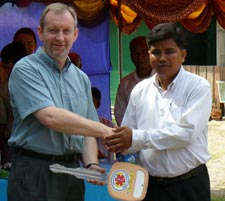 | | Ratanak Foundation head Brian McConaghy presents the symbolic key of a new ambulence to the leader of a team of Cambodian paramedics. |
ON April 17, 1975, I was 12 years old and living in
Belfast. I was dyslexic, and in many ways an academic failure; and I was
subjected to bullying. I had little knowledge of anything outside my own
world.
If you asked Cambodians to recall that date, they would
remember exactly where they were on April 17, 1975. That was the date the
civil war ended – and life, as they knew it, was about to end.
The population of Phnom Penh, more than two million
people, came out nervous, but relieved to welcome the victors, the
Cambodian communists.
They anticipated life could be rough under the
communists, but wouldn’t be as bad as the bloody Civil War. Little
did any of them know the Khmer Rouge was about to institute a revolution
unprecedented in the 20th century. The country’s physical,
governmental, educational, economic and social structures were to be
systematically dismantled.
Families were separated, and sent to the killing
fields. All city residents were evacuated; thousands died just in that
process. People like you and I were forced out into the fields, and had to
learn survival.
Little did I know the events of April 17, 1975 were to
utterly change my life.
Christian principles
I grew up in a Christian home and was well taught
Christian principles. But sooner or later I had to decide whether this was
a real faith for me. Was it truly mine, or was it my parents? Would it have
an impact on my life, or be simply a tradition I adhered to because of
my culture and heritage?
Through my teen years in church, I was exposed to
missionaries. I didn’t have a particularly high opinion of them.
They would come and tell their stories; but it was very ‘other
world’ for me. It did not really interact with my life at all.
In 1978 we emigrated to Canada. I well remember one of
the very first days of school when I was brought into an English class. I
was the kid with the funny accent. I felt totally out of place. Just as I
sat down, a car backfired outside. For a kid from Ireland, that meant a
fairly dramatic physical response. And I was quickly off my chair,
and lying on the floor being stared at by these amazing Canadian kids
– who were wondering: “Who is this weirdo?”
It didn’t get a whole lot easier, but I struggled
through. I eventually went to university
and obtained a degree – to the amazement of myself and others. I
became skilled in the academic study of firearms, and also became skilled
in their use as a sniper. The combination of the academics and hands-on
skills caused the RCMP to pursue me for work.
And so I was taken on by the RCMP in April 1986, and
was the subject of a rigorous training program. I had seen violence in
North Ireland, but hadn’t really seen it up close and personal. Now,
as part of my RCMP work, I was subjected to autopsies and crime scenes and
all the ugliness those things can provide. It was not a particularly
positive thing for me.
As therapy, if nothing else, I started working with
international students at UBC who needed a lot of help adjusting to
Vancouver. They were interested in learning about Canadian culture. One of
the best ways to accomplish this is to understand the Judeo-Christian ethic
which inspired our legal system, our medical system, and the democracy we
all cherish. This was done through Bible studies.
But as I led these studies, and as we attempted to
understand the history of Christian faith and how it impacted Western
culture, it became clear they were fairly bewildered. I figured the
best way for me to serve these students was to get to know how they
processed information; the best way to do that was to get on a plane and go
to Asia.
So I decided to do just that, with no plans, just to
learn what it felt like to walk out of an airport scared, as they all had
done in Vancouver.
Continue article >>
|
On this first trip, I had been asked to bring a care
package to a homesick Canadian girl who was working with Christian and
Missionary Alliance in Thailand. I took the package to her, and she made
arrangements for me to go out to the refugee camps on the Thai-Cambodian
border. What I experienced there in October 1989 was to change my
life.
Compassion
The refugee camp, where a small team of about 15
expatriates were working, held 42,000 people. The team was trying to
provide medical services while the camp was being shelled. This was
truly amazing, to witness real missionaries; I was witnessing compassion in
a way I had never before seen it.
On several occasions, I was brought up to the Cambodian
border and allowed to see into this forbidden, mysterious country no one
was allowed to enter, which was awash with mines, gunfire and shelling.
The very fact that it was forbidden presented a certain
challenge to my personality. And I dedicated myself to helping.
My plan was to collect two suitcases of medication and
bring them into Cambodia for kids who needed it, because very little
medication was getting into the country because of an embargo. That was my
plan. It was not God’s.
God’s plan was to provide me with nine tons of
medication – and he did not consult with me about the change of
plans. So I ended up with no shipping experience, no medical experience, no
anything – but I was sitting on nine tons and $100,000 worth of
medical supplies in Vancouver.
I managed to figure out how to ship and distribute it
in Cambodia despite the communist officials who were, to say the least, not
helpful.
Underdogs
Through all of this I discovered a real heart for the
underdog -- the underdog I felt I had been for so many years. Now,
rather than just witnessing the compassion I had seen in the missionaries,
I had the privilege of participating in it.
Coming from the heritage of Northern Ireland and having
been to countries such as Somalia, I’ve seen hate as a very powerful,
insidious thing, multiplying from generation to generation. Over the years
I have discovered that compassion is more powerful – and can
disarm even hate.
As my involvement with Cambodia grew, I established the
Ratanak Foundation. We developed water systems, emergency rice
distributions, literacy programs, agricultural training programs, clinics
and hospitals.
Do I have a particular strength of character?
Absolutely not. I have simply found that my faith drives me to really live.
For me, faith is not the repetition of ancient rituals or social practices,
nor is it a crutch.
Faith frees me to function in areas in which I would
not otherwise function. It allows me to function outside the box that
caution and fear would dictate I should live within. I hope I live up to
the responsibilities to others, both far and near, whom God has given me to
love.
As a forensic firearms specialist, I have a fairly
useless skill set for Christian missions. Yet I have known the privilege of
seeing the oppressed helped, the rescuing of the lame, the gathering of the
scattered and the bringing of many to a new home. I have been
privileged to participate in all of this while completely unqualified,
untrained and unprepared.
The only thing I’ve been able to bring to the
table is a willingness. I am convinced that God requires only willing
hearts and hands. We have few excuses to not engage with our world –
be it far away, or in our own communities. I am thankful God uses our
willingness.
Brian McConaghy is head of the Ratanak Foundation. His
testimony was adapted from a B.C. Prayer Breakfast presentation.
March 2008
|