|
By Dan Wooding & Michael Ireland
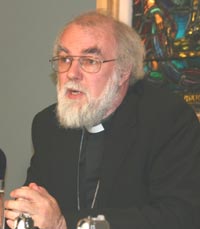 |
| The embattled Archbishop of Canterbury, Rowan Williams. Photo: Sue Careless. |
THE ARCHBISHOP of Canterbury opened the Church of England General Synod in London to rapturous applause February 11, as he attempted to clarify his comments on Islamic law.
Rowan Williams faced a backlash after stating February 8 that the accommodation of certain aspects of the Muslim sharia code in British law was "unavoidable."
His comments came ahead of a lecture at the Royal Courts of Justice in which the Archbishop pointed to the possibility of overlapping jurisdictions in which "individuals might choose in certain limited areas whether to seek justice under one system or another."
ChristianToday.com (CT.com) reported that Williams "apologized for any distress that may have been caused by 'unclarity' or a 'misleading choice of words', but stopped short of retracting his comments."
The Archbishop's initial comments on Sharia law drew fire from many sources, including British Prime Minister Gordon Brown, who pointed out that British law should be based on British values.
The Institute on Religion & Democracy expressed dismay over Dr. Williams' comments and criticized the idea of elevating a legal system that does not share British values.
Ralph Webb, director of IRD's Anglican Action Program, commented: "Only a few months ago, Archbishop of Canterbury Rowan Williams angered people on both the left and the right with his harsh, sweeping attack on American foreign policy. Now he has angered people by proposing that there should be some way of accommodating elements of sharia law in British society.
"At a time when the Anglican Communion is in danger of fragmenting, Williams' comments are not helpful and run the risk of alienating some Anglicans who live under sharia law.
Faith J.H. McDonnell, IRD religious liberty program director, commented: "Allowing sharia law in Britain is an act of tolerance for something that practices none of its own. We're concerned for British Muslims that have fled the intolerance of their own countries, only to find it gaining a foothold in Britain.
"Those who argue that accommodating sharia law would be contingent upon the agreement of both parties in a dispute don't understand that there is no individual choice in sharia law, especially for women.
"Archbishop Williams is going in exactly the wrong direction with his comments supporting sharia law. He should be supporting Bishop Michael Nazir-Ali who has warned against the encroachment of Islamic fundamentalism in Britain, not attempting to buy off Muslim groups with appeasements."
Continue article >>
|
At Synod, Williams defended his comments.
"I believe quite strongly that it is not inappropriate for a pastor of the Church of England to address issues around the perceived concerns of other religious communities and to try and bring them into better public focus," the prelate told Synod - although the Archbishop later conceded that his efforts in this instance had been "clumsily deployed."
CT.com said Williams stressed he was not advocating a system in which some citizens are subject to British laws, while others are governed by sharia.
"We are not talking about parallel jurisdictions; and I tried to make clear that there could be no 'blank cheques' in this regard, in particular as regards some of the sensitive questions about the status and liberties of women," he said. "The law of the land still guarantees for all the basic components of human dignity."
Williams raised the question of whether "certain additional choices" could and should be made available under the law for resolving and regulating transactions.
"It would be analogous to what is already possible in terms of the legal recognition of certain kinds of financial transactions under Islamic regulation," he said. "And it would create a helpful interaction between the courts and the practice of Muslim legal scholars in this country."
The Archbishop pointed to Christian minorities who suffer in Muslim majority countries, even where a national legal framework is in place guaranteeing their civil liberties.
"But I noted that many Muslim majority countries do distinguish clearly between the rights of citizens overall and the duties accepted by some citizens of obedience to Islamic law," he continued. "It is this that encourages me to think that there may be ways of engaging with the world of Islamic law on something other than an all-or-nothing basis."
Williams said he had hoped to raise the questions on the relation between faith and law, particularly the extent to which the law could accommodate conscience.
While the law had so far provided space for conscientious objection on religious grounds, Dr Williams warned that "there are signs that this cannot necessarily be taken quite so easily for granted as the assumptions of our society become more secular."
"I think we ought to keep an eye on this trend; and if we do, we shall have to do more thinking about the models of society and law we work with," he said, adding, "It's an area where Christians and people of other faiths ought to be doing some reflecting together."
March 2008
|