|
By Jim Coggins
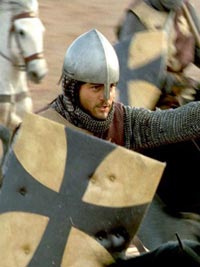 | | A crusader (Orlando Bloom) sallies forth in Kingdom of Heaven. |
GREEN PARTY of Canada leader Elizabeth May touched off
a controversy in late January when she said the troops fighting in
Afghanistan – including those from Canada – come
from a “Christian/Crusader heritage.”
She made the statement in a news release criticizing
the conclusions of the Independent Panel on Canada’s Future Role in
Afghanistan. The panel’s ‘Manley Report’ recommended
Canadian troops remain in southern Afghanistan after February 2009,
provided an additional 1,000 troops are sent to the region by
Canada’s Western allies.
May said Canadians should be replaced by Afghans, and
troops from “a different cultural mix of UN countries.”
The report, she asserted, “fails to consider that
the recommendation of more . . . forces from a Christian/Crusader heritage
will continue to fuel an insurgency that has been framed as a
‘jihad.’ This, in turn, may feed the recruitment of suicide
bombers and other insurgents.”
However, it was not May’s policy proposals which
raised the controversy.
‘Crusade’ has become an increasingly
volatile word, and public figures have shied away from using it in recent
years.
U.S. President George W. Bush stated on September 16,
2001, in the aftermath of the 9/11 attack: “This crusade, this war on
terrorism, is going to take awhile.” After the term aroused
widespread criticism, he withdrew the remark and apologized.
For decades, Billy Graham conducted evangelistic
‘crusades.’ His son and successor Franklin Graham presents
‘evangelistic festivals.’
The ‘c-word’ was first applied, almost
1,000 years ago, to the military campaigns waged by some Christian European
countries to take back Jerusalem and the Holy Land, which had been
conquered by Muslims a few centuries earlier. The term is now often
associated with the atrocities committed by the original Crusaders; and it
is often applied to people from Western countries – which are
perceived by many Muslims as still basically ‘Christian’
nations.
A Conservative Party response to May’s statement
called called her comments “grossly insulting to Canadian
forces,” arguing that Canada’s military is working “to
bring peace and human rights to the people of Afghanistan . . . at the
invitation of the Afghan government.”
A National Post editorial made a similar point: “Canadian
soldiers in Afghanistan are fighting for values that people of all faiths
(or of no faith), can freely support.”
A Calgary Herald editorial maintained Canadian troops’ purpose
“is not conquest, but security for those trying to build schools and
clinics.” The Herald also suggested that, ironically, May’s warning against
fuelling jihad will have the opposite effect – her
“hapless choice of words” will confirm “radical
suspicions” of “Muslim fundamentalists” and
“endanger the lives of Canadian soldiers.”
In a February 1 piece published in the National Post, May conceded she
should have put ‘Christian/crusader heritage’ in quotation
marks – to signify she was not calling Canada’s military effort
a Christian crusade, but was saying the Taliban would use that term as a
means of gaining more recruits.
Continue article >>
|
“The point we are making is that Taliban
recruitment propaganda portrays the NATO mission, led by the United States,
Canada and other Western countries, as a conflict between the Christian
West and Islam,” she wrote.
James Beverley, a professor of Christian thought and
ethics history at Tyndale University College and Seminary, told BCCN the conflict in
Afghanistan is an attempt to combat terrorism and is not a religious war.
Although the West is “still largely Christian . . . most people in
the West do not view the campaign against terrorism as a religious
war,” he said.
While there is a danger the Taliban will characterize
the war as a Christian crusade, and Canadian leaders should be aware of
that, sending Canadian troops there “is not necessarily wrong,”
he added.
The furor over May’s terminology has been an
“over-reaction,” said Beverley, adding: “I doubt if the
Taliban leaders are really following the Green Party.”
Newspapers and politicians, including May herself, are
backing away from any suggestion that the conflict in Afghanistan is in any
sense a Muslim-Christian war. Rather, they insist it is an attempt to bring
democracy and human rights to Afghanistan.
Beverley said it is unlikely troops from Muslim
countries would replace Canadians in Afghanistan because it would arouse
opposition in their own countries from factions who would see them as being
“co-opted by the West.”
He said it is important to remember that “Islam
comes in different varieties,” and that “the vast majority of
Muslims in the world don’t like Islamic terrorism”
– which is “so lacking in respect for Muslim law about the
use of force.”
However, Roman Catholic columnist Raymond J. de Souza
commented in the January 31 Post that, “despite the awkwardness in her
formulation, May is largely correct.”
De Souza argued that Muslims, Christians and others
understand the Crusades as “the outrages of fundamentalist Christian
zealots setting upon irenic Muslims in the east, raping and massacring and
pillaging as they went.” Without defending these atrocities, he said
the Crusades should properly be understood as “an episode in a long
series of battles between Christian and Muslim armies.” Moreover, in
those battles, Muslims were often the aggressors, “advancing for
several centuries, even into Europe, before being turned back.”
Joanne Pepper, coordinator of inter-religious studies
at Trinity Western University, told BCCN it is important to understand that the Crusaders were
often complete secularists just emerging from the Dark Ages
– who were not able to read the Bible since it was available
only in Latin.
“They supposedly acted for “gold, glory and
God,” she said, but asserted there was often “little gold, a
lot of glory and nothing of God” in them.
“Most Christians have come to realize that
carrying the sword does not help advance the gospel,” said Beverley.
“Christians don’t want the Christian story connected to sending
armies to kill and conquer.”
Helping the Afghan government fight off terrorism
might be “a terrible necessity” in the short run, said
Beverley. However, while that might be the responsibility of the Canadian
government, the Christian church should have a different agenda.
“The most important thing Christians can do is
help people in every country come to the gospel,” he said. “And
the best way to do that is through social care, loving action and trying to
work for peace.”
March 2008
|