|
By Jim Coggins
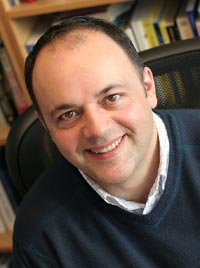 | | Michael Wilkinson directs the Religion in Canada Institute, based at Trinity Western University. |
THERE IS growing interest in the study of religion in
Canada – but we know very little about the subject.
That is one conclusion that could be drawn from a
workshop held February 9 at Trinity Western University (TWU). The workshop
was the first major project of TWU’s Religion in Canada Institute
(RCI).
Michael Wilkinson, director of RCI, said one of the
event’s achievements was “bringing together as many scholars as
we did from as many disciplines as we did.” The 30 or so conference
attendees included academics in sociology, history, anthropology, religion,
political science, English and health care.
This was important, Wilkinson said, because scholars in
different disciplines may be studying similar things but not know of each
other’s work.
Lori Beaman, who holds the Canada Research Chair in the
Contextualization of Religion in a Diverse Canada at the University of
Ottawa, said the workshop was “incredibly valuable” because of
the opportunity to connect with scholars she might not otherwise have met.
One of the assertions made repeatedly at the workshop
was that mainstream universities in Canada have to a large degree ignored
the study of Canadian religion, although there are some signs that this is
changing.
Canadian universities have had “a long history of
not taking religion seriously,” said Beaman, who suggested this was
partly because universities had bought into “the myth of
secularization.” Academics were convinced that religion would
“just disappear and not be important,” she said.
“This assumption of secularization has slowed
down our understanding of religion in Canada,” concurred Wilkinson.
But declining church attendance should not be equated
with secularization, Beaman warned, and interest in the impact of religion
on people’s lives remains high.
“There is so much religious activity going on at
the ground level,” said Wilkinson, “but we can’t see it
at the top.”
This neglect of religion followed by a growing interest
was reflected in presentations which summarized academic work that has been
done in four disciplines.
Pamela Klassen from the University of Toronto said that
in the past, anthropologists studied native religion in Canada but
“distrusted Christianity because it destroyed the cultures they
wanted to study.”
However, younger anthropologists, with less antagonism
to Christianity, have now begun to look at subjects such as the interaction
of native culture with European and ‘Christian’ culture.
Solange Lefebvre from the Universite de Montreal
observed that universities in Quebec virtually abandoned the study of
religion in Quebec during the Quiet Revolution of the 1960s, in reaction
against the power of the Roman Catholic Church.
Again, however, a younger generation of scholars have
become interested because of issues such as secularization, immigration and
the recent ‘reasonable accommodation’ debates.
Continue article >>
|
Mark McGowan of St. Michael’s College in Toronto
said that before the 1970s, the study of Canadian religious history was
“done by clerics in divinity schools.” Now it is being done by
academics in universities, who are often more interested in studying
popular religion, rather than institutions. In the last decade, there have
been hundreds of books and articles written on Canadian religious history.
In contrast, Sam Reimer from Atlantic Baptist
University said the growing interest in religion is “not on the
radar” of most sociology departments in Canada.
One frequently made observation is that government
bodies such as the Social Sciences and Humanities Research Council (SSHRC)
give little funding to religious research proposals because they
don’t think religious studies are important. One indication that this
situation is changing is that the SSHRC provided the funding for the IRC
workshop.
“There is a growing interest in religion among
scholars generally,” said Beaman. For instance, one of the leading
introductory sociology textbooks for the first time is adding a chapter on
the sociology of religion.
One of the dangers of that, she said, is that “a
lot of people are diving in” to the subject who know nothing about
religion, who haven’t studied past research, and yet are making
scholarly pronouncements.
Another problem is that religion in Canada has been
dominated by several large Christian denominations, such as the Roman
Catholic Church and a few mainline Protestant churches.
The result is that many of the religious questions
studied by scholars are based on an institutional framework that suits
these denominations but doesn’t work for minority Christian groups,
popular religious practices and non-Christian religions.
Reimer pointed out that Statistics Canada collects
considerable quantitative data, but primarily on mainstream Christian
religions.
On the other hand, the qualitative studies and in-depth
interviews done by scholars tend to focus on members of minority religions.
The result is that we don’t know the numbers for minority religions
or the quality of mainstream religions.
The data indicates that a large percentage of Canadians
claim to be Christians but only sporadically go to church; there is very
little research into what these people are actually thinking, said
Wilkinson. There is very little information on “how religion is
practiced in Canada outside of the organizational forms.”
Similarly, he added, “There seems to be something
significant happening with youth and religion in Quebec,” but there
is “not much data on how youth think about and practice
religion.” Similar things could be said about immigrants and members
of minority religions, he said.
Some progress was made in overcoming the secular/sacred
divide. Some scholars from mainstream universities gained new appreciation
for the fact that an institution such as Trinity Western University is not
just a school of theology. The new perception is that a Christian
university can be seen as “a legitimate repository of scholars
interested in the study of religion,” said conference
co-organizer, historian Bruce Guenther.
The scholars also discussed setting up some kind of
‘clearing house’ or website where scholars from different
disciplines can interact with each other and access research being done in
Canadian religion, to continue the initiatives of the workshop.
TWU continues its exploration of these issues
with a symposium. ‘Faith Forward: Politics and The Religious
Imagination’ takes place March 12–14. Admission is free;
seating is limited.
March 2008
|