|
AN IMPRESSIVE range of material was covered by
the plenary speakers at Vancouver’s Missions Fest in late January.
The presentations ranged from biographical and practical to philosophical
and theological. Following are some highlights.
Bruce Olsson
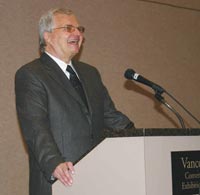 | | Bruce Olson, author of Bruchko. Photos: Elaine Cramer. |
In South America, we have popular television programs
where people are converted to promises from scriptures.
They take a special combination from scriptures, and
[say] ‘God will give you what you need.’
And so we convert people to materialism. We convert
people to a system of worship – but not the Saviour. And what happens
to many of these movements? They die out and disappear . . .
[To] the church in the West, in Canada and the United
States: Get off your pedestal – and live with the world that is next
to you. To the church in South America: Get into God’s word. Know it.
Don’t speculate on it. Don’t turn the promises of God into
combinations to become wealthy.
Live the conscience of Christ, and his compassions . .
. That’s why you’re here during the missions conference, [so]
that the compassions of Jesus can work through your
life, and you change the world – not for
your economy, but [for] the church which is being established, and [which]
should grow properly . . .
I lived with the Motilone [people in Colombia] in many
strange situations . . . situations that were tragic, that were frightful.
Yet in all these circumstances, the presence of Christ is with us. He never
abandons us.
Even when we make mistakes, he doesn’t chide us;
he’s with us always. And we believe that he is guiding our steps,
even in our imperfection. . . .
God is with you in all of life’s experiences. You
in Canada suffer sickness, social problems, family problems. You think life
isn’t worth living.
It is worth living, because Jesus is with you now in any of these experiences
– just as Jesus was with me [when I was] captured by the
guerrillas.
Karen Henriksen
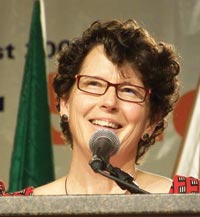 | | Karen Henriksen, SIM hospital director in Angola. |
Some of my reflections – in terms of, ‘Is
there a place for medical work in missions?’ – started with
some of my observations in the first years that I went to Angola, [to live]
in the bush, in the rural area . . .
When I [first arrived] there, all the Angolan church
folk said to me: ‘We’re so glad that you’ve come, because
now we in the church, we’ve got help. We can get health care.’
And I thought: ‘That’s good. But I’m
coming as a missionary to partner with you, the church, so that we can take
medicine to the unreached.’
As a new missionary in Angola, that was my thinking.
Of course, I didn’t understand the solidarity
that an Angolan has . . . For an Angolan, there isn’t that
compartmentalized way of thinking. If we need the health care, of course it doesn’t exclude
other people. We all need
it – us, and everybody [else].
George Verwer
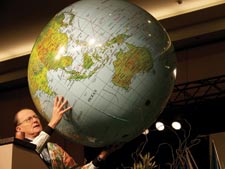 | | Operation Mobilisation founder George Viewer. |
Do you know how many denominations there are in the
world today? It’s gone over the 27,000 mark.
Now I bet there’s some of you here –
you’re convinced your denomination is best.
I bet there’s some of you [who] actually believe
your own local church – maybe it’s an independent,
feisty-deisty Baptist church – your independent church is really the best.
Continue article >>
|
Keep your sense of humour, okay?
Twenty-seven thousand denominations. Some people, when
they hear this . . . they find it very discouraging. Why aren’t we
united? In fact, some movements have been born trying to get everybody to
unite.
It’s one of the greatest wastes of time on the
planet – because God works through language; God works through
culture; God works through nations; God works through personality. Most
denominations were pioneered by some personality – which means that
will leave its stamp . . . It’s [been] going on for 2,000 years.
I celebrate the diversity. I celebrate all these denominations.
There’d be a few of them that would be totally apostate. Many of them
do have heretical and apostate people within their denomination. I’m sure you understand that in
dear Canada.
But in the first place, it happens because of the way that God works. And you
and I would be a lot happier as Christians, if we could understand more the
way that God works – and how we can work through a mess; how we can work when error is present;
how we can work sometimes when even there is sin, or pride.
Where are those in ministry that can say they are
totally delivered from all pride – and now that they’re totally
delivered from all pride, they know that God will use them.
Huh? Do donkeys do ballet on bobsleds in Canada? I
don’t think so. I know you’re an unusual country.
We celebrate God’s diversity.
Russell Stendal
Tragically, North America is in the process of falling
away from the Lord. It’s not going in the right direction.
But God may yet turn the situation around –
although it is most likely going to take hard times. And I am just about
certain that the United States is in for trouble, as a country; and
[I’m] not sure exactly to what extent Canada will go through this as
well.
But it is in the middle of hard times and difficulty
that the Lord has provided tremendous open doors for the gospel in eastern
Colombia.
The cities are now more secure, and it’s harder
to reach people in the cities. They want to use God to get what they want.
But the people in the rural areas, particularly along the
Colombia/Venezuelan border and along the Colombia/ Ecuador border –
where a major conflict is brewing – these people are turning to the
Lord in large numbers.
These are precisely the areas where there are very few
missionaries, very few pastors. In some of these areas, church builders are
not allowed, church meetings are not allowed. But that’s where God is
moving.
Vishal Mangalwadi
The Bible created the modern West. The West became what
it became, because of the Bible. Now that the West has rejected the Bible,
the sun must set on the Western civilization – unless the West turns
back to the Bible . . .
Western civilization has moved beyond secularism – secular
humanism, materialism – towards paganism . . . The world in which
many of us grew up was very different; that world has changed. Why has it
changed?
A number of reasons – but may I give a very
simple reason? Because secular humanism, or secularism – the
worldview that you studied in the universities and colleges – that
worldview rules out God, revelation from God.
It does not, and it cannot, discuss questions of the
purpose of life, meaning of life. What is the meaning of human life? Why am
I here? What is the purpose of my life?
If you are a product of blind accident, cosmic
accident, you just happen to be here, your life has no meaning, no purpose
– anymore than a stone which is lying in the middle of a jungle.
It’s just there – thrown up in a volcanic eruption, or
whatever. It has no meaning or purpose . . .
Secular education, having committed itself to that
darwinian outlook, destroyed the very possibility of schools, colleges,
universities discussing the central issues that every human being . . . has
to come to terms with.
Because secular education, university, can no longer
talk about meaning and purpose and value, et cetera, people are turning to
religion.
March 2008
|