|
By Nathan Vanderklippe
FOR a few weeks every year, skin – yes, even the
exposed kind – is fair game inside the sanctuary of Grace Vancouver.
Not only that, it’s on display.
If that sounds sacrilegious, then know this: the
pastor’s wife wants it that way. And if Caron Smed had her way, it
would be like this every day at Grace Vancouver.
Grace is a fast-growing Presbyterian church plant on
Vancouver’s west side – which has, from its first days,
nurtured an arts festival as a unique way of inviting the community inside
its doors.
Called ‘Arts in the City,’ there is, in
truth, nothing salacious about it: in fact, overly suggestive works are
generally turned away.
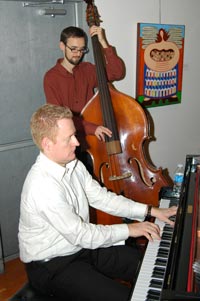 | | Adam Thomas on bass and Nelson Boschman on piano. |
But there are few other rules when it comes to who can
participate in the festival – which has, in past years, featured
musicals, dramatic readings, visual art and music, and does not
discriminate between secular and non-secular work.
Smed, a sculptor and painter, helped organize the first
four festivals; there have now been 11 in eight years.
She sees it as a “long-range mission” to
build relationships with city artists and art-lovers. It was a natural fit,
given her own artistic abilities and the church’s proximity to a
number of art galleries.
“Right from the beginning, we wanted it to be a
part of the church. As Christians, we’re not just a cloistered group
of people who are meeting together to learn the Bible. God’s given us
a mission to the city,” she said.
“The church is already a big barrier to people,
and you have to have springboards in order to get people near a church.
Especially in Vancouver, where a lot of people have a real opposition
towards the church.”
And so, on a drizzly February evening in Vancouver,
just under 200 people file through the church doors into a sanctuary filled
with paintings, sculptures and photography – which depict everything
from partial nudes to patterns of abstract geometry.
A pair of volunteers serves wine – at $2,
possibly the cheapest half-glass in town – while the sanctuary
itself, with its hardwood floors and spot lighting, looks little different
from a gallery.
Parishioners blend with unfamiliar faces and the
artists themselves.
A few years ago, Rachel Oh was one of those unfamiliar
with the church. A former art auctioneer who now works at one of the
biggest galleries in the city, she has come to Arts in the City for the
past several years.
She has been pleasantly surprised by both the
“beautiful” art and “the very inviting feeling.
It’s not like a strict, conservative feeling,” she said.
Continue article >>
|
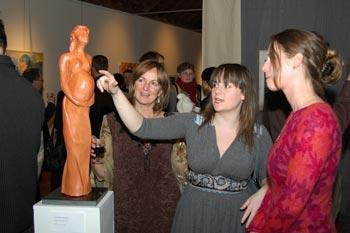 | | Left to right: sculpture Caron Smed, with Katherine Delaney and Renae Dorsey. |
It may sound counter-intuitive, but for Juan de Marias,
a flamenco guitarist who played at the 2007 festival, holding a concert in
a church “is a good idea. Because otherwise the concept of the church
is something strange and different – that you go there on Sunday and
that’s it,” he said.
Although he does not attend himself, “what the
church is trying to do is to promote some teaching and some ideas,”
he said. “And to me, the more chances you have to open up to regular
things that people in the street do, the better it is for the
church.”
Doug Sherlock, the organizer of this year’s
festival, feels the way to do that is by making the event about outreach
rather than evangelism.
The goal is the same – to bring people into
contact with the gospel and those who believe in it – but the
approach is dramatically different.
Instead of handing out tracts, the idea is simply to be
neighbours who know how to have fun – and listen.
“The arts festival is a dialogue, through art,
between the church and the community. What that means is that it’s
not a ‘Christian’ arts festival. We want to experience secular
artists and learn about them through their art,” he said.
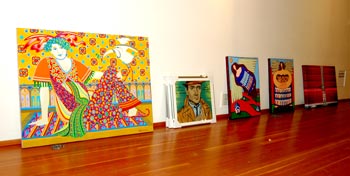 | | A sampling of Arts in the City. All photos of the event by Alan Katowitz. |
Still, the dialogue goes both ways, and perhaps the
best example of that came last year, when a performer from outside the
church paused at the end of the evening, described a problem a friend was
having, and then asked: “is this a praying church?”
Soon, the entire audience was bowing their heads as
pastor Smed prayed for the woman.
“This is something that’s really quite
novel in the church,” said Sherlock. “What we’re saying
in this is that there are no strings attached here. We're not demanding you
change the way you live or believe. We are inviting you out so that we can
get to know you and love you.”
March 2008
|