|
By Jim Coggins
THE Canadian Human Rights Commission (CHRC) has
dismissed a complaint against the Christian Heritage Party (CHP)
lodged by Edmonton gay activist Rob Wells.
According to a CHP news release, the CHRC decided that
“the content and context of the material which forms the basis of the
complaint is not likely to expose a person or persons to hatred or contempt
based on sexual orientation . . . Accordingly, the file on this matter is
now closed.”
Former CHP leader Ron Gray still expressed frustration,
suggesting the party has already been “punished” by the process
itself. And new research by the CHRC itself raises questions about that
agency’s neutrality.
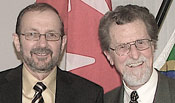 | | Jim Hnatiuk, recently chosen leader of the Christian Heritage Party, spoke at six meetings on a tour of British Columbia in February, Hnatiuk (left) is pictured here with his predecessor, long-time leader Ron Gray, in Abbotsford February 8. At the meetings Hnatiuk outlined party policies on government finances, family law and health issues. He argued that the Christian community's lobbying efforts and work to elect Christian MPs from other parties hae failed to have any impact, because party discipline keeps those MPs from voicing Christian viewpoints. |
Gray, who lives in Langley, told BCCN the issue began in 2001, when the Stanford University Law Review
commissioned academic articles on homosexual rights. The editor chose to
publish only the ‘pro-gay’ articles. The other articles were
published by the Regent University Law Review in April 2002.
A news story about the issue was published by WorldNet Daily. Gray had it posted
on the CHP website, and it was posted on a CHP affiliate’s site.
In late 2006, Wells lodged a complaint with the CHRC
about the two postings, and also four articles Gray had written. Gray
said the articles highlighted research showing that homosexuality
“shortens life expectancy dramatically,” and argued that media
promotion of that lifestyle could “sentence some young people to an
early grave.”
The CHP calls the CHRC’s method of operation
“both slipshod and unjust.” Gray offered to meet with Wells on
a planned trip to Alberta; but the CHRC didn’t respond until the day
he was leaving, when it was too late to adjust his schedule. Gray suggested
the meeting be rescheduled, but the next thing he heard was in June 2007,
when the CHRC said the case had been referred to an investigator, because
both sides had refused mediation.
Gray responded that he had not refused mediation, but
again he got no response. Finally, Gray hired a lawyer, who prepared a
3,200-page ‘brief.’ Gray heard no more, until late December
2008 – when he received a letter, dated October 24, 2008, stating
that the case had been closed.
Gray contended that the CHRC’s failure to respond
to him violates normal government standards for responding to citizens
– and that “justice delayed is justice denied.” He also
expressed disappointment that the case did not proceed, so that he could
appeal any decision to the regular court system, “where standards of
evidence matter.” Gray sees this as a missed opportunity “to
establish free speech rights.”
The CHP news release noted “the complainant bore
no costs at all for filing a frivolous and groundless complaint,”
since the investigation and preparation of any case is done by CHRC staff.
CHP’s legal costs amounted to $50,000.
Continue article >>
|
Wells has also lodged similar complaints against the
Roman Catholic magazine Insight; Alberta pastor Stephen Boisson; and journalist Ezra Levant.
Gray contended gay lobbyists such as Wells are “using the power of
the state to silence critics.”
He noted individuals can be silenced more easily
because “most people don’t have the resources to fight such
cases.”
He also said the mainstream media have not devoted
“a drop of ink” to his case. “In a democracy, everything
must be open to scrutiny,” he said. However, when the
statements of political parties are limited by frivolous human rights
complaints and “the press won’t cover stories that are
politically incorrect, the system breaks down.”
Christian political scientist John H. Redekop disagrees
with what he sees as CHP’s campaign to “legislate
Christianity.” But he defended the CHP’s “right to
advocate whatever they want,” as long as they do not “threaten
the well-being of society.” He added: “We should have very
broad liberties. That is how God treats us. God gives us freedom to make
wrong choices while pleading with us not to make them.”
A new CHRC study describes the organization as
“an autonomous non-partisan body.” However, it also states the
Commission has “advocated for equality for homosexuals from its first
days.”
The CHRC’s goal was to prevent
“discrimination in employment and in the provision of services . . .
on the basis of sexual orientation.” However, the study shows the
CHRC also pushed for same-sex marriage, even though this “did not
directly engage the Commission’s mandate.”
The study reveals the CHRC saw its role as
“moulding public opinion and stimulating policy change,” and
suggests that the CHRC was instrumental in changing public support for
homosexual rights.
March 2009
|