|
 By Peter T. Chattaway By Peter T. Chattaway
THE OSCARS have come and gone, so it must be time for
the Genies, the awards that pay tribute to Canadian films. And, as it
happens, the movie with the most Genie nominations – a Quebec film
called The Necessities of Life – opens in Vancouver March 13.
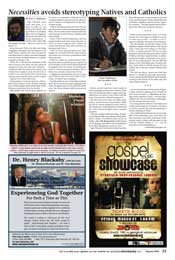
Set in the early 1950s, the film stars Natar Ungalaaq (Atanarjuat: The Fast Runner) as an
Inuit hunter named Tivii who, because he has tuberculosis, is taken
somewhat abruptly from his home on Baffin Island to a Catholic hospital in
Quebec City.
There, he is told that his treatment could take as long
as two years, and the enforced separation from his wife and children
– combined with the haircut he is given, the clothes he is made to
wear, the food he is made to eat, and all the other things that separate
him from his home and his culture – deprive Tivii of his will to
live.
 | | Natar Ungalalaaq in The Necessities of Life. |
Things begin to look up, however, when a kind nurse
named Carole (Éveline Gélinas) has an Inuit orphan named Kaki
(Paul-André Brasseur) transferred into the facility.
Kaki speaks both French and Inuktitut, so he serves as
a translator, while giving Tivii companionship in general and an
opportunity to instruct a young person in the ways of their people.
Written by Bernard Émond (The Novena) and directed by noted
documentarian Benoît Pilon, The
Necessities of Life nicely avoids easy
stereotyping of both Roman Catholics and Inuit people.
Some of the Catholic authorities, and the medical staff
as well, may seem a bit strict or a bit too keen to impose their culture on
others; but they all mean well, and they are saving people’s lives.
Some of Tivii’s preconceptions are challenged,
too, not least when he meets a priest who turns out to be more sympathetic
than Tivii expected.
What you make of a scene between Tivii, the priest and
a local bishop may depend on how strongly you feel about denominational
boundaries and the merits of bending the truth to correct a perceived
injustice. But to these eyes, at least, it doesn’t go too far.
Ungalaaq was named Best Actor in a Canadian Film by the
Vancouver Film Critics Circle, of which I am a member.
The film itself was one of nine that made the short
list for the Best Foreign Language Film Oscar, though it was not one of the
five nominees. The Genie winners will be announced April 4.
• • •
Movies about Jesus have been made in many languages and
in many cultures; there was even an Iranian film a couple years ago called Jesus, the Spirit of God, which
told the story of Jesus from a Muslim perspective.
But there has never been an Arabic Jesus movie –
partly because Sunni Islam, unlike the Shi’ite version popular in
Iran, tends to discourage any visual depiction of Jesus and the other
historical figures they consider prophets.
Continue article >>
|
That may change in the near future, though. Variety reports that some Lebanese
filmmakers plan to make a $2 million Jesus movie in Arabic, called The Resurrected; it will be based
on the gospels, and will be told in flashbacks from Mary Magdalene’s
point of view.
Eagle Pictures chief Jamal Al-Sharif said the film will
represent “a real attempt to go back to the mutual respect which
existed between Christians, Muslims and Jews in this region for
centuries.” The film already has the blessing of the Maronite
Christian Patriarch.
• • •
Easter is just around the corner, so it must be time
for a new batch of religious movies to come out on DVD – or, better,
to be re-issued on Blu-Ray with lots of new features.
The list includes: the Blu-Ray release of the
‘definitive edition’ of Mel Gibson’s The Passion of the Christ; the DVD
release of The Silver Chalice, a widely panned 1953 movie that happens to mark the big-screen
debut of Paul Newman (he later found the film so embarrassing he bought a
newspaper ad to apologize for his performance); and the Blu-Ray release of
the 1950s Bible epics The Robe and Quo Vadis, both of which feature Roman soldiers who come into contact with
the early church.
The last two discs, which are both due March 17,
should be especially interesting, as they will reportedly include bonus
features looking at the history of the Bible epic and other related
subjects.
• • •
A short documentary produced by a Regent College
student is playing at the Women in Film festival March 6. Montana de Luz, directed by
Matthew Leahy, concerns three children who live in a Honduran orphanage,
and the dreams that they have.
It is being shown with the short films Lost Children and Daughters of Gardeners, the latter
of which concerns the selective aborting of female offspring in India.
More details about Montana
de Luz are available at NoondayFilms.com,
and tickets for this screening – and other screenings at the
festival, most of which will take place at the VanCity Theatre March 4
– 8 – can be purchased at WomenInFilm.ca.
– filmchatblog.blogspot.com
March 2009
|