|
By Wally Dennison
AT 88, Kelowna’s Sjenta Wilkinson remains as
dynamically caring and God-serving as she was during the Second World War,
outwitting the Nazis and later overcoming their inhumanity in a
concentration camp.
Underground movement
Sjenta was born to a Jewish father and a Christian
mother in the Netherlands. At age 19, in 1942, she was unwittingly drawn
into the Dutch underground movement by an older brother who was in hiding.
Meanwhile, Sjenta’s mother was hiding Jews in the
family home and placing others with friends throughout Holland.
Sjenta travelled to Amsterdam on behalf of her brother,
delivering packages to designated locations in the Dutch capital.
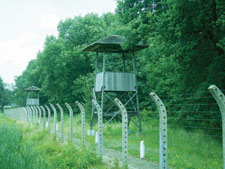 | | Vught concentration camp was once home to long-time Kelowna resident Sjenta Wilkinson |
Sjenta often had been blissfully unaware the contents
were resistance newspapers printed by the Dutch underground movement, plus
falsified passports, photos and other material geared to facilitate the
escape of Jews.
Her freedom ended with the arrival of two SS guards at
the family’s home near Haarlem December 7, 1943.
Sjenta sweated under powerful search lights for an hour
as SS interrogators pummeled her with questions and wild accusations that
she had been involved in the derailing of German troop trains.
Camp Vught
One of those trains took Sjenta and hundreds of others
to KZ Herzogenbusch – aka Camp Vught.
Once off the train, the mob silently marched for a half
hour to the camp’s massive gate flanked by monumental watch towers.
Then on to a long, ominously grey stone wall against
which all were ordered to face, just inches from its surface.
One would be shot for even slightly turning his or her
head. Then came a thunderous fusillade of gunfire.
The SS had focused their revolvers on the line of
prisoners, but all fired in unison into the air. Supreme psychological
terror was intended to instill robotic obedience. “What an awful
moment that was!” Sjenta grimaced.
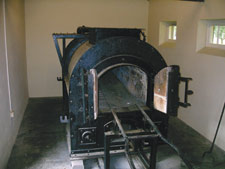 | | A mobile crematorium on display in Camp Vught, a Nazi concentration camp in the Netherlands. |
She soon learned that barbaric atrocities were routine.
Guards tortured prisoners with incredible cruelty, beating some to death
with whatever weapon was most handy, Sjenta said. Several were fatally
brutalized by clubs fixed with barbed wire. The SS often ordered their dogs
to attack prisoners.
Her saving grace during those first months and
throughout the war, Sjenta emphasizes, was her strong Protestant faith.
Twice, at critical junctures during her ordeal, a consoling vision of a
healing Jesus appeared to her as she lay despairingly upon a prison bunk.
Jesus’ presence, Sjenta says, sustained her
through the massive shocks which characterized the days and months into
1944.
Sadistic SS guards would drop by periodically, taunting
the wives whose husbands had been slain by firing squads the previous
night, even displaying their bodies for excruciating witness.
As political prisoners, Sjenta says she and her13
barrack mates were feared by their Nazi captors, since all were highly
intelligent professionals and top underground workers – doctors,
lawyers and a professor’s daughter among them.
Tenderness amid tragedy
Sjenta carried a few tender memories amid the tragic
gloom – scenes indelibly engraved into her soul.
Every day she saw children cuddling together in a large
room;. Not one adult there, older brothers and sisters lovingly embraced
and attended to their younger siblings.
“We smiled and threw kisses to them through a
glass window. It’s as much love as we could express. But, sometimes a
door was ajar and we would storm in and repeatedly hug one after another.
They loved it. Sometimes we got caught, and were punished
heavily.”
Her time in Vught ended when a bus took the political
prisoners into a factory whose windows were blacked out.
The bus exited through an opening and into another
plant entrance with open grassland encircling it in an industrial area.
In the factory, plant SS guards pointed to monstrous
kettle furnaces.
“They said that’s where anyone who caused
trouble would be incinerated.” Sjenta and the other political
prisoners produced gas masks.
One day Sjenta was summoned to the prison office, where
a man in civilian clothes identified himself as a Nazi lawyer. He told her
he had been asked by her boyfriend to free her.
“He told me he would try to arrange that if
possible. I just burst into tears when I heard that word,
‘free.’ The lawyer smiled graciously as he handed me some
chocolates. He told me not to tell anyone. At last, my survival was
possible.”
Continue article >>
|
Buoyant with hope, Sjenta was soon aboard a bus for
Amsterdam. She was dropped off in Utrecht, where she was imprisoned for a
month before her court appearance.
Silenced by fear
During that month, Sjenta’s fearful anxiety over
her future caused her to lose her voice several times.
Thankfully, a brave young girl, daughter of a town
police commissioner, arrived as a prisoner.
“She observed my speechlessness, grabbed my
shoulders and shook them angrily. She demanded that I smarten up, declaring
that we must win the war.” A dear friendship blossomed from that
stern confrontation. “After a couple days, my voice returned for
good.”
Every day Sjenta and her new friend played make-believe
court, coaching and rehearsing to each other what their answers would be to
the make-believe judge, whom each took turns portraying, complete with a
wooden spoon as a gavel.
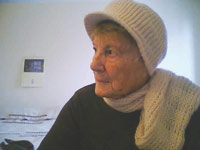 | | Sjenta Wilkinson, a Kelowna resident who endured many months in Vught as a political prisoner, for anti-Nazi activities |
“We laughed, joked and cried as we freed
ourselves, and described the beauty of the sky walking into freedom. We
played so well that I’m convinced it helped us both in court.
“One day, she returned to our cell crying,
happily saying she had been freed to go home, but saddened that we were
parting.
“I promised her, in fact I vowed to her, that I
would fight for my life and become free. We hugged each other, both of us
sobbing. A week later, I was freed.”
Seven years after the German surrender in 1945, Sjenta,
her husband and their two children immigrated to Canada.
Fulfilling new lives
From wartime misery, deprivation and harsh post-war
readjusting, the couple eventually fashioned hugely fulfilling new lives.
Her husband partnered in operating a floral show garden, while Sjenta
worked as a nurse’s aide at Kelowna General Hospital.
“I loved helping people, caring for them as I had
been cared for earlier – especially those Vietnam War veterans who
returned suffering the terrible traumatic effects of combat.”
Sjenta had been married 25 years when her husband died.
Five years later, she remarried. She and her second husband had also been
wed 25 years when Sjenta again became a widow.
Their time together overflowed with world travel and
global servanthood to God.
In Portugal, they assisted at a home for street kids,
transforming many lives, with Sjenta parenting, schooling and even
massaging the disabled kids.
Unique servanthood
Obviously, all that Sjenta is today came from
God’s hand moulding her for her unique servanthood to others.
“Studying prisoners and myself taught me a lot
back in those camp days. You had to master the art of living, and
surviving.”
Sjenta’s life today is focused on a great finish
for God. While her heart aches from news of the recent European outbreak of
anti-Semitic incidents triggered by Islamic extremists, she goes on
energetically addressing audiences about those nightmarish wartime years.
Years ago, she discarded the word ‘worry’
from her vocabulary, realizing it’s the darkroom in which negatives
are developed.
This remarkably energetic and enthusiastic lady
emphasizes that a positive mindset and a spirit grounded in faith sustained
her.
“With God driving us, we are strengthened for a
future, but we also should be prepared to die, if necessary, for our values
and ideals. Helping other people in that camp ensured my own sanity and
survival.
“So, I’m really no heroine. I was just
using my God-given gifts helping others. I just did what anyone would
do.”
Camp Vught is now a national monument. More than 1,800
Jewish children, separated from their parents, stayed there until they were
transported to extermination camps in Poland and Germany.
Outside the building into which Sjenta and her friend
tried to smuggle sandwiches to the kids is a sheet metal memorial –
with stars of David at the top, and toys at its base.
March 2009
|