|
By Jim Coggins
 | | Vancouver |
AS CANADIANS bask in historic Olympic gold, Christians are already planning for what comes next.
A team of 15 organizers for the outreach planned for the London 2012 summer Games were in Vancouver. They spent several days being briefed by leaders of More Than Gold (MTG), the collaborative outreach effort of Christians for the 2010 Games.
Also present were some hoping to learn lessons that could be applied at the 2014 Games in the Sochi area of Russia.
David Willson, who will lead the London effort, sees Olympic outreaches as “a good excuse to get the church working together.” He emphasized that service comes before evangelism – adding that if Christians show love, “people will ask why.”
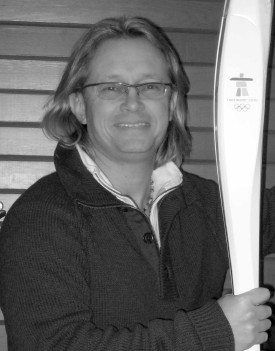 | | David Willson, who will lead the Christian outreach during the London 2012 Olympics |
A native of England with a master’s degree in sports education, Willson was asked by the Salvation Army to head up its involvement in the 1996 Atlanta summer Olympics.
After involvement at other games, Willson realized that “there was not much transfer of knowledge” from one Olympic outreach to the next.
In 2000, he was asked to help set up and become CEO of Global Events Group, an organization which could assist Christian outreaches at Olympic games and other major events.
Since then, he has been able to offer advice to Christian organizing committees at about 40 events, from the Commonwealth Games to soccer’s World Cup. He was instrumental in helping the Vancouver MTG effort come together.
With 250 – 300 churches from 15 denominations and 60 Christian agencies involved, Willson called Vancouver’s effort “the biggest winter games outreach we’ve seen.”
Willson said he is always learning new things that will be helpful for future outreaches. For instance, the Vancouver MTG’s success in working with VANOC (the Vancouver Olympic Organizing Committee) and with the TransLink transit authority has been encouraging.
On the other hand, he noted, “the Lord plans differently then we do,” and Christian outreach looks different in each locality.
In summer games, churches have more success with big screen outdoor TVs and sports clinics for local athletes.
At other Olympics, churches have also offered inexpensive home stay accommodations for international athletes’ families.
That didn’t happen in Vancouver, partly because VANOC needed homes to provide accommodations for Olympic volunteers at the North Vancouver and Whistler Olympic sites. That effort was coordinated through North Shore Alliance Church.
MTG success
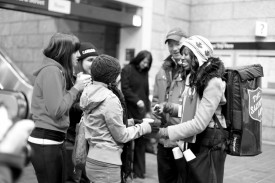 | | A volunteer serves coffee at a SkyTrain station, as part of the More Than Gold campaign. |
MTG was particularly successful at offering coffee and other drinks – over 600,000 hot drinks altogether, well beyond the original target of 440,000 – to people at SkyTrain stations and Olympic venues. The delivery of drinks using back packs rather than refreshment tables was a fruitful innovation, allowing volunteers to move outside the stations to where the people were circulating.
MTG “exceeded expectations on a wide variety of fronts,” said executive director Karen Reed.
Referring to the outburst of patriotism reported in the secular press, Reed stated, “A collective experience has been awakened across the country, but also in the Christian community – and we want to keep the momentum going.”
Reed said the Christian outreach at the Olympics demonstrated the power of collaboration but also “the power of one” as individual Christians initiated conversations and “stepped into divine appointments.”
Dave Carson, who headed the MTG prayer group, stated, “One of the legacies of the Olympics is greater unity in the Canadian prayer movement.”
He noted the various prayer efforts, from The Burn, a 27-hour prayer and worship event attended by hundreds of young adults at Cariboo Road Christian Fellowship, to the two-week prayer centre on Keats Island.
Richard Long, who led the Keats Island effort, noted that, besides those praying on site, the group’s prayer update “went out to 445 prayer leaders, who then in many cases sent it out further to prayer groups, church lists, nation-wide networks and even international networks of intercessors. Literally thousands of us have been praying together.”
In response, the prayer centre received “many wonderful reports of what the Lord has been doing in answer to our prayers. We have heard testimonies of people being led to the Lord by chaplains, hospitality workers, street evangelists and prayer teams in different venues.”
London 2012
 | | London |
The London initiative will be larger than Vancouver’s, Willson said, partly because the summer Olympics are much bigger than the winter Olympics – and the 2012 events will be scattered all across the United Kingdom.
Therefore, while Vancouver had up to 300 churches involved, Willson hopes to have 3,000 of the 47,000 churches in the UK participating.
There will be more use of outdoor big screen TVs, sports clinics and barbecues – and even a sports version of the Alpha Course. As a practice run, some churches will be offering big-screen showings of the World Cup soccer games held in South Africa this summer.
To Russia with faith
A team of Christians from the Sochi area in southern Russia had also hoped to come Vancouver, but did not get visas in time.
However, a couple of representatives did make it to B.C. One was Carl Dambman, who has worked with Athletes in Action in Moscow since 1990. His involvement in the Olympics goes back to Montreal in 1976, when he was on the U.S. wrestling team.
Continue article >>
|
While Dambman will not be leading the Sochi outreach, he told BCCN he is offering his experience as “a resource, connector and encourager.” He moved to Moscow because, he said, “God gave me a heart for Russia and the whole Soviet bloc.” He emphasized that Olympic outreaches “use sports cultural festivals to show people God loves them.”
Dambman said the three leading religions in Russia are Eastern Orthodox Christianity, Islam and Judaism.
However, there are several fair-sized evangelical congregations in the Sochi area. Key to Christian outreach there is whether evangelical, charismatic and Orthodox churches can find ways to work together.
Wells of spirituality
One effort which received positive secular press coverage was the work of David Wells, head chaplain at the Olympic villages. Wells, who is general superintendent of the Pentecostal Assemblies of Canada, was profiled by Douglas Todd in The Vancouver Sun.
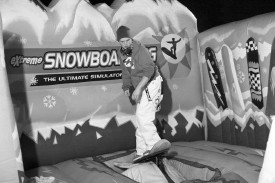 | | A skateboard demonstration from Youth for Christ’s Shred Fest Olympic celebration. |
Todd noted the fact that several religions were represented by chaplaincy. While the majority of the athletes listed their religion as Christian, there were also clergy for Muslim, Buddhist, Hindu and Jewish athletes.
Todd wrote: “Even though Wells . . . is clear that he doesn’t share the theological doctrines of many of the non-evangelical Christian clergy he oversees . . . [he] believes the five major world religions have a right ‘to be at the table’ at the Games, where their representatives can help all interested athletes obtain the spiritual support they need.”
Olympic Bibles
Christians handed out tens of thousands of scripture booklets, featuring colorful Olympic editions of the Gospel of John and the Book of Romans. The Olympic Bible Project was directed by David Hardin, from Hillcrest Baptist Church in Acworth, Georgia. The local host was Greater Vancouver Baptist Church.
The project was assisted by other independent Baptist churches. Most participants came from across the U.S., and paid their own way to come to the Olympics. Testimonies can be seen at gvbclife.ca.
While most Christian involvement in the games focused on hospitality and witness, others used the event to draw attention to issues ranging from the environment and homelessness to globalization and sex trafficking.
Ashes and protest
On Ash Wednesday, February 17, close to 50 activists gathered at St. Mark’s College Chapel on the grounds of the University of British Columbia (UBC). According to organizers, their purpose was to raise awareness of “the negative impacts of the Olympics on the poorest people in Vancouver.”
 | | An Ash Wednesday protest against homelessness. |
The Student Christian Movement (SCM), a UBC club, sponsored the protest.
SCM issued an account of the event: “After joining the congregation at St. Mark’s for a service and receiving ashes, we gathered, prayed and headed off to Thunderbird Arena, an Olympic venue – carrying signs, reading scripture, singing hymns and chanting: ‘Ashes to ashes, dust to dust, building homes now is a must!’”
The statement noted: “One of the most surprising things was the police presence – several police officers, cars, motorcycles, a truck and even a helicopter circling outside the mass, filming and observing even the parishioners who were not taking part in the march.” Some were threatened with arrest, but no arrests were made.
At Thunderbird, the protesters knelt and said the Lord’s Prayer, sang songs and asked God “to forgive us for our sins against the poor.” Participants included members of InterVarsity Christian Fellowship and the Regent College Students’ Association.
The homeless village
Streams of Justice (SOJ) helped set up a large makeshift cluster of homeless shelters in downtown Vancouver. SOJ spokesperson Dave Diewert gave this account:
“The Olympic Tent Village was launched . . . following a rally for homes. We successfully occupied an empty lot (58 W. Hastings), and have grown since then. We probably have 100 or so tents on the site, with lots of folks coming and going.
“Initially, we set in place an infrastructure to last us for five days; but the community of people who are on the site have decided to stay until the end of the Olympics, and maybe beyond.”
Share the Gold
A human chain organized by a coalition of groups called Share the Gold stretched down Hastings Street in Vancouver February 24.
Organizers invited both supporters and opponents of the Olympics to take part. The purpose was to promote the idea that the same effort which went into the Games should be put into fighting homelessness.
Organizers asked participants to wear gold toques or scarves, to engage in conversations with people across socioeconomic barriers, and to consider contributing five percent of what they spent on Olympic activities to a fund for ending homelessness. The chain started from First United Church, where 300 homeless people are given shelter each night.
Premier encounter
The Olympics gave B.C. Christians an unprecedented opportunity to show their capacity for outreach on a large scale. One anecdote exemplifies the extent of the outreach.
One of the chaplains under David Wells’ leadership was Dwayne Buhler – whose day job is directing Missions Fest Vancouver. He described a memorable encounter during the Games:
“I was walking by the CBC Building, when Premier Gordon Campbell and one other person came out and walked my way. There were very few people on Hamilton Street at the time, and we had a brief conversation – where I thanked him for his leadership . . .
“He noticed my lanyard and name tag, and asked if I was volunteering with the Salvation Army.
“I said that I was a part of the More Than Gold network, and that we were working in partnership with the Salvation Army.
“His comment was: ‘You guys are doing an excellent work at the SkyTrain stations! We’ll have to send out a big thank you.’”
– additional reporting by David F. Dawes
More Olympics coverage: Random Acts of Radical Hospitality
March 2010
|