|
By Lloyd Mackey
TRINITY WESTERN University (TWU) works within a definition of academic freedom which includes a “generous orthodoxy” in its approach to faith matters, according to president Jonathan Raymond.
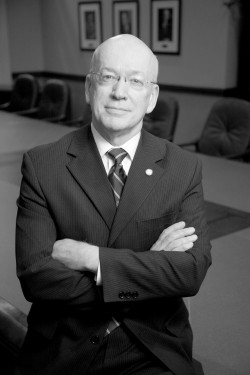 | | TWU president Jonathan Raymond. |
And “we will stay the course” on that stance, he added – despite the conclusions of a 25-page “report of inquiry” from the Canadian Association of University Teachers (CAUT).
The report concludes that TWU’s policies “allow for unwarranted and unacceptable constraints on academic freedom.”
Ironically, around the same time CAUT was censuring the university, another secular entity gave TWU high marks.
Maclean’s magazine published results of two annual surveys of Canadian university students in its February 22 issue.
The National Survey of Student Engagement ranked 56 schools. TWU ranked first in enriching educational experience; second in level of academic challenge; and second in supportive campus environment.
When students were asked to evaluate their entire education experience, TWU placed first among senior-year students, and second among first-year students.
The CAUT inquiry took place over the past 16 months. Its report was authored by William Bruneau, a University of British Columbia education professor emeritus and Thomas Friedman of the English and modern languages department of Thompson Rivers University.
CAUT functions in many ways like a teachers’ union. Many Canadian universities have CAUT local associations – although TWU is not among them.
In an interview with BCCN , Raymond pointed out that TWU fits well into the definition of academic freedom adopted by the Association of Universities and Colleges of Canada (AUCC), of which Trinity “has been a well-accepted member for 25 years.”
Noted the TWU president: “Here is the heart of it: We are a Christian institution – systemically Christian – in identity and in fidelity to our Charter, which requires us to take that posture.”
The school, which enrolls around 4,000, is considered a bit of an anomaly – which may well be why CAUT decided to investigate it.
The association has indicated its intention of developing similar ‘inquiries’ into Canadian Mennonite and Crandall universities in Winnipeg and Moncton, respectively; and Redeemer University College, near Hamilton. They are similar in faith emphases, but each has about one-third the student body of Trinity.
All three, like TWU, require faculty members to sign Christian faith statements. They all accept the academic freedom statement adopted by the AUCC.
Not all Christian universities require such statements to be signed by faculty members. In a footnote to its report, the CAUT points out that St. Thomas University, a Catholic institution in Fredericton, New Brunswick, and The King’s University College, a Reformed-rooted school in Edmonton, welcome faculty and students “from all faiths and backgrounds.”
The ultimate recommendation in the inquiry report is to create and disseminate a “list” of institutions whose faculty relations practices do not fit CAUT criteria.
The report quoted extensively from various TWU statements on faith and practice to build its case that, despite the school’s high academic standards, the statements that faculty signed precluded them from the kind of academic freedom CAUT calls for.
David Robinson, CAUT associate executive director for research and advocacy, readily agreed in a phone interview that the association’s definition of academic freedom is different from that of the AUCC.
He said CAUT’s definition is the “generally accepted model,” adding that “ours is the consistent model based on the UNESCO (United Nations Educational, Scientific and Cultural Organizations) definition of the status of teachers.”
Continue article >>
|
Under that model, Robinson asserted, “professors and academic staff should be able to raise questions without being confined to a specific doctrine or belief.” He said an institution with a narrower approach to academic freedom, in CAUT’s view, “would not be considered a real university,” no matter how high its academic standards.
Robinson suggested emerging faith-based educational institutions need to keep in mind the history of universities, particularly relating to the quest to “be free of orthodoxy.”
One of the issues, he agreed, relates to an institution’s age and maturity. Catholic universities in Canada – St. Francis Xavier, for example – have adapted to secularization while retaining their religious roots.
“We are happy to continue the dialogue” with TWU and similar schools, “to help in their adjustment,” Robinson noted.
Raymond said Trinity welcomes – and has – students from non-Christian and non-faith backgrounds. They sign a community covenant which allows them to recognize that they are studying within a Christian framework.
He also spoke of CAUT’s seeming attempt to “stereotype” Trinity in a “narrow fundamentalist context.”
Raymond portrayed the school as offering a “broadening experience. We are geared to help students find their way within a generously orthodox context. We will always be challenged, and we will wear the [CAUT censure] badge with honour.”
TWU will be 50 years old in 2012. “And we are not unhappy when we are compared with Wheaton College, which is 150 years old and remains anchored in its [concept of] Christ preeminent.”
Both the CAUT report and Raymond’s four-page response are on the CAUT web page (caut.ca). In his response, the TWU president pointed out that the association commenced its inquiry “without any ‘informal negotiation’ with us – which was required by CAUT’s own policies.”
He said that the teacher group created a “negative perception throughout the province before TWU even had opportunity to discuss this matter with CAUT.”
Raymond stressed that Trinity was created by law to be a Christian university. “However, within that legal mandate, TWU welcomes a broad diversity of viewpoints. Faculty and staff come to [the school] from a wide spectrum of Christian backgrounds.
“Students need not have any religious belief to attend TWU. While [it] is a faith-based university, it is also a richly diverse community and certainly not narrowly ‘homogenous.’ The [CAUT] report is simply in error in describing the TWU community in this way.”
People representing a variety of interests have weighed in on the issue.
John Stackhouse, a Regent College theology professor and leading authority on Canadian evangelicalism, said he found CAUT’s stance on academic freedom to be a “curious claim.”
He characterized it as “hegemonic” in nature, because CAUT is “insisting that there is only one way of pursuing legitimate university education.”
He noted: “As one who has been educated in and has taught at both kinds of institution, I believe CAUT is right to champion academic freedom. I also aver that TWU is right to champion confessional education and scholarship.”
Charles Lewis wrote a piece on the issue for the National Post. One unidentified non-Christian Trinity student, responding online to Lewis’ article, stated: “I have never felt any pressure from my professors, to need to think a certain way.
“We are given the choice: they teach us both what they believe and what others believe – and we, in the end, choose ourselves. These people are not ignorant, Bible-thumping Jesus freaks. They deserve the respect that they have earned in academia.”
The Princeton-based National Association of Scholars’ communication director, Ashley Thorne, suggested tongue-in-cheek that “We at the NAS are considering an investigation to see whether we should put the CAUT on our list of organizations that misappropriate the notion of academic freedom and endanger true freedom of inquiry.”
Raymond said he is appreciative of the fact that, while CAUT refused to withdraw the inquiry report from its website, the association did post TWU’s response just below the report.
March 2010
|