|
By Steve Weatherbe
SUCH is the current touchiness around separation of church and state that when a visiting clergyman recently slipped a reference to Jesus Christ into the prayer that customarily opens sessions of the B.C. Legislature, one MLA raised a secularist hue and cry.
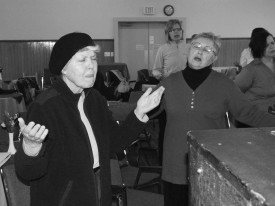 | | Supporters of PrayBC praying just before the February 9 Throne Speech. |
People with longer memories recall that, in 1987, a much greater alarm was raised when then-Premier Bill Vander Zalm directed a room in the Legislature be set aside for prayer.
Self-styled Gnostic bishops, rabble-rousing lawyers and erstwhile swamis crashed the first prayer session with clanging cymbals and thrumming drums, as TV news crew recorded the mayhem. And the prayer room was quietly closed.
So Tim Schindel has generally been keeping a low profile for the past two years, as he’s attempted to become the unofficial chaplain to the 84 MLAs.
In one of his more public efforts, Schindel gathered 50 supporters of his PrayBC ministry at Victoria’s Church of Our Lord for an hour before the Throne Speech opened the 2010 session in early February. He then led them over to the Legislature, to pray for wisdom for the MLAs.
Rejecting the offer of some members to lobby for an office for him, Schindel prefers to emulate his opposite number in the House of Commons: Rob Parker, whom Maclean’s magazine dubbed “a devout loiterer.”
Schindel loiters, too. Devoutly.
Question period offers the best opportunity for loitering. All members in the Legislature buildings, including cabinet ministers, attend question period – and the ‘introductions by members’ which precede it, where MLAs introduce guests sitting in the visitors’ gallery.
Afterwards, MLAs and guests meet in the rotunda outside. Schindel discreetly hangs about for MLAs and ministers (cabinet ministers, that is) to approach if they want, for a chat – and, very discreetly, a prayer.
“I’ve developed a relationship with one in four of the members,” said Schindel.
“I’ve made it clear from the beginning I’m not there to lobby; I don’t have a hidden agenda. By now, they know I’m not going to whack them with a Bible.”
What Schindel does talk to the MLAs about is, frankly, between him and them. But generally, it’s the usual personal and pastoral issues – albeit, shaped by the unusual circumstances of government. He will say that “some MLAs are churchgoers – but their lives are way too complicated for them to go to their own pastors, with their problems here.”
Continue article >>
|
Others have simply come to know him as someone sincerely concerned about them – and without any other agenda, hidden or otherwise.
Schindel’s journey to this job was a gradual one – but not without epiphanies. After pastoring several years in Kamloops for the Pentecostal Assemblies of Canada, he got involved with the local Chamber of Commerce – and, after a few more years, led it.
This brought him into contact with civil, federal and provincial politicians – some of whom, when they discovered his profession, opened up to him about personal issues such as drinking too much, loneliness and marital strife.
He was, at this time, studying the lives of such Old Testament figures as Joseph and Nehemiah, who became advisors to pharaohs and kings.
“There was an ‘aha’ moment,” Schindel recalled. “God was always placing his people in the lives of leaders. And the question popped into my head: ‘I wonder who does that today?’”
The question after that was: “How do I minister to our MLAs?”
Schindel and his wife decided to move to Victoria. They found churches, organizations such as Prayer Canada, and individual prayer and financial supporters for the project, which they dubbed Leading Influence Ministries.
Providentially, his own MLA, Kevin Krueger, planned to introduce him before question period on opening day of a session, when the clergyman scheduled to invoke the introductory prayer failed to show up. Krueger volunteered Schindel, who as a result of filling in, was then treated to lunch by the Speaker a week later. Krueger came too, and brought some sympathetic MLAs from both parties.
Schindel’s foot was in the door. The rest was a matter of showing up and being present.
“Fundamentally,” Schindel said, “I believe that if I can reach their hearts for God, the political side will take care of itself. I don’t get into that. Even if every one of the 84 MLAs came to faith in Christ, you’d still have political differences.”
He concluded: “We’re all people who are tired of the churches complaining all the time to politicians. Let’s engage them on a personal level.”
March 2010
|