|
By Jeff Dewsbury
AS I watched Wilde, my new five year old son, lower his milk carton boat to the surface of the creek behind our home, I thought of a photograph I had seen recently.
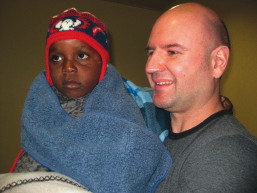 | | New father Jeff Dewsbury with Wilde, adopted and rescued from Haiti. |
It was an aerial shot of hundreds of Haitians seeking refuge on a boat, literally cramming every inch of the vessel.
Understandably scared and worn down by the merciless rocking of tremor after tremor following the terror of the initial earthquake on January 12, they looked to the ocean for whatever peace it could bring.
Watching Wilde now, smiling down on the clear water in his new favourite wardrobe acquisition – bright yellow rubber boots – I found it hard to believe that this child survived that very same earthquake.
The same ground that shook beneath all of those terrified people, shook beneath him as well.
Although Wilde officially joined our family without much warning, he didn’t just suddenly appear in our lives. My wife Melinda and I – with the support of our other sons, Manny, 11, and Nick, eight – had been working on his adoption for more than three years.
It would be easy to get sidetracked by the long list of signatures and qualifications that had to be put in place (some people call it being ‘paper pregnant’), but the bottom line is that every single paper chasing moment was worth it. After the first time Wilde called us “momo and papa” in his high, soft voice, we forgot about it all.
Some believe that if women could really preserve lasting memories of the pain of childbirth, no one would ever have more than one child. It’s that way with adoption, too.
Once your child is part of your family, the hours spent building a War and Peace sized dossier seem no more real or relevant than those size 32 jeans you wore in high school.
The two weeks and a day between the earthquake and the moment Wilde was tucked under a blanket and whisked from an Air Transat jet into our arms in Ottawa were the most emotional, painful and faith-affirming days we have ever experienced.
On the afternoon of January 12, a friend called Melinda at work to ask if Wilde and his orphanage were okay. Having been teaching all afternoon, she was caught by surprise at the news of the earthquake. Her first frantic internet search came up with a wire service article describing homes that had fallen off the mountainside in Petionville, a suburb of Port au Prince.
A deep despair set in as she thought about our visit to the orphanage there in November, and how we had stood in the play yard with Wilde looking over the rooftops of the homes below.
Mercifully, God spared us the pain of the unknown. God’s Littlest Angels orphanage (GLA), where Wilde was living, had remained standing and even maintained internet access.
Within a short time of the initial quake, the orphanage administrators were able to post a message on their home page that everyone was alive. Words cannot express the upwelling joy of that moment.
Many other adoptive families weren’t so lucky. Many waited days to find out if their children were alive or injured. I remember praying all day for one orphanage where all the children (reportedly 80) were living outside under the care of only one adult.
In the first two weeks after the quake, there seemed to be hundreds of equally desperate stories – whole cities demolished and seemingly forgotten, as the world’s blue ribbon relief agencies struggled to find ways of meeting the great need in Port au Prince alone.
Reports of escalating tensions over limited resources started to emerge as well, – causing us to lose sleep, wondering if adopted children would be left to languish in orphanages because original documents were sitting in piles of rubble.
No one knew what would happen, and misinformation abounded – for instance, many media outlets initially got the story wrong, failing to understand the difference between adoptions of newly orphaned children and adoptions of those who had been in process before the earthquake.
Even our Canadian Immigration Minister seemed to be parroting UNICEF’s anti-adoption rhetoric, likening the Netherlands’ evacuation of adopted children to kidnapping.
Continue article >>
|
At the end of a particularly weary day full of phone calls to Immigration Canada and our MP’s office, and endless email exchanges with other adoptive parents who were getting conflicting news from various other government officials, my mind was crashing.
The picture in Haiti was bleak. We had been praying without ceasing, but there was so much to pray for. It was so overwhelming.
The only thing I could do was to ask God for a focus. It took only a moment for his response, as the words “loaves and fishes” blocked out the cacophony in my mind.
The Sunday before the earthquake, a doctor who had gone on a short term medical mission to Zambia had spoken on Christ’s loaves and fishes miracle in our church.
The message: in the face of overwhelming need, God takes our modest offerings and multiplies them over and over. Everything from food and medical aid to personal skills, energy and compassion – and even time – he seemingly multiplies it all.
In the days following, we returned again and again to the freedom and comfort of those words – and what they represented to the people of Haiti, and to those who rushed to their aid.
The liberation of knowing that God wasn’t expecting individuals to fix things on their own – he wasn’t preparing a performance review with a bonus structure – enabled us to consistently find energy and hope.
It encouraged us as we tried to bring Wilde home, while still weaving his plight together with the immense needs of those around him. As much as we could from afar, we grieved, prayed and acted.
And every time I started to worry, or slipped into sarcasm and bitterness (sorry, Minister of Immigration), I felt God refocusing my mind.
I drew on images of Haitians in the streets, in pain, grieving the loss of their family members and friends – juxtaposed with reports of those same people lifting their hands and praising God amidst relentless aftershocks and rising tensions.
At GLA, the children spent that first shocking night outside in the courtyard. There are several beautiful accounts of the whole community there – Haitian nannies and caregivers, foreign staff, volunteers and neighbours – singing praise songs in the darkness that cloaked an uncertain tomorrow. Their faith softened our hearts in a lasting way. And though we desperately wanted Wilde to come home, we could see that his story was bound with those nannies who had lost their homes and family members, and yet continued to praise and rejoice.
Later in the week, we received news that Wilde’s adoption order (the one that legally declared him our son, issued by a Haitian judge) had come out of the court the day of the earthquake.
The courthouse had then collapsed in the quake, and the judge who had presided over adoptions in the area had been killed.
The news was bittersweet. We were overjoyed that Wilde’s papers had been approved and were in a safe place. Yet, I cried when I heard that Judge Cadet had died. Inadvertently, he had given us a precious gift. In 2009, out of the blue, he had required adoptive families to travel to Haiti to sign a paper before their adoptions were complete.
This meant adoptive parents would, on one hand, have the privilege of meeting their soon-to-be children. But they would also have to leave their children in Haiti while they waited months for the remaining paperwork to be complete. At the time, we were unhappy with this. We believed the trip would send mixed messages to Wilde and he would feel that we had abandoned him.
While it was – as we expected – the most gut-wrenching of goodbyes, in the end it was the best thing that could have happened. We were able to see Port au Prince before it changed forever, and we got to see Wilde in his surroundings and meet all his friends and caregivers. And because we had already begun to bond together, Wilde knew us right away as we hurriedly embraced him in Ottawa and welcomed him to his new home.
It’s hard to believe that everything up until now has only been a prelude to our journey with Wilde. And when the time comes to discuss these days, and how he rested in our arms after one of the world’s most devastating natural disasters, I pray that God will increase my ability to truly convey the wonder and sadness of January 2010, just as Jesus multiplied those loaves and fishes.
March 2010
|