|
By Preston Manning
CONFLICT, and the search for peace, are two ever-present elements of the human condition which affect the lives and destinies of every human being, in every country in every generation.
Conflict: between husbands and wives, brothers and sisters, young and old, rich and poor, management and labour.
Conflict: between religious and ethnic groups, among interest groups and political parties, and on the world stage between nation states and their surrogates – sometimes on a scale that threatens the very destruction of our planet.
How do we resolve these conflicts, and reconcile where possible these conflicting interests? How do we achieve peace, order and good governance in our families, economies, communities and world? The great question demands an answer, wherever and whenever conflict rears its ugly head.
Where do we begin to address this question? I suggest that we begin by retelling and re-applying with fresh insight the lessons of an old, old story – the most enduring story of our culture – and finding anew our own role in that story.
In the beginning
It is a story that begins in a garden. There the first human beings, by their own choice, become estranged from and in conflict with their Creator. The Creator then takes the initiative in seeking to reconcile his creatures to himself, and to each other. He raises up a lawgiver, who gives them commandments written on tablets of stone. Reconciliation is to be achieved through covenants and laws.
Can peace between God and man, and among people themselves, be achieved by law?
A 400-year experiment, involving the ancient Hebrew people, fails. It is a lesson for all those who think that conflicts can be resolved by rules and laws alone.
This chapter of the story ends with the Hebrew prophets declaring that, for laws to be effective in truly reconciling conflicts, they must be inscribed – not only on stone tablets or in statute books – but on the tablets of the human heart.
Conflict resolution and peace, at its most basic level, requires a change – and a ‘changer of hearts.’
The Great Mediator
The story continues, the scene shifting unexpectedly from the legal arena to a humble stable in Bethlehem.
This time, the Creator seeks to reconcile his creatures to himself and to each other by sending – not another lawgiver – but someone uniquely qualified: the Great Mediator. This is the ‘changer of hearts’ longed for by the prophets.
What does he do? Unlike a judicial mediator, who must remain aloof from the disputants, this Mediator identifies himself intimately with both parties to the conflict.
Continue article >>
|
He literally incorporates the essence and interests of each into himself. He communicates with both parties – with the one through prayer, and with the other through fellowship and teaching.
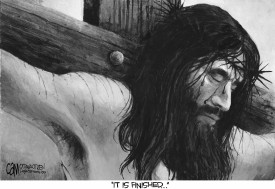
He then does an amazing thing – still remembered and talked about 2,000 years later. He determines the price of bringing the two parties together, and pays it himself – sacrificing his interests for theirs, sacrificing his life so that others might have it more abundantly.
This chapter ends with the Mediator inviting, not compelling, the alienated parties to make an out-of-court settlement – by accepting his sacrifice on their behalf. God indicates his acceptance by raising the Mediator from the dead.
Man is left free to choose: to be reconciled to God and his fellow man by accepting the Mediator’s sacrifice, and emulating it in his relations with others; or to reject it, and then to pursue conflict – or resolve his conflicts some other way.
The story then continues, for another 2,000 years and counting. The next chapter is the story of the three great streams that flow from those choices.
Choose ye this day
One stream comprises those who reject reconciliation and deliberately choose to pursue the path of conflict, from the Roman Emperor Caligula to Hitler, Stalin and Mao Zedong in more recent times – and including all those who choose conflict over reconciliation, whether the conflicts are big or small, personal or international.
The second stream comprises those who seek peace and conflict resolution by means other than those provided by the Mediator – from religions based on other rules and practices to the secular mediation and new age spirituality of our time.
But there is a third stream, comprising those who actively seek reconciliation with God – and conflict resolution within their own families, businesses and communities – by accepting anew the Mediator’s sacrifice, and by applying anew his approach to the conflicts in their own lives.
This stream is personified in different ages by such diverse figures as the apostle Paul, Augustine, Luther, Calvin and Wesley, and by Dietrich Bonhoeffer, Billy Graham and Mother Teresa in our time.
As a husband and father, as a management consultant and politician, I have studied many different approaches to conflict resolution, and I disparage none of them. Jesus said “Blessed are the peacemakers, for they shall see God.”
But when it comes to choosing that approach which best addresses, at their most basic level, the conflicts with which I am concerned, this is the story and path to peace that I find most compelling – and which I commend to all those who wrestle with conflict at home, in politics or in the marketplace.
Preston Manning is president and CEO of the Manning Centre for Building Democracy (manningcentre.ca). Reprinted, with permission, from the Spring 2009 issue of Business Life.
March 2010
|