|
By Jim Coggins
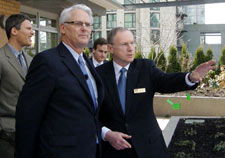 | |
B.C. premier Gordon Campbell (left) listens as More Than a Roof
director Lorne Epp describes the new facility at Kindred Place. |
A CHRISTIAN non-profit organization is increasingly at
the heart of British Columbia’s social housing strategy.
In 2007, the B.C. government announced it was
constructing 12 social housing complexes in Vancouver.
On March 17, it announced that six of those complexes
have gone through the design, permit and tendering stages, and that
construction will begin soon. The announcement was made by Premier Gordon
Campbell, Vancouver Mayor Gregor Robertson and federal MP Andrew Saxton.
The setting for the announcement was Kindred Place, a
complex operated by More Than a Roof (MTR) Mennonite Housing Society. MTR
was founded in 1984 by Mennonite Central Committee British Columbia. It now
operates nine social housing complexes, and has developed a level of
expertise that has gained it the respect of governments.
Construction of Kindred Place on Richards Street in
Vancouver was begun in 2007, and the 87-unit complex is now filling up with
its first residents.
The residents come from a waiting list of people
needing housing, which was compiled by B.C. Housing, a branch of the
provincial government.
The building is modeled on the 63-unit Candela Place a
couple of blocks away, which opened in 2002 and is operated by MTR. One of
the six complexes about to be built is Karis Place, on Seymour Street just
behind Kindred Place, which will also be managed by MTR.
The government will build the six other complexes in
Vancouver and 11 in seven other communities once the permits are in place.
More Than a Roof and some other Christian non-profit organizations will be
involved in some of those projects as well.
The residents of the three MTR complexes in downtown
Vancouver are designated as “low income urban singles.” Some
have physical disabilities, and receive rooms modified for wheelchair
access. Some have mental health issues, and receive on-site support from a
health professional. Still others have overcome drug or alcohol addictions.
Each resident is given a 340 square-foot bachelor suite
with bathroom and kitchen. The suites are clean, bright, attractive and
functional. The residents pay rent out of their social assistance payments
and other income.
These complexes are joint efforts. The city often
provides the land, the federal and provincial governments provide the bulk
of the funding, and non-profit organizations operate the complexes.
Governments can supply bricks and mortar, said B.C.
housing and social development minister Rick Coleman, “but somebody
has to put the heart into the building.”
Residents of the MTR complexes receive a clean, safe
room – and are incorporated into a community through common areas and
a variety of group activities; this provides residents with the social
support they need.
Vital to MTR’s success, said executive director
Lorne Epp, are the support staff – who work for less money because
they have a “Christian service mindset,” and dedicate their
lives to helping people. Finding these people does not come through
newspaper ads as much as through personal contact with people – and
discovering “a mutual sense of calling.”
Continue article >>
|
Especially encouraging is that some of the staff are
former residents of MTR complexes – people who come with “total
buy-in” to the program.
The B.C. government used the March 17 news conference
to announce a variety of capital spending projects, amounting to $800
million. It is not often that such announcements are accompanied by prayer.
but, Adam Wiggins was asked to do just that.
Wiggins, pastor of Pacific Church, a Mennonite Brethren
church plant which meets a few blocks from Kindred Place, reminded those
present that Jesus “brought good news to the poor.” He prayed
the social housing complexes would be “places of healing and
hope.”
While the politicians were holding their press
conference at Kindred Place, a handful of protesters were demonstrating on
the vacant lot across the alley.
Streams of Justice (SOJ), a Christian social action
group, staged a two-day demonstration, walking to all 12 proposed social
housing sites in Vancouver to raise awareness of the problem of
homelessness.
SOJ’s Dave Diewert said the government had
promised construction would begin on six of the sites by the end of
2008, adding it has not shown the same urgency in building social housing
as it has in building 2010 Olympic Games venues.
He pointed out there are 10,000 people on the waiting
list for social housing, and “endless postponements prolong the
suffering.”
Since it costs the government $18,000 more per person
per year to care for people on the street, compared to those in social
housing, it would save money if the complexes were built more quickly.
While ministries such as MTR “work on
practicalities,” Diewert sees his organization as having a different
ministry – examining structural issues, walking in solidarity with
the disempowered, and calling leadership to account on issues of justice.
April 2009
|