|
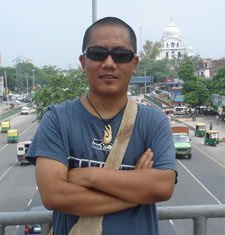
By Lalpi Guite
 I AM a tribal boy who has seen the hand of God move in
and through me. I AM a tribal boy who has seen the hand of God move in
and through me.
I was born in a little town called Churachandpur
– locally known as Lamka; it is in the state of Manipur, in northeast
India.
I belong to a small hill tribe called Paite. We were
known to be a nomadic head hunting tribe until the gospel of Jesus Christ
came through missionaries about 100 years ago. There are less than 100,000
people who speak my dialect in this world.
Not forgotten by God
I find it amazingly comforting when I reflect on how an
unknown, forgotten tribe was not forgotten by God. He sent his messengers
to bring us the good news.
My maternal grandfather was one of the first converts
from the tribe. He suffered much taunting and persecution from his
tribesmen as a result, because he was considered a traitor. “Men, cut
your hair. Stop drinking. Stop worshipping spirits, and turn to
Jesus” was his message.
I got my name from my grandfather. Lalpi Guite means
‘Magnificent King.’
When we were kids, our parents were very keen on
teaching and leading my brother, sister and I in the path of Christian
life, doing the best they knew how. And as a preacher’s daughter, my
mother was extra zealous when it came to faith issues.
I remember being taught memory verses from the Bible
when we were very young. And we learned to read the Bible in our own
language much earlier than kids our age, which was not easy. Saying
mealtime and bedtime prayers were a must.
Suffering of the faithful
As I grew older, I tried to piece together the things
in my life. On the one hand, I learned from my parents and from Sunday
school that God is a good and loving God.
But on the other hand, I saw much suffering, even in my
grandfather’s household – despite him being a faithful and
dedicated follower of a powerful, loving God.
Grandpa had been widowed three times. Some of these
deaths happened while he travelled village-to-village, zealously sharing
his newfound faith and hope with his tribesmen. I could not, in my young
mind, resolve how a loving God would allow such a horrible thing to happen
to his servant.
The area I lived in was a hotbed of the drug trade. It
was part of a ‘highway’ going from south Asia’s
opium-producing Golden Triangle, through the porous border with Burma and
into India.
It is a known fact today that my part of the world has
a very high percentage of injecting drug users – and consequently,
thousands of people living with HIV.
Drugs for all
Drugs were easily available for anyone, of any age,
when we were kids. I tried out hard drugs very early on in life. By age 12,
I had already graduated to heroin.
I was partially motivated by curiosity, but also by a
deep longing to belong. Peer pressure is strong at that age, and especially
strong for a tribal boy – because life is all about being loyal to
your friends, your tribe.
When I was 14, one of the boys I used to hang out with
died of a drug overdose. That was the first OD that I remember hearing
about. The death scared all of us for a time; but this fear did not last
long, as our habits and dependence on the drugs increased.
There was much that was sacrificed along the way. Very
soon, teenage deaths and drug overdoses became a very common occurrence in
the neighbourhood.
By age 16, I was using a cane to support myself when
walking. This was due to my lack of care for myself – and perhaps
also due to side effects from all the drugs I had abused.
Over the years my family prayed and did what they
could, by introducing me to spiritual leaders and other people who could
help me. They also sent me to camps, in the hope that I would seek and find
help.
Heroin panic
I was in one such camp at age 17. One day, I sneaked
out and took a shot of heroin in the toilet. But as I pulled the syringe
from my arm, I could feel my face swelling up. Instead of the
expected nice calm high, it sent me on a panic spiral.
My face swelled shut, and I was rushed to the hospital.
Despite the doctors’ attempts to save me, judging from my appearance
it didn’t look like the medication was helping.
Continue article >>
|
Looking into the mirror, I saw how ugly I looked. I
felt I had a glimpse of my inner person, my helplessness and my desperate
need for help from someone higher than myself.
The next day, I prayed to receive Jesus, and asked him
to come and reign in my heart. Immediately, the swelling on my face
subsided. There was a new birth of hope and purpose in my life. I had never
felt so clean before. Cold turkey and heroin withdrawal symptoms went away,
just like that.
Having set out to be a follower of Jesus, I had much to
learn about him, life and myself. Christian life does not end at kicking a
habit. It’s about learning to know and worship God for who he is.
There were moments of utter disgust for things I had
done. But a humble gratitude would sweep in with the revelation that the
love of God covers my sins. I found strength in the truth that I could come
to God just as I was, and look him in the eye.
Not free of struggles
This did not mean my life was suddenly free of
struggles, however.
In my mid 20s, my roommate drowned; and just five or
six months later, another friend died of a drug overdose. The shock and
grief, as well as having to take care of details like the post mortem and
the funeral, wore me out emotionally.
For a period, it was a struggle to even pray. I
condemned myself as a bad Christian for not having enough faith, for not
praying.
While consumed with these emotions, one day I went off
to the beach. It was there that God spoke to me, through Isaiah 42:3.
He spoke to me of how he does not disregard the small
and insignificant – and how I could come to him even in my most
fragile and confused state of faith.
I wrote a song called ‘Count on You,’
there on the beach. It became a personal anthem in the years to follow.
Available to Jesus
I was also reminded, over and over, that Jesus is
no ‘respecter of persons” – but uses anyone who is
available to him.
I moved to Vancouver in the year 2003, and now serve at
Cityview Baptist Church. I also work with OpenTable, a ministry to the
homeless and less fortunate in the city.
Week after week, as I testify and lead worship, I know
that lives do not get changed and people do not turn to Jesus in worshipful
awe, just because of my mantra.
There have been many challenging moments. I’ve
had guys just drop on the floor in the middle of my sharing, because they
were too intoxicated. One fellow chose to call Jesus ‘Albert’
– “because it’s more personal,” he said.
Another broke down and cried in the middle of my
scripture reading, and said: “I do not believe in that because the
pope does not believe in it.” Despite these kinds of challenges,
we’ve seen faith commitments and baptisms over the years.
When ex-cons call you up to say “We are running
about five minutes late, please do not start the prayer without us,”
you cannot help but believe God is doing deep work in the lives of these
folks.
While some might dismiss this congregation as a group
of misfits and welfare cheque dependents, we have sponsored an African
child in Burkina Faso through Compassion Canada for over a year. At Easter
this year, we are hoping to sign up for our second one.
Lalpi Guite is pastor of worship and community at
Cityview Church. Contact: lalpi.com.
April 2009
|