|
By John Hainsworth
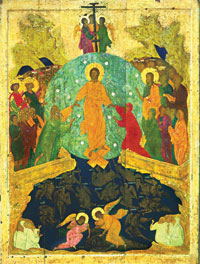 | | Jesus on the third day - and this changes everything. |
MANY Christians in the West have no idea that the
Eastern Orthodox Church exists.
Orthodox Christians in North America – home to
only about one percent of the world’s 300 million Orthodox –
are accustomed to answering big questions:
“What is Orthodoxy? Do you believe in the
Bible?”
And this is perhaps the most common question:
“How come I have never heard of you before?”
Orthodox people often find themselves echoing
Philip’s plea to Nathaniel: “Come and see!”
In the season of Holy Week and Easter, Orthodox
churches everywhere play host to folks who are checking out these services
for the first time.
The city of Victoria is no exception – and of
course, the doors of our Orthodox churches are always open to all, and not
just at this time of year.
But your first experience of any Orthodox service can
be pretty overwhelming – this is, after all, the Eastern Church
– and the Holy Week and Easter services are overwhelming even
by Orthodox standards! Here are just a few things to help you as you attend
your first Orthodox ‘Easter’ service.
Pascha
Chances are you will not actually hear the word
‘Easter’ in Orthodox churches. Rather, the Orthodox will almost
always use the word Pascha for the feast of the resurrection of Christ, as we have since
about the time of the Lord’s ascension.
‘Pascha’ is the Greek transliteration of pesach, which is the Hebrew
word for Passover. From apostolic times, the Orthodox celebration of the
resurrection has been framed within the story of the Passover in Exodus.
The original Passover is the prophecy for the true
Passover, which Christ would accomplish through his death and resurrection
on the third day.
This is why Christ died on Passover, and why he
celebrated the Passover supper with his disciples. He was saying, basically:
“The event we celebrate is only a prophecy, a model of the event
which I am now bringing to reality before you.”
As the Israelites were enslaved to Pharaoh, the world
was enslaved to sin; as Moses came to be the deliverer, so came Christ, God
himself, Immanuel.
As the lamb was slain and its blood saved the
Israelites, so Christ’s sacrifice saved the world from sin and death.
Moses was the type; Christ is the fulfillment.
Feast of feasts
There are 12 major feasts celebrating Christ in the
Orthodox year – and Pascha is not among them! Pascha is too big; it
is the Feast of feasts, and it gives meaning to everything else we do and
believe.
So, like the woman in the gospel pouring costly oil on
the Lord’s feet, we spare nothing in our love and response to his
glorious resurrection.
Continue article >>
|
We fill our churches with flowers, strew the floors
with basil leaves and rose petals, clad the clergy in gleaming white
embroidered vestments, sing heart-aching theological poetry set to
beautiful music, process out into the night with candles, incense and
icons, issue wall-shaking cries of ‘Christ is risen’, and read
aloud the gospel in many languages – our hearts radiant in the
presence of the risen Lord.
Then there is the fellowship meal, or trapeza, after the paschal
services, which continues into dawn – tables laden with food and
drink, red-dyed eggs and decorated bread, and everyone in bright (or white)
festive clothing.
No other feast of the church comes anywhere close to
the extravagant, colourful and loud celebration of Pascha.
Eighth Day
From about 70 AD, the Orthodox have called the day of
Pascha the Eighth Day. This is because Christ was raised from the dead on
the first day of the week (Sunday). This day quickly came to be experienced
as the first day of the new creation, the day which has no evening, the day
of the kingdom, the everlasting day of God.
For the Orthodox, the resurrection is not a postscript
to the crucifixion, and the crucifixion is not just about his suffering.
Christ’s suffering, without death, is meaningless; and his death,
without the resurrection, is empty. But God raised Jesus on the third day
– and this changes everything.
Now his birth unites God and man in himself, since he
is perfect God and perfect man. Now the word of the cross has become the
word of love.
Now his death on the cross has ‘put death to
death,’ since death “took in a body and encountered God,”
as St. John Chrysostom says in his exquisite Paschal homily.
Death itself is abolished, and Christ has become the
first fruits of the new creation.
We can preach and celebrate all of this not because it
happened once upon a time, but because it has been accomplished for all
time.
Thus, when the Orthodox speak of Pascha, the
resurrection of Christ, it is always in the present tense: “Christ is
risen!” the priest cries out.
From the nave of the church the people, the royal
priesthood, joyously respond: “He is risen indeed!”
Fr John Hainsworth is priest of All Saints of Alaska
Orthodox Church, in Victoria.
For more information about Orthodox Services of Holy
Week and Pascha, go to: www.orthodoxvictoria.ca.
April 2009
|