|
By Gary Bennett
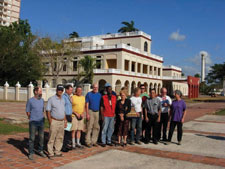 | | Members of the Cuba Mission Team from Victoria First Church of the
Nazarene are seen here with Oscar Saname (centre), the Communist Party
representative for religious affairs in the Province of Camaguey. |
WHEN I hearken back decades ago to my involvement in
‘Christians and Communists’ – that Friday night activity
which still is, amazingly, a perennial favourite among some local church
youth groups – I realize that some of those old Cold War stereotypes
are hard to kill.
You could probably imagine some of my preconceptions,
as I travelled recently to Cuba with a team of 12 adventurous crusaders
from the Victoria First Church of the Nazarene.
When entering a communist country with the intent of
advancing the gospel of Jesus Christ, one could expect engaging in at least
a certain degree of high stakes drama, a sprinkling of evangelical
espionage, and perhaps even a dollop of sanctified skulduggery.
But before we could say “Move over, Brother
Andrew!” we found an incredibly wide-open door to Christian ministry
and service in Camaguey.
Splitting the distance between the far reaches of
Havana and Guantanamo, the city of Camaguey – the capital of the
central Cuban province of the same name – was the location for our
two week Work & Witness mission.
In the autumn of 2008, this area was hit by three
hurricanes and a major flood. Our objective in Camaguey was to assist in
the construction of a church building for the Saratoga Church of the
Nazarene.
Rather than going the regular tourist route, our church
contacts in Cuba had advised us a couple of months in advance of our visit
to apply to the Cuban government for ‘religious’ visas. We did,
and those visas were waiting for us when we arrived at the Holguin airport.
There would be no travelling beneath the radar screen
this trip. Not that we really expected that. After all, our 30 suitcases
chock-full of baseball equipment, construction tools, sewing machines,
medical supplies, wedding dresses, Spanish Bibles, bicycle parts and guitar
strings were somewhat hard to ignore.
While in Camaguey, we had the privilege of worshipping
in three different churches: the Saratoga and Jayama Churches of the
Nazarene, and the Hallelujah Temple Pentecostal Assembly. With the capable
assistance of my young trusty interpreter, Augusto, it was a thrill for me
to preach to all three congregations.
The church in Cuba is definitely not an underground
movement. Reinforcing that fact are the two most prominent pieces of
ecclesiastical furnishing in a typical Cuban church: the P.A. system
and the drum kit.
Through open windows, loud strains of joyful
salsa-flavoured worship punctuate the bold claims of the gospel, as they
are literally blasted out into the surrounding community.
People walking along the surrounding streets, or
sweeping the entrances of their homes, or enjoying a good cup of strong
coffee on their small balconies cannot ignore the presence of the church in
their community.
Cuba recently celebrated the 50th anniversary of the
revolution which established Fidel Castro as its leader in 1959. From the
early years following the revolution, there are stories which chronicle the
hardline stance of the communist government against the church.
Continue article >>
|
One of our hosts, Pastor Samuel, told us of the time
his uncle (also a Nazarene pastor) was imprisoned for six months for
carrying his Bible onto a bus. Pastor Benjamin, of the Hallelujah Temple,
in the early years of his ministry, was beaten and injured by several
people who were antagonistic to the gospel. But at their trial, in a spirit
of grace and forgiveness, Pastor Benjamin refused to bring charges against
them.
These are just a couple of examples of religious
persecution faced by Cuban Christians in the early years following the
revolution. But we were told by our hosts that things changed for the
better from around 1982.
They couldn’t give me a specific event or a
reason for the change at that time, but attributed it more to the fact that
a generation had passed since 1959, and that the government was taking an
increasingly more relaxed and accepting approach to the role of the church
in the lives of Cubans.
One of the most incredible experiences of our two weeks
in Camaguey was being invited to the office of Oscar Saname, the Cuban
Party Representative in Charge of Religious Affairs for the Province of
Camaguey.
For our visit, Mr. Saname was flanked by two Cuban
pastors: the Venerable Juan Antonio Gonzalez Rodriguez, an Episcopal Church
minister in charge of a fraternity of pastors of different denominations in
Camaguey; and Pastor Esther Quintero, an 81year old Pentecostal minister in
charge of the Council of Churches in Camaguey.
They met with us for more than an hour, answering our
questions, serving us coffee and cold water, and thanking us for the work
we had come to do. At the end of our meeting, I asked Mr. Saname for the
opportunity of praying a prayer of blessing on him and those with whom he
worked and represented. He graciously granted that request.
Doors are opening. God is on the move in the lives of
his people in Cuba. The inscription in one of the churches we visited said
it all: Cristos Por Cuba – ‘Christ for Cuba!’
Gary Bennett is the head pastor of First Church of the
Nazarene in Victoria.
April 2009
|