|
By Shara Lee
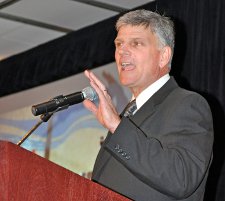 |
| Franklin Graham in Langley March 12. |
The prime mover of Rock the River (RTR) is Franklin Graham. The son of
evangelistic icon Billy Graham, he has made his own unique mark in the
Christian community – and in the larger world, through his Samaritan’s Purse humanitarian organization. Graham was in Langley March 12, promoting the
RTR Fraser Valley initiative, and spoke to BCCN.
BCCN: Tell us about Rock the River. For example, where did the name come from?
Franklin Graham: Well, we started last year. We thought, “Let’s go up the Mississippi River – start in Louisiana and go all the way up to Minnesota. Go to all the population
centres – and let’s have an all day youth concert, and make it evangelistic.”
What I mean by evangelistic: we go for an hour and a half of head-bangin’ music; I get up, preach, and give an invitation. At the end, we had Flyleaf.
When it was all said and done, [lead singer Lacey Mosley] turned to those kids
out there. She said, “God loves you and God wants to be your father. He wants you, and he wants to
have a relationship with you and you can have that relationship right now.”
She’s a little preacher. Every time I gave an invitation, kids got saved.
The kids that came to this thing, a lot of them are not Christian kids. There
are kids out there, you know, smoking cigarettes – but those are the kids we’re wanting to reach.
We’re wanting to reach kids that have never been to church, know nothing about God.
And where we live now in our secular society, we have a generation of kids who
know nothing about God – absolutely nothing about God. Their impressions of God are not good, because of
what they’ve heard from mainline media, from what they’ve heard from schools.
[They’ve heard] that God isn’t real, he’s just a part of some people’s imagination – and that all God is trying to do is control you, to keep you from having fun.
And he doesn’t want you to have sex, and he doesn’t want you to drink or do drugs – and so God is not a partier. “And so, why do I want to follow God?” That’s what they think, and that’s what they know. I want them to know that God loves them. And God is not there
with a stick to beat them . . .
I think everybody likes music, and we’ve got these bands that kids like – and I use these bands as a magnet to draw kids . . .
Let’s do something all-out, just for the kids. Now if the adults want to come and
have that head-bangin’ music, then they’re invited. Come on, but bring your earplugs – it is loud.
BCCN: Are the bands all Christian?
FG: They are; but you see, Lacey and Flyleaf – that’s not a Christian band, it’s a secular band. They open for Korn, a hard rock group. Everybody in the band
is Christian, but they don’t play Christian music . . .
BCCN: As a young person, you went through a ‘rebel’ phase. How does your rebellious past play a part in how you reach out to non-
believers?
Continue article >>
|
FG: It’s not so much that I rebelled. It wasn’t that I didn’t believe in God, I did. It wasn’t that I didn’t believe in Jesus, I did. But every demon in hell believes in Jesus, too. Just
like the demons in hell, I didn’t want Jesus to be the Lord of my life.
I wanted to party, I just wanted to have fun. I thought that if I gave my life
to God, I’d be in some kind of spiritual straitjacket – and I didn’t want that, I wanted to be free. But I found that the freedom that I was
searching for was enslaving me. And I wasn’t fulfilled, there was an emptiness in my life.
Kurt Cobain, that rock guy who died, he left a suicide note, and he talked about
a great big empty hole that had opened up in his life. Drugs couldn’t fill it, sex couldn’t fill it, alcohol, fame, women – it didn’t fill the vacuum in his life. And so he took a shotgun, and he took his life.
And I think there are millions and millions of kids today who have that big
black hole in their life. They try to fill it with drugs, sexual relationships,
looking for money, thinking: “If I could only find this or that, that could make me happy.”
And you know, some people are fashion people. They think, “If I can get the latest fashions, this will make me happy, ‘cause I’m gonna look good.” They get that, but it doesn’t satisfy them.
They think these things will make them happy, but it doesn’t. There’s an emptiness. The reason there’s an emptiness is because there’s a vacuum, a void – that can only be filled by God himself . . .
I was 22, when I got on my knees one night, and I just said: “God, I’ve sinned. I’m sorry, forgive me. I do believe Jesus Christ is your Son . . . If he can take
the pieces of my life and try to put them together, it’s yours, go at it. But I take my hands off, from this day forward.” And I prayed that prayer, and I meant it.
BCCN: How does that experience shape the way you minister?
FG: It doesn’t matter what generation we come out of. There are different influences on our
lives; the music today is different than the music when I was growing up. But
the problem is that we are lost when we get separated from God.
I just want to try and reach kids today – and I’m 57 years old – that normally would probably never come hear what I have to say.
But they’ll come hear Flyleaf, or they’ll come hear some of these other groups that are playing. And I’m gonna get up and preach to them. And when I preach to them, I don’t talk long – 15 minutes, 12 minutes.
And I give them the truth. And guess what: kids today want to hear the truth . .
.
BCCN: What would make Rock the River a success?
FG: If a kid gives his life to Christ. But for him to be successful, its gonna take
the churches, the pastors committing to it, the youth pastors committing to it,
the Christian kids inviting their unsaved friends to come.
It’s not just Franklin Graham coming in and renting a piece of property and
bringing a bunch of bands with him. It has got to be a concerted effort . . .
It begins with prayer – churches praying, moms and dads, grandmothers and grandfathers praying for their
unsaved grandchildren.
It’s Christian kids caring enough about the souls of their fellow students,
realizing that they are going to hell – they’ll be separated from God. This is the opportunity where maybe these kids will
listen . . .
I can bring all the cool bands, and come up here – but it’s not gonna work if we don’t have the prayer behind it, the churches praying. The pastors, the youth
pastors and the Christian kids have got to take hold of it.
April 2010
|