 |
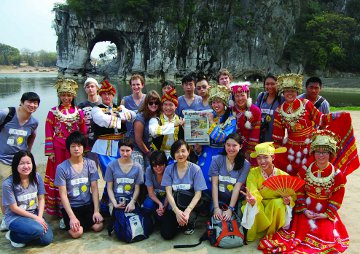
| Carver Christian High School students pause during their recent trip to China.
Note two in the centre, holding up a copy of Burnaby Now. |
By Grace Lo-Voo
THE Guangxi Autonomous Region is one of the most beautiful areas in China.
Noted for its mountains and rice terraces, Guangxi has a rich cultural history.
But there is also a dark side to the area. Some parts of this province are
officially labeled “poverty- stricken” by the government.
I was there from February 27 to March 10, leading a group of grade 11s from Burnaby’s Carver Christian High School.
I recalled standing in awe of God’s majesty and beauty while visiting this place for the first time in 2001. He
has, since then, placed in my heart a compassion for ministering to China
through various other opportunities.
The families of many students living in the Guangxi region are farmers with very
low incomes.
We were able to meet some of these people, who shared their stories with us.
We learned that, although China provides nine years of free education, many
students still did not attend school because they cannot afford the costs of
room and board, textbooks and supplies.
Our students were scheduled to teach English in the local secondary school for
seven days. Even though we did not get to do this as planned, God had his own plans for our
team.
We were notified that the government in the town we were going to did not want
any foreigners in their schools during the 2010 National People’s Congress meeting – which was happening the same week that we were there.
Instead, we taught the same lessons to children in a ‘Three-Self Patriotic Movement’ church. The first night, 28 kids showed up; and by the last night there were
more than 80 children. The word had spread, and many came to see this group of ‘foreigners.’
In China, it is illegal to openly evangelize children under the age of 18; and
so it was a blessing for this church to have us naturally draw the children in.
God is working through the Three Self Churches in China, though the government
has a hand in the day-to-day routine of church life. It was eye-opening to see
how the pastoral team and the congregation trust God to provide and protect
them in such an oppressed society.
What caught my eye when I first entered the church building was that the
congregation consisted mainly of women and young children.
There were also a few men, but I was told the reason it was okay for them to be
seen at the church was because they did not have good jobs to lose. Educated
citizens who wanted to move up in society would not dare to be associated with
any religion.
Continue article >>
|
I was told by the local pastor that there are increasing cult activities in
their region.
Government authorities often tightly control religious practices – and when cults are shut down, the government treats all religious activity
alike.
Many Chinese Christians also meet in ‘unregistered’ house church meetings. We were able to meet members of some of these churches,
and hear their testimonies.
Our team had the chance to visit two seniors’ homes in Guangxi. We were shocked when we saw the first home.
The conditions were harsh. The lighting was dark, and the deafening sound of
pain echoed against the bare walls. Many of the seniors were immobile; they
were bound to their beds like prisoners, until death.
Even though this place was filled with despair and hopelessness, we were able to
convey God’s love, comfort and hope through laying on hands and praying for the elderly. We
left each of them a bookmark imprinted with the Chinese word for ‘Love’ and 1 Corinthians 13.
In certain areas of the building, when we could not use words to intercede,
students sang “Jesus loves me, this I know.”
As we were leaving the dark building, a middle-aged man came running toward the door. He wanted to thank the group that
had prayed for his father at the very moment he was going through psychological
pain.
He knew our visit had brought his father peace; his gratitude was very moving.
He admitted he wanted to know more about the verse written on the bookmark we
had left. He said both his parents had been staying in the building for a few
years, and had never seen such love brought into the depressing facility.
One of the most touching parts of our trip was when we visited the Disabled
Children’s School. The couple that started the school have a heart for such youngsters.
If not for them, these disabled kids would not have had a chance to go to school
– because such facilities are very poorly funded by the government.
Our students painted their dormitory walls with beautiful cartoons and
paintings, which will hopefully bring the children joy.
Officials from the religious department visited us a couple of times during our
trip. The students were prepared to be careful of what they said during their
presence.
When we visited a village church, I was able to lay hands on an official who
came to monitor us, and pray for him. It was an honour for our team to have the
chance to pray over him, because local Christians normally would not have been
able to openly pray like that.
So, what did we learn from this trip?
We learned, above all, that God is still in China. He never left. He allowed us
to feel a bit of what it is like to be oppressed as a Christian, and how much
we take our freedom for granted. God protected our team. Students learned the
importance of prayer and missions. The gospel became real to them.
My faith has been strengthened through seeing God work in my students’ lives.
I never imagined I would ever partake in the sacraments of our Lord Jesus with a
church in China. But God made it possible!
Grace Lo-Voo is vice principal at Carver Christian High School.
April 2010
|