|
By Frank Stirk
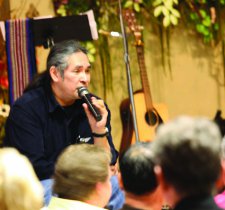 |
| Cree Christian Kenny Blacksmith
speaking in Edmonton last month. |
MOMENTS after Prime Minister Stephen Harper formally apologized and asked for
forgiveness for the federal government’s catastrophic residential schools policy, native leader Elijah Harper and 100 Huntley Street’s David Mainse went down to the Speaker’s Chair in the House of Commons.
“We knelt down at the chair and prayed together,” the aboriginal icon said at the time, “and I expressed my forgiveness in my prayer.”
That was on June 11, 2008. This spring, a team led by Kenny Blacksmith,
co-founder of Gathering Nations International and former chief of the Cree
community of Mistissini, Quebec, is travelling the country urging his people to
accept the Prime Minister’s plea.
It is time, Blacksmith believes, to forgive the wounds that so deeply scarred
Canada’s First Nations peoples; they and many of their descendants still bear those
scars.
Blacksmith’s cross-Canada trek began in late January at Westwood Community Church in
Coquitlam. It will climax at the National Forgiven Summit in Ottawa, that
begins on the second anniversary of the government’s apology.
“We’re asking our people,” said Blacksmith, “to seriously look at your life and see and understand your bondage to offence,
your bondage to unforgiveness. And then when you recognize you can’t do it by yourself, surrender to God and ask God to help you and enable you to
release forgiveness.”
There is much to be forgiven – so much, in fact, that many First Nations, Inuit and Metis people feel it is
impossible for them to forgive.
As Harper noted in his speech, the policy involved nothing less than an attempt
by the government to “kill the Indian in the child” by forcibly separating children from their families, culture, language and
heritage.
For almost a century, tens of thousands of young children were sent to one of
132 residential schools, including 18 in British Columbia. Most of the children
suffered abuse, and many of them died.
By one estimate, there are still some 14,000 residential school survivors in
B.C. out of perhaps 80,000 nation-wide, making it the second-highest survivor
population in Canada.
The majority of the schools were operated as joint ventures with Anglican,
Catholic, Presbyterian and United churches and organizations. All have since
apologized for their part in this tragedy.
Michael Cachagee spent 12-and-a-half years of his childhood at an Anglican
residential school. He said he has personally forgiven the church and the
government for what they did to him. But he rejects the corporate act of
forgiveness Blacksmith is seeking.
“Forgiveness is an individual thing,” said Cachagee, who is now executive director of the National Residential
Schools Survivors Society. “I was wronged. They wronged my mother, they wronged my children, they wronged my
grandchildren – if you look at the generational impacts. I don’t know if it’s in my capacity to forgive on behalf of them.”
Continue article >>
|
In aboriginal culture, Cachagee added, it is not possible to forgive an
institution, because “corporations do not have spirits.”
Blacksmith agrees. But said he also chooses to “look beyond the institution.”
“Government is a group of individuals that . . . are elected to represent the
people,” he said. “It is made up of a Prime Minister that’s very much human – he’s got a heart, he’s got a spirit – and he’s speaking on behalf of the people of Canada.”
Blacksmith believes the act of offering Harper forgiveness – even if he declines their invitation to attend the summit – will be liberating. “If he accepts our forgiveness or if he doesn’t, that’s not our problem anymore,” he said. “It’s between him and God. But we are free.”
“It’s the same thing with the church,” Blacksmith added. “For 500 years, they brought these missionaries to our people. Now we’re saying to the church: ‘We understand what Christ did for us. We’re coming to you and we’re saying we forgive. That is your message, and we’re bringing it back to you.’ And it’s up to the church now to do what they need to do with that release of a sincere
forgiveness.”
National Indigenous Anglican bishop Mark MacDonald told BCCN he believes that what Blacksmith is attempting “has the potential of being a prophetic act.”
He elaborated: “I think there’s a strong and growing sense that we’ve now entered into a new era, a God-given time of recovery, release,
reconciliation.
“A word that I hear often is ‘restoration.’ That’s what I feel in the air – that excitement that God is leading us into a new day. And Christian indigenous
people are so much at the heart and the spirit of that.”
“I know that there is some talk within the aboriginal community connected with
the United Church, as to whether it’s time to accept [our] apology or not,” said James Scott, the church’s General Council officer for residential schools.
Just two days after the Forgiven Summit ends, the Truth and Reconciliation
Commission (TRC) – set up by the government as a way to help bring closure to the residential
schools tragedy – holds its first national event at The Forks in Winnipeg.
Cachagee is not sure the TRC will be able to effect reconciliation, but he is
encouraging especially the children and grandchildren of survivors to attend,
to make sure Canadians hear the truth. “What I’m telling them,” he said, “is it’s an opportunity to share in our history. It’s a segment of our Canadian history that’s never, never been told.”
Blacksmith said the summit is also for the sake of the children – to mark the moment when their people moved beyond surviving past injustices to
actually overcoming them.
“Our children will look to that day and say, ‘My ancestors, they stood before the government. They stood before the church.
They stood as a people.
“They recognized who God is in our nation. And they did not back down. And they
believed for the healing of our nation. They believed for a revival in our
people – and the freedom,’” he said.
“That’s what this is all about.”
Contact: i4give.ca and gatheringnations.ca.
April 2010
|