|
By Lloyd Mackey
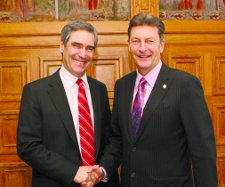 |
| Michael Ignatieff & Liberal MP John McKay. |
THE LEADER of Canada’s official opposition has been striving to cultivate better communication with
people of faith.
For close to a year, John McKay – a Toronto-area Liberal MP with longstanding evangelical Christian connections – has been acting as Liberal leader Michael Ignatieff’s liaison into various sectors of the Canadian Christian community.
McKay told BCCN he is “encouraged and delighted with the reception I have received.”
But he also cautioned that it is almost impossible to know whether there will be
a direct “political payoff” to the Liberals, growing out of his efforts. There used to be, he acknowledged,
but “today is a different era.”
It will be a while – perhaps an election or two – before the party will know for sure.
McKay received the assignment from Ignatieff last spring, shortly after the
former Harvard professor assumed the Liberal leadership. The initiative brought
them to Vancouver in late February.
Ignatieff has an eclectic religious background: Russian Orthodox on one side of
the family, and direct descent from Presbyterian cleric stalwart George Grant
on the other.
Generally, however, he counts himself as an occasional “but not very churchy” attender at worship.
On coming into the Liberal leadership, however, he recognized that, in the past
few decades, some of his party members had become increasingly derisive of
evangelical Christians.
That vitriol was especially directed at Christian politicians with Conservative
or Reform party connections.
Leaders like Stockwell Day were described as “scary,” especially with respect to their pro-life or pro-creationist viewpoints.
The apparent result was that evangelical support for Liberals was waning,
particularly in Ontario. It was falling dramatically from the days when
now-Senator David Smith managed the federal Liberal backrooms.
Smith, a serious Baptist with many family links to Pentecostalism, networked
heavily with his fellow believers.
He often identified Liberal candidates capable of attracting evangelical voters
in swing ridings, where evangelicals might make up 10 percent of the voter
profile. Smith and the late John Munro, a former key Hamilton area Liberal
cabinet minister, worked the network; they built helpful friendships with
people such as television host David Mainse.
In recent years, aware of the apparent Liberal cynicism regarding evangelical
beliefs, Mainse had quietly shifted his encouragement toward Conservative
candidates.
The decline in the number of Liberal seats in rural and small-city Ontario could
be traced to the favour with which evangelicals were viewing the Conservatives.
Continue article >>
|
That happened especially after the merger of the Canadian Alliance and
Progressive Conservative parties. While Catholic voters always leaned Liberal,
even those figures were declining in more recent years.
In McKay, Ignatieff believed he had a good antidote to those declining trends.
A Toronto lawyer, now in his early 60s, McKay had been influential in the
founding of the Christian Legal Fellowship in Canada. He was well able to
articulate both socially and fiscally conservative views.
While articulating strongly why he believes evangelical and Catholic Christians
should be supportive of the federal Liberals, McKay took care not to be
corrosively critical of the Conservatives.
He did caution, however, that what he sees as the current Conservative penchant
to “lock up the pro-Israel and evangelical votes,” as heading in a “dangerous” direction.
Regarding recent experiences in meeting with Christian leaders – with or without his leader – McKay talked about some pleasant “surprises” in the process.
In Vancouver, earlier this year, the main concern was for social housing – something that has been on McKay’s radar since the late 90s, when he was first elected to Parliament.
In Edmonton, he found that a group of ministers with which he met were
interested in immigration and refugee determination issues – something that he would not have expected to be the case in Alberta.
In Winnipeg, he met with leaders and faculty members at Booth College, a
Salvation Army institution. He was told of a sense of disappointment on the
part of the educators, that they heard so seldom from members of parliament – from any party.
Of all Christians, Salvationists have something significant to say about poverty
and justice, McKay pointed out.
An interesting challenge for McKay has been to build networks with Christians
who are unhappy with Ignatieff’s insistence that maternal and child health in less developed countries should
include support for abortion and contraception.
As a pro-life Liberal, McKay would be most hesitant to back Ignatieff on that
matter – although some of his caucus colleagues would take quite an opposite stance.
He emphasized that “I made my own opinions abundantly clear to my leader,” after Ignatieff’s pro-abortion announcement – which was made following a Liberal roundtable on international development.
Earlier reports had indicated that Liberal strategists had recommended Ignatieff
take a pro-abortion stance as a means of establishing a wedge issue among
Conservatives.
All that considered, McKay said he has been enjoying the challenge of networking
on these faith-political issues – and so, apparently, has Ignatieff.
“He enjoys listening and he enjoys the interactions. And he takes notes.”
That last point had been made by one of the west coast clerics with whom they
met. And that seemed to make a good impression, McKay recalled.
“The pastor told me that if someone will not take notes, he won’t express his views.”
April 2010
|