|
By Steve Weatherbe
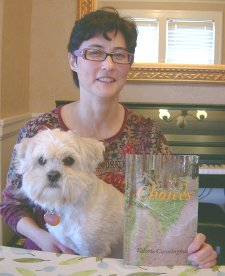 |
| Choices author Valorie Cunningham. |
THE best-selling status of The Shack, by Canadian William Young, indicates a huge hunger for answers to what many
consider the biggest stumbling block to acceptance of Christianity: the concept
that a God of love could permit a world with so much evil and suffering.
Victorian Valorie Cunningham has drawn on her experience as an emergency ward
doctor to write her own fictional treatment of what C.S. Lewis called “the problem of pain.”
Many have told her the book, titled Choices, gives them hope – and that her stories match their own experiences.
“People who feel lost spiritually, who are in pain – this book speaks to them,” she said. Some are agnostics, but Cunningham said a surprising number of the
Christians she meets in her practice “are really, really afraid of dying. I think it comes from a fear of judgment. Of
‘What if I am not good enough?’”
As her title suggests, Cunningham’s main thesis is like Lewis’ perspective: God permits suffering and evil as necessary conditions of free
will – without which life would not be worth living, and without which real love would
not be possible. Choices tells a series of fable-like stories set in different times and places, where people are
challenged to respond to suffering and evil with love.
A mentally handicapped child who is hidden, out of love, by his mother
transforms the lives of all he meets – after she changes her approach, on the advice of a friend, and teaches him to
live in the world.
A boy is dragged into a cruel act against an animal, that scars his psyche
permanently. But that scar leads him to defend a prostitute from being beaten
up – an act that triggers her reformation.
A young girl in Africa escapes from a savage attack on her village with her
little sister, but with both hands brutally chopped off. Their helplessness
allows a series of people to exercise generosity; ultimately rescued by monks,
she is able to let her sister make her own way in life – and she does the same.
“God puts these challenges in front of us in order to teach us about love,” said Cunningham. She didn’t start out with the idea of writing a book; but her experiences – especially with the suffering of infants with major medical problems, and with
the suffering of their parents – led her into serious reflection. Her meditations turned into stories – and the stories into the book.
“You look and see that whole Christian message – that God loves us to an extent you can’t even comprehend. And yet, you look and you see children that are suffering,
and good people that are suffering. And you wonder, as a spiritual person, how
that can happen – and what is God’s purpose in that.”
Continue article >>
|
A member of the Sylvan United Church in Cobble Hill, Cunningham hopes the book
will explain the Christian response to the problem of suffering to
non-believers and members of other faiths.
There is no mention of religion, except for the undenominated monks. But God
appears, each time in a different form, at the end of each life, to debrief the person about lessons learned. In one of
the more telling passages, the Deity explains to the recently deceased that he
had not been alone in his suffering – that God had suffered along with him:
“‘I am with you there, always. I will help you. You have only to ask,’ said God, this time a female.
‘How do we learn this,’ I asked. ‘The knowledge of Your Presence is hidden when we are in human form.’
‘You think so,’ She said, apparently surprised. ‘Many souls have been given knowledge in their human forms and served as my
messengers. I have clothed a part of myself in the form of a human to deliver
this message.’”
So suffering, in Cunningham’s well-told tales, not only teaches the morality of love – but is intended to bring us closer to God.
The author, however, takes the journey to God in a different direction: into
reincarnation. Each of her stories is about the same soul in a series of lives,
learning more about love in each one. And the final story depicts the ultimate
act of love: the protagonist forgives his enemy, who has murdered his family – and then sacrifices his life for him.
The deed is Christlike; but blending it with reincarnation, Cunningham admitted,
“some would consider heretical.”
She explained her belief in reincarnation as her response to the seeming
senselessness of the disease-shortened lives of some children.
“We were taught: if they die unbaptized, their souls are lost. How can that
happen? Where do they go, all those baby souls? So I thought, maybe they are
recycled. What a concept!”
A concept, however, that is contradicted by both scripture and Christian
tradition. Paul’s letter to the Hebrews states: “Man is destined to die once, and after that to face judgment.”
“Christians believe that we are created at the moment of conception. We do not
keep coming back,” responded pastor Gary Bennett of Victoria’s First Church of the Nazarene.
But Bennett conceded that many Christians do not know what to make of pain and
suffering.
“Some teach that being blessed by God means being materially blessed. They equate
the downturns in life with the absence of God. But one of the greatest lessons
we can learn is to experience his presence when things aren’t going so well.”
Choices is on sale at Ivy’s and Koinonia’s bookstores in Victoria, at Gallowglass and Volume One in Duncan, and on
Amazon, for $20. The proceeds go to PEERS, a Victoria organization for the
rehabilitation of prostitutes.
April 2010
|