|
 The following is from a lecture by Preston Manning, president of the
Manning Centre for Building Democracy. It was presented in Ottawa last
February at a seminar on ‘Navigating the Faith/Political
Interface.’ Manning notes that much of his information was obtained
from Adam Hochschild’s Bury the Chains (Houghton Mifflin, 2005). The following is from a lecture by Preston Manning, president of the
Manning Centre for Building Democracy. It was presented in Ottawa last
February at a seminar on ‘Navigating the Faith/Political
Interface.’ Manning notes that much of his information was obtained
from Adam Hochschild’s Bury the Chains (Houghton Mifflin, 2005).
MANY lessons can be learned from a notable
faith-oriented campaign which achieved a great social good: the
emancipation of slaves within the British Empire.
Use the law
Use the existing law, imperfect as it is, to the
maximum extent possible to advance your cause.
The first round against slavery was fought in the legal
arena in the late 18th century. It was spearheaded by Granville Sharp, a
committed Christian (Anglican) who held a minor post in the ordinance
office in the Tower of London. He arranged for the legal defence of James
Somerset, an escaped slave whose former owner was trying to recapture him.
Sharp argued forcibly that the British law allowed no
one to be a slave in England itself.
Lord Chief Justice Mansfield’s carefully worded
ruling set Somerset at liberty without automatically freeing other slaves.
But almost everyone, including many lower court judges, believed Mansfield
had indeed outlawed slavery in England.
Christians should follow Sharp’s example, and use
the current laws. We should also use the Canadian Charter of Rights and
Freedoms, not just criticize the Charter.
Publicize suffering
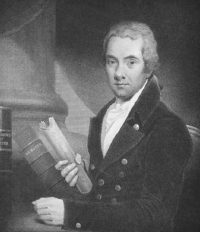 |
| Christian anti-slavery campaigner and politician
William Wilberforce |
Begin your initiative not by moralizing, but by
identifying and publicizing the suffering that the violation of your
principles/ethics creates.
The suffering of slaves in transit across the Atlantic
was illustrated by the Zong case in 1783. The case concerned a slave ship
whose captain threw 136 slaves into the sea, and whose owners filed an
insurance claim for the value of the dead slaves.
The case came up before Lord Mansfield. Granville Sharp
attempted to turn it into a homicide trial, not a civil insurance dispute.
The case illustrates the point that if you’re going to crusade
against an evil, make a start by identifying with the suffering that it
causes – rather than with abstract principles and points of
law.
The Zong case produced no legal victory –
but as Adam Hochschild writes, it provided a “horror
story” to stir public sentiment.
Immediate objectives
Distinguish between your immediate objective and your
ultimate objective – and proceed incrementally, rather than
taking an all-or-nothing approach. Hochschild notes the
abolitionists’ decision to make the immediate objective one of
abolishing the slave ‘trade’ rather than slavery itself.
Hochschild recommends that activists “legitimate
the discussion” of their issues in public and political arenas where
it is still taboo. One way to do this is by proposing an innocuous rather
than provocative introductory resolution.
A good example is MP William Wilberforce’s
initial resolution “that the House will, early in the next session,
proceed to take into consideration the circumstances of the slave
trade.”
It is also helpful to be inclusive rather than
accusatory in your language, in describing the evil to be remedied. In his
introductory speech on his slave-trade resolution, Wilberforce declared:
“I mean not to accuse anyone, but to take the shame upon myself, in
common, indeed, with the whole Parliament of Great Britain, for having
suffered this horrid trade to be carried on under their authority. We are
all guilty – we ought all to plead guilty, and not to exculpate
ourselves by throwing the blame on others.”
Improve language
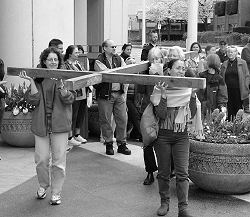 |
| Starting at Vancouver’s First United Church, the
21st annual Good Friday Stations of the Cross made stops at landmarks such
as Canada Place and The Women’s Centre. These contemporary
‘stations’ were designated as “cross-sections of the
struggles of justice and evil over the course of the last year.” The
event ended at the 2010 Olympic Clock – which was renamed the
‘Homelessness Action Clock.’ Photo: Al McKay |
Change your language, if necessary, to suitably present
the issue. Thomas Clarkson (a divinity student and committed evangelical)
won a 1785 essay contest, which asked the question: “Is it lawful to
make slaves of others against their will?”
He became the apostle Paul of the anti-slavery
movement; without Clarkson there would have been no movement.
Quaker abolitionists undertook to publish his essay in
1786. This demonstrated the importance of finding the right language.
One of the things which hampered the Quakers’ crusade against
slavery was that they spoke and wrote differently than most other
Englishmen – using “thee” and “thou”
and other quaint phrases.
Clarkson and Granville Sharp (who were not Quakers)
changed the language of the campaign, improving on the archaic language of
the Quaker abolitionists.
Embody the cause
Find articulate spokesmen who literally
‘embody’ your cause.
A freed slave became a striking and articulate public
advocate of abolition of the trade. Olaudah Equiano published his
biography, and went on a great political book tour.
Nothing is more useful to a cause than a person who
seems to embody it. Ask yourself: “Out of whose mouth would our
message be most credible?”
Attack myths
Identify and attack the ‘myths’ which
sustain the status quo and opposition to change.
One of the myths which sustained the slave trade was
the idea that it provided, as Hochschild puts it, a “useful nursery
for British seamen.”
The abolitionists attacked the falsehood that the slave
trade somehow was a good training ground for sailors; in actuality, 20
percent of the crews of slave ships died on their voyages.
Continue article >>
|
Utilize democracy
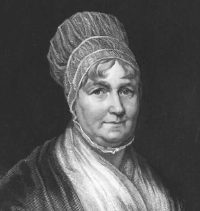 |
| Quaker Elizabeth Fry spearheaded the movement for prison reform in Britain. |
Utilize the tools which democracy, however flawed,
gives you. The anti-slavery advocates used freedom of speech and the
freedom to petition Parliament, even though most of the British population
at the time did not yet enjoy the vote.
The anti-slave-trade committee pioneered several tools
used by civic organizations today:
• Direct-mail fundraising and pamphleteering.
• Striking symbolism, utilizing Wedgewood’s
special line of china showing a kneeling African with chains uplifted and
beseechingly asking, ‘Am I not a man and a brother?’
• Petitioning of Parliament. By 1788, petitions for
abolition or reform of the slave trade had been signed by between 60,000
and 100,000 people.
• Impressive spokespersons, such as ‘Amazing
Grace’ writer John Newton, a reformed slave ship captain.
• Giving voice to the victims: such as Quobna Ottobah
Cugoano, another freed slave who published a book.
Invent tools
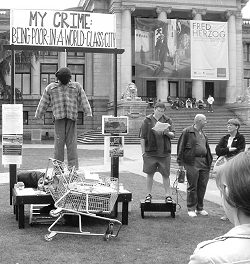 |
| This display was the centrepiece of a vigil conducted
by Streams of Justice at the Vancouver Art Gallery on Good Friday.
The following day, participants returned to make a more positive
statement, according to organizer Dave Diewert. “We used the gallows,
without the rope or hanging man, as a space for kids to draw pictures of a
new reality. It was an enactment of turning swords into
ploughshares.” Photo: Al McKay |
Invent new tools to advance your cause. Abolitionists
discovered a new tactic: the boycott.
The British public started to boycott sugar from the
slave-oriented West Indies, in favour of sugar from India. The boycott was
such a novel idea that the very word would not come into the language for
nearly another century.
At a time when only a small fraction of the population
could vote, citizens took upon themselves the power to act when Parliament
would not. The boycott was essentially the work of women.
Endure setbacks
Be prepared to suffer, and endure major and
discouraging setbacks. In the case of the Society for Effecting the
Abolition of the Slave Trade, these included:
• The insanity of the King, which brought parliament to
a standstill.
• Slave revolts in the Caribbean, which produced fear
and a counter-reaction.
• The French Revolution, which originally raised hopes
– and then dashed them.
• The insidious influences of the
‘gradualists’ in Parliament – who did not oppose
the abolition of the slave trade, but only advocated that it be done
‘gradually.’ As a result, the public wearied of the debate.
• The dominance of the House of Lords, which was
generally hostile to abolition.
• The war with France, which brought all democratic and
social reform in Britain to a grinding halt.
• The lack of a good strategist in Parliament –
which led to Wilberforce’s bills being defeated time and time
again.
Divide opposition
Find a strategy that divides the opposition to your
reform.
The anti-slavery campaign found its much-needed
strategist in James Stephen. One of the Empire’s leading maritime
lawyers, and a prominent authority on international law, he had a visceral
hatred of slavery – born of living in the West Indies.
He devised the strategy of calling for the abolition of
the slave trade with the French at a time when England was at war with
France.
He decided to appeal not to the conscience of the
British parliamentarians but to their prudence – arguing that
abolition was a wise and expedient thing to do.
Stephen called on Wilberforce to draft a bill which
banned British subjects, shipyards, outfitters and insurers from
participating in the slave trade to the colonies of France and its allies.
This linked slavery to the war effort, and split the pro-slavery lobby. The
foreign slave trade act sailed through the House of Commons with surprising
ease – and the bill passed in the House of Lords.
Shift arenas
If you can’t get a favourable decision for your
cause in one arena (e.g. the House of Lords), shift the decision to another
arena (e.g. the House of Commons) where you can get a favourable decision
– and do everything to support reforms which strengthen that
decision-making arena.
The moral/social reformers who opposed slavery made
common cause with the parliamentary reform movement in Britain. The fate of
slavery ultimately depended on whether Parliament would pass the great
Reform Bill in 1831. Thus, moving the decision-making to a chamber more
susceptible to public opinion was a key factor in the anti-slavery
campaign.
The Reform Bill passed Parliament in 1832 –
greatly strengthening the House of Commons vis-à-vis the House
of Lords, and making it more susceptible to public pressure.
Final victory
The Emancipation Bill, completely abolishing slavery
throughout the British Empire, passed both houses of Parliament in the
summer of 1833.
The real victory came August 1, 1838, when nearly
800,000 black men, women and children throughout the British Empire became
officially free. By then, of the 12 men who had been part of the original
committee, only Thomas Clarkson was still alive.
A faith-oriented campaign to eradicate a great social
evil and achieve a great social good – freedom for hundreds of
thousands of blacks – was successful. This was largely because
it was conducted by people operating with the wisdom of serpents and the
graciousness of doves, at the interface of faith and politics. Canadians
who want to conduct such campaigns – to eradicate the social
evils of our time and advance social goods – should study this
campaign backward and forward, until they are able to learn and practice
its lessons.
May 2007
|