 |
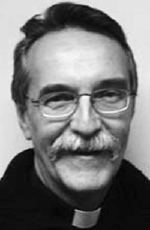
| Anglican Church of Canada general secretary Michael
Pollesel. |
CANADIAN ANGLICANS will soon vote on a resolution which
states that “the blessing of same-sex unions is consistent with the
core doctrine of the Anglican Church of Canada.”
The vote will take place during the General Synod,
which meets every three years, and is the chief governing mechanism of the
denomination in Canada. This year’s synod will meet June 19 –
25 in Winnipeg.
The controversial resolution is one of five on the
topic that were agreed on by the Council of General Synod at a meeting
March 8 – 11 in Mississauga, Ontario. The Council is a smaller body
that serves as an executive between meetings of the General Synod.
The same-sex resolution, if passed, could sever the
Anglican Church of Canada (ACC) from many other national bodies throughout
the worldwide Anglican communion; and it could cause some Canadian members
to leave the church.
Heartfelt debate
Michael Pollesel, general secretary of the General
Synod, told BCCN he
expects “a heartfelt and deeply searching debate.” Noting
Council resolutions are turned down by General Synod “all the
time,” he added: “How it’s going to end, I couldn’t
say.”
One thing Pollesel said he is sure of, however, is that
“there will be pain. From what I can see, it’s a no-win
situation.”
Changes to official ACC doctrines must be approved by a
two-thirds majority of laypeople and clergy, voting at two General Synods.
One member of the Council observed that this would be “very hard to
achieve.”
Archbishop Andrew Hutchison, primate of the ACC,
suggested the 2007 synod should make a clear decision and not put the
matter off another three years – which a canonical change would
require.
The Council thus concluded that the issue is a matter
of “pastoral discipline” rather than doctrine, and that it
could therefore be dealt with by the simple statement that blessing
same-sex unions “is consistent with the core doctrine” of the
ACC.
Pollesel said the resolution would likely be understood
to be in opposition to the Tanzania Communique, in which the primates
convening in Africa earlier this year gave the U.S. branch of the church
until September 30.
Pollesel said conservative primates might well decide
they are no longer “in communion” with the ACC – or with
the Episcopal Church of the USA, which recently voted to defy the Tanzania
Communique.
Jurisdiction
Pollesel noted the other primates have no authority to
expel the ACC and Episcopal churches from the worldwide communion, or to
force those churches to change their stance on homosexuality. “The
primates have no jurisdictional authority within Canada,” he said.
“They can’t say we are not in communion with them, but they can
say that they are not in communion with us.”
Pollesel said a break in communion might mean that
national Anglican bodies in developing countries would refuse money from
the ACC, and that “unfortunately the ones who would likely suffer are
at the grassroots.” Currently, aid to Anglicans in developing
countries is the second-largest item in the ACC’s annual $10 million
budget.
Continue article >>
|
Pollesel said such a refusal of aid “has not
happened yet,” although one province in Africa is now refusing
aid from the U.S. church.
If the resolutions were to pass, Pollesel said
“some parishes and/or some members would remove themselves from the
Anglican Church of Canada.” However, he noted that some people in
favour of same-sex blessings have “probably” already left the
church, out of frustration with the slowness of the process.
Buildings
One complication is that all church buildings are owned
by the dioceses; any parishes that left the denomination would have to
leave their buildings behind. Pollesel said he does not expect any whole
dioceses to withdraw from the denomination in Canada, although two or three
are apparently considering leaving the U.S. church.
The ACC website states there are 800,000 Anglicans in
30 dioceses in Canada. However, Sunday morning attendance is thought to be
only about a quarter of that.
Ed Hird, B.C.-based communications officer for the
Anglican Coalition in Canada (ACiC), called the new resolutions
“strange.”
The ACiC is a group of 10 churches which operate in
Canada, but outside of the ACC. Most of them withdrew from the ACC over the
Diocese of New Westminster’s decision to bless same-sex unions five
years ago. These 10 churches are now part of the Anglican Mission in the
Americas – a coalition of about 110 churches, under the authority of
the Archbishop of Rwanda.
Hird said there are “many biblically orthodox
Anglicans in Canada,” including parishes and individuals who have
remained within the ACC and are working to maintain traditional Anglican
doctrines. Hird said the ACiC is in a “common cause network”
with Anglican Essentials, a movement that represents Anglicans who have
remained within the Canadian church.
Scripture
Hird said the deeper issues are “the authority of
scripture and the Lordship of Jesus Christ” and that homosexuality is
only one aspect of the disagreement.
Hird also noted that parishes which joined the ACiC
paid a heavy price, by giving up their buildings. However, he said it was
worth it, because they are “no longer under a dark cloud of
uncertainty,” and “glad to be free.”
Hird said it is going to be “very costly for the
global South primates to stop taking American money.” However, he
noted many have already set up their own theological schools because they
no longer trust North American-funded theological education.
He added that most Anglicans now live in the South but
“the Western church does not want to share power” and that a
lot of the money donated by the Western church was “controlled
money.”
Hird maintained the global south churches are
“exploding with growth,” while “the Western church is
shrinking and aging.” He concluded: “Money isn’t
everything. The gospel is worth the cost.”
– Jim Coggins
May 2007
|