|
By John Cody
• Gayle F. Wald: Shout, Sister, Shout! The Untold Story of Rock-And-Roll
Trailblazer Sister Rosetta Tharpe, Beacon Press
A half century ago she was an international star, but today Sister Rosetta Tharpe is almost forgotten.
As a black, female guitarist singing gospel, Tharpe managed to not only cross color barriers, but find acceptance with everyone from jazz aficionados to country music lovers. One of the first crossover artists, she performed everywhere from Harlem’s Savoy Ballroom to the Grand Ole Opry and the Village Vanguard. 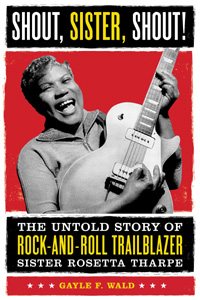 Tharpe played gospel, but with her amplified guitar set at maximum volume, it rocked as hard as any secular act.
Her influence can be felt in rock, blues, country and jazz, but as she can’t be easily classified or pinned down to a single style, she’s conspicuously absent from most music history books. Shout, Sister Shout is the first ever biography devoted to Tharpe, and author Gayle F. Wald goes a long way towards correcting the slight.
Born in Cotton Plant, Arkansas in 1915, Tharpe’s parents were members of the Church of God in Christ, a Pentecostal denomination that emphasized lively music in its worship services. Performing since the age of three, she would be hoisted on top of a piano so the entire congregation to see the ‘singing and guitar-playing miracle.’
Her mother, Katie Bell - a self-styled religious prophet who would occasionally don a turban - left her husband when Rosetta was five years old, ostensibly to further her ministry. They moved to Chicago, and by the end of the decade mother and daughter were touring the gospel highway, performing at tent meetings, revivals and churches across the country. Katie Bell would preach and Rosetta would sing.
Rosetta married a Church Of God In Christ pastor in 1934, but it didn’t last. Discovering he was cheating, she left the marriage, and - making a clean sweep - decided to expand her engagements outside of the church.
Relocating to New York City in 1938, she enjoyed almost immediate success. Dubbed the ‘hymn swinging evangelist,’ many of her moves – hand clapping, finger snapping and flailing across the stage – were straight out of the Church, but new and exotic to mainstream audiences. She performed at churches on Sunday mornings and venues like the Cotton Club and Apollo Theatre during the week. Regardless of where she played, the material remained the same. A breakout performance as part of From Spirituals To Swing – a Carnegie Hall concert put together by legendary producer and promoter John Hammond to showcase ‘the music nobody knows’- coupled with her debut recording (‘This Train’) brought overnight success.
The book takes its title from one of her biggest hits; ‘Shout, Sister, Shout,’ which she recorded as vocalist with Lucky Millinder & his Orchestra in 1942. Her contract with Millinder specified she sing both gospel and secular material and throughout her career Tharpe performed both styles, invariably returning to gospel.
Her relationship with the church could be tempestuous. Adored by some, others felt her to flashy to be singing the gospel. Her performances were equal part genuine sincerity and solid show biz. A larger-than-life figure, she was no stranger to the grand gesture. She frequently performed adorned in colorful wigs and sequined gowns, and in 1951 staged her third wedding – after signing the contract she went looking for a husband - in a Washington D.C. stadium. The ceremony/concert drew over 20,000 attendees. Her wedding dress alone cost $1,500; a phenomenal amount at the time.
Through it all, she retained a deep-seated faith, and believed her talents were divinely inspired. To the naysayers, she argued that playing in night clubs would bring the gospel to people who might never attend church.
Tharpe is rarely mentioned in the rock ‘n’ roll history books, yet she played a significant part in the music’s creation. Her biggest hit, ‘Strange Things Happening Every Day’ was released in the spring of 1945, and has been heralded as one of the first rock ‘n’ roll songs.
Many rockers credited her as an influence, including Chuck Berry and Little Richard. Elvis Presley and Johnny Cash were both long-time fans; Presley took a page from Tharpe when it came to incorporating divergent styles, and Cash named her his all-time favorite singer. Carl Perkins once claimed “I’d always play ‘Strange Things Happening Every Day.’ It was rockabilly…” and Jerry Lee Lewis sang the song when he auditioned for Sun Records.
Subsequent generations were impacted as well; Eric Clapton, Pete Townsend, Angus Young, Bonnie Raitt and Prince are just a few of the guitarists that owe a debt to Tharpe.
By the early 1940s she was billed as ‘America’s greatest spiritual singer,’ and enjoyed world wide fame and considerable wealth, but during the 1950s her popularity waned due to a number of factors. The very music she had helped create was in full bloom and Tharpe, now in her forties, was considered too old to rock ‘n’ roll. In the gospel market, her popularity was eclipsed by Mahalia Jackson. Jackson stuck to straight gospel, refusing to even appear on the same bill with secular act, and found favor in and outside the church.
Continue article >>
|
Tharpe found new fans in Britain, where she was received by ecstatic audiences during the later part of the decade and well into the sixties. She continued touring until shortly before her death. She had a longstanding distrust of doctors, partially as a result of attitudes within the Sanctified Church, and an undiagnosed case of diabetes resulted in her leg being amputated. Rather than taking time to recuperate, her husband – who also managed her - made sure she stayed on the road right up to the end. Tharpe was scheduled for a recording session the day before she died in 1973, at the age of 58. She was buried in an unmarked grave, as her husband refused to spend money on a gravestone.
While Shout Sister Shout! may not be the definitive work on Tharpe - additional photos and a more comprehensive discography are sorely needed – it’s a long overdue and welcome addition to the bookshelf.
Gospel Music (Hyena) 2006
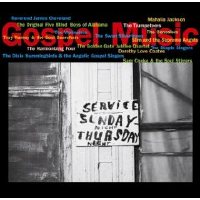 Hyena is the latest label imprint from legendary producer and entrepreneur Joel Dorn, whose name guarantees quality. Gospel Music is no exception. A handpicked collection of material, the disc offers an excellent introduction to the genre. There is precious little information on the disc - Dorn’s brief liner notes state that he prefers the music to stand on its own, regardless of historical context. Hyena is the latest label imprint from legendary producer and entrepreneur Joel Dorn, whose name guarantees quality. Gospel Music is no exception. A handpicked collection of material, the disc offers an excellent introduction to the genre. There is precious little information on the disc - Dorn’s brief liner notes state that he prefers the music to stand on its own, regardless of historical context.
Many of the biggest names from the Golden Age of Black Gospel are featured, including the Swan Silvertones, the Golden Gate Quartet, Sam Cooke with the Soul Stirrers, Mahalia Jackson, and Dorothy Love Coates.
By the mid fifties and well into the sixties, the Pop and R&B charts were full of acts that owed a huge debt to gospel. Many had come up in the church, and cut their teeth playing gospel. Two different versions of ‘This May Be The Last Time’ - by The Original Five Blind Boys of Alabama and The Staple Singers – show just how close the forms had became. The song was revamped into a top ten hit by the Rolling Stones in 1965 as ‘The Last Time.’ It’s not the only one - a few of the songs here enjoyed new life in the pop scene, including ‘Stand By Me,’ ‘Motherless Children,’ ‘Get Right Church’ and ‘Strange Man.’
The Violinaires and The Consolers sang gospel, but outside of lyrics, are practically indistinguishable from the of soul sounds of acts like Sam & Dave
The disc opens and closes with excerpt from sermon from Rev James Cleveland entitled ‘He Decided To Die’ which breaks into song, demonstrates just how close good preaching is to music.
Good God! A Gospel Funk Hymnal
 Good God! picks things up in the seventies, with the black church funked-up and psychedelicized. Where Gospel Music sticks with the tried and true, this collection of 18 tracks spanning 1968 – 1981 consists almost entirely of names unrecognizable to even the most ardent collectors. It’s funk with a gospel message, sounding like a mixture of the Spinners, Temptations and James Brown testifying with wah wah guitars, hi-hats and clavinets. Good God! picks things up in the seventies, with the black church funked-up and psychedelicized. Where Gospel Music sticks with the tried and true, this collection of 18 tracks spanning 1968 – 1981 consists almost entirely of names unrecognizable to even the most ardent collectors. It’s funk with a gospel message, sounding like a mixture of the Spinners, Temptations and James Brown testifying with wah wah guitars, hi-hats and clavinets.
It’s nearly all original material. One of the few traditional numbers; a version of ‘I’m Just A Poor Wayfairing Stranger’ by Cliff Gober comes across like a lost Curtis Mayfield track from ‘Superfly.’
The twenty piece choir Voices of Conquest is accompanied solely by a drummer – but what a drummer. Rocking in John Bonham playing funk, the track doesn’t let up for a second.
Two songs come from that seventies staple, the amateur church musical. In ‘Thoughs Were The Days’ (sic), from Two Sisters From Baghdad, one of Satan’s minions bemoans the fact that so few are making it to Hell anymore. ‘Heaven on Their Minds’ by Sam Taylor - one of the few tracks to originally appear on an album as oppose to 45 – is taken from The Soul of Jesus Christ Superstar, a soulful salute to the popular musical.
Throughout, the disc is funky, soulful, and as the compilers point out, an “antidote to both the ugly modern sheen of contemporary gospel and the chaste dignity of the standard hymn.”
Like a playlist from an alternate universe’s best of 70’s funk station, chances are you’ve never heard anything from this collection, but if you love funk, It’s essential listening.
May 2007
|