|
Veteran CBC journalist extols ‘profound
impact’ on poverty
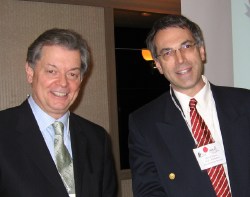 |
| CBC journalist Brian Stewart (left), with Canadian Church Press president David Harris. Photo: Canadian Catholic News |
By Deborah Gyapong
THE SUCCESS of churches and faith-based organizations
in providing disaster relief and fighting world poverty is one of
“the greatest overlooked stories of our time,” said veteran CBC
television journalist Brian Stewart.
Speaking to the Canadian Church Press (CCP) and
Association of Roman Catholic Communicators of Canada (ARCCC) conference in
Toronto May 3, Stewart praised the “courageous” work of
churches and faith-based NGOs, calling them “uniquely efficient
engines of human development.”
These organizations have had a “profound
impact” on human rights, peace, health care, clean water and
education around the globe said Stewart, who has covered more than nine
wars in his 43-year career. Intractable world poverty is the
“greatest problem of our time with the exception of global
warming,” he said, yet the successes churches and NGOs have had are
“almost always overlooked by the mainstream media.”
This success story began during the 1984 famine in
Ethiopia. One million people died in “the worst hell on earth,”
Stewart said. However, in Ethiopia and elsewhere, aid and development
organizations stayed behind long after the cameras and the reporters left.
In Africa alone, churches and NGOs have left a legacy that includes 40
million more children in school, and tens of thousands who “made it
from famine camps to college.”
Concentration on Africa’s failures breeds
defeatism and ignores the marked improvement in the lives of millions
through the efforts of small-scale, often faith-based projects, he said.
The story of those successes parallels Stewart’s
personal transformation – which led to his becoming a faithful
Presbyterian. The role of faith in those successes is not taken seriously
enough, even provoking “titters” among mainstream journalists,
he said.
Continue article >>
|
In the 1960s, Stewart’s generation declared
organized religion was on its death bed. They underestimated the strength
of spiritual hunger and the “human drive to serve and to help
others.”
Since then, he has witnessed the “galvanic force
of faith in action,” a faith he described as “hard,
institutionalized, organized and clear-sighted.”
Since the Cold War, the provision of international aid
has shifted from “big aid battalions” and “five year
plans” he said, to smaller, independent NGOs which
“partner” with local people and have “refused to give up
their sense of mission,” he said.
He said he regretted the fact that the term
“muscular Christianity” has passed out of fashion, because that
is what he has observed on the front lines of famine, war and catastrophe,
where he and his crew were almost always greeted by Christian workers who
had arrived first.
“A lot of good things start up quietly in humble
church halls,” he said, pointing to the 1787 meeting of 12
evangelicals in a church basement that launched the movement to abolish
slavery.
He noted the rise of the Solidarity trade union in
Poland. With the support of the Catholic Church, Solidarity helped bring
down the Iron Curtain.
Stewart recalled meeting Solidarity leader Lech Walesa
in a stairwell as he was on his way to mass. It was shortly after he had
been released from prison in the early 1980s and many feared Walesa would
be assassinated. Walesa was asked whether he was afraid.
“No, I am afraid of no-one or nothing. Only
God,” Walesa said.
“It was a transcendent moment,” Stewart
said, revealing that no force or empire could ever extinguish the power of
faith.
– Canadian Catholic News
June 2007
|