|
By Frank Stirk
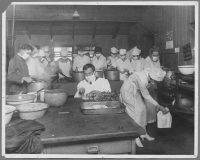 |
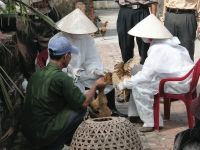
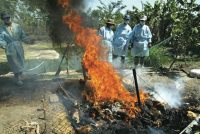
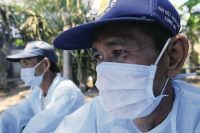
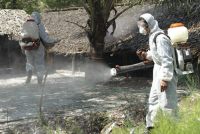
| Volunteers cook food in San Jose, California, during the devastating 1918 Spanish Flu catastrophe. Elsewhere on this page are scenes from the 2004 Avian Flu pandemic. |
CHURCHES can expect to be approached by government and
health authorities for help in coping with what most experts believe is the
certainty of a global and potentially catastrophic influenza pandemic that
could break out at any time.
“It would be nice to respond in the affirmative
– ‘Sure, we’ll help’ – instead of saying,
‘We’re too scared,’” says Dr. Tim Foggin, a Burnaby
family physician and a Christian who sees in this coming crisis an
unparalleled opportunity for churches to show the love of Christ in their
communities.
Foggin moderates an email group dedicated to helping
churches prepare for a pandemic, and co-authored a new Church
Preparedness Checklist with a specific focus on the next pandemic.
Alarm
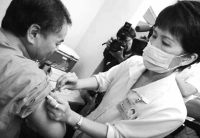 What has governments, healthcare professionals,
scientists and economists so alarmed is that the world could soon
experience an avian (H5N1) flu pandemic that would make the death toll from
the 2005 tsunami pale by comparison. What has governments, healthcare professionals,
scientists and economists so alarmed is that the world could soon
experience an avian (H5N1) flu pandemic that would make the death toll from
the 2005 tsunami pale by comparison.
“We’re talking 10 times bigger. Two to
seven million [deaths] is usually the ballpark figure,” says Foggin.
“What happens in a pandemic is there’s a
major [genetic] shift in the virus,” says Dr. Eric Young,
B.C.’s deputy provincial health officer. “Our immune systems
don’t recognize that because it’s new. That’s why
there’s no immunity developed in the population.”
“The saving grace so far,” he adds,
“has been that the H5N1 strain hasn’t been easily spread from
person to person. But it’s been pretty virulent when it has gotten
into a person. The mortality rate’s been pretty high.”
For several centuries now, flu pandemics have broken
out every 10 to 40 years with varying degrees of virulence. Some, as in
1957 and 1968, can be relatively minor, and pose about the same threat as
the annual flu outbreak.
But others can be extremely dangerous – the most
recent being the ‘Spanish flu’ pandemic of 1918 -19 which
claimed somewhere between 20 and 40 million lives worldwide, including
50,000 in Canada.
Waves
 And unlike other natural disasters, pandemics can
typically last more than a year, striking in waves sometimes months apart.
Each wave can last upwards of six to eight weeks, affecting an estimated 15
to 35 per cent of the population to some degree. And unlike other natural disasters, pandemics can
typically last more than a year, striking in waves sometimes months apart.
Each wave can last upwards of six to eight weeks, affecting an estimated 15
to 35 per cent of the population to some degree.
The social impact would be devastating. Ottawa Public
Health, for instance, estimates that if 25 per cent of the city’s
population was affected and the pandemic lasted seven weeks, there could be
roughly 30,000 new cases, 16,000 people seeking medical assessment, 350
hospitalization and 80 deaths each week of the crisis.
In the Greater Vancouver area, says Foggin, “one
local hospital is looking at having one-third of the staff off sick or [at
home] caring for the sick, and one-third redistributed in the communities.
Now they’re down to one-third of their usual staffing – and
expecting, by conservative modeling, a five-times increase in patient
load.”
No segment of society would be immune, as thousands of
workers book off sick, schools are closed, the movement of people and goods
is disrupted, and so on. As well, says Anglican Canon Douglas Graydon, who
chairs a tri-diocesan working group on pandemic preparedness in southern
Ontario: “It would be so comprehensively global there might not
necessarily be resources that can come into your community from
outside.”
Standing in the gap
 It is in this gap that churches are being encouraged to
stand. “Faith-based communities can actually do quite a bit,”
says Young. It is in this gap that churches are being encouraged to
stand. “Faith-based communities can actually do quite a bit,”
says Young.
“Some people may be ill in the home without
anyone really knowing about it . . . so helping to keep an eye on your
neighbour is going to be a really important thing during a pandemic. Some
people will need services that are generally provided in regular times like
Meals on Wheels.”
The opportunities to serve can be as varied as the
needs that arise, as long as stringent rules of personal hygiene (such as
frequent hand-washing) and the prohibitions on physical contact (such as
giving someone a hug) are adhered to.
“Try to think outside of the box,” Foggin
advises. “I don’t expect this to be crystallized or formalized
before anything happens. But if we can have a framework or foundation set,
then there’ll be something that can be ramped up fairly
quickly.”
Churches that do get involved, he adds, also need to
let their municipalities know their intentions “just to have that
dialogue, [keep] those channels of communication open.”
Continue article >>
|
Template
 A template for pandemic preparedness that
Graydon’s working group has developed and offered to every Anglican
diocese seeks to remind them that, as he says, part of every
Christian’s calling is “to be servants . . . to embrace risk
and to minister during times of anxiety, confusion and
catastrophes.” A template for pandemic preparedness that
Graydon’s working group has developed and offered to every Anglican
diocese seeks to remind them that, as he says, part of every
Christian’s calling is “to be servants . . . to embrace risk
and to minister during times of anxiety, confusion and
catastrophes.”
Also included, says Graydon, “is a checklist that
parishes, dioceses, actually just about anybody, is encouraged to think
their way through, which should begin to answer . . . how do I go about
getting ready for such an event and what do I need to do next.”
“What I would hope for,” says Foggin,
“is in the major urban centres particularly that there’d be a
handful of churches that can start interacting more intentionally along
these lines and thinking this through and making some initial
plans.”
Yet so far, it seems most churches remain skeptical.
“I have gotten comments about how we’re
just not really sure we believe this is a legitimate concern,” says
Graydon.
They are not alone. Some critics, such as American
science journalist Michael Fumento, writing in the National Post in April 2006, argue
that the whole idea of an impending global pandemic betrays “sheer
ignorance of how viruses change.
“There’s no evidence H5N1 is mutating
toward becoming transmissible between humans. . . . Rather, as one mutation
draws the virus closer to human transmissibility, another is as likely to
draw it farther away.”
False fears?
 Fumento warns: “The false fears we sow today we
shall reap in the future as public complacency if a monster truly appears
at the door.” Fumento warns: “The false fears we sow today we
shall reap in the future as public complacency if a monster truly appears
at the door.”
While obviously not questioning the imminent threat of
a pandemic, Young is nonetheless confident that B.C., at least, “will
be very well prepared” when it does strike.
“The indications are,” he says, “that
the antivirals for influenza that we do have may well work to some extent
in a pandemic, even if the virus changes. So there is the possibility that
we’ll have a couple of antivirals that will work.”
In addition, Canada will have a guaranteed supply of
antivirals thanks to its ability to produce and stockpile the drugs, says
Young. “We will be one of the few self-sufficient countries to be
able to do that.”
And even if the skeptics are proven right – or
even if the pandemic turns out to be not as disastrous as many fear it will
be – Graydon believes it still makes good common sense for churches
to have some plans in place in the event of an emergency.
“Let’s look upon this preparedness as part
of our community ministry,” he says, “so that if the parish
really wants to embrace something like this, they can be known within their
community as a Christian community that’s there and available and
ready to help out in times of need.”
Leadership
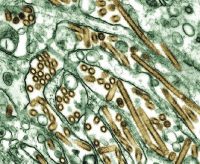 |
| Avian Flu microbes. |
Even so, Glen Klassen, a biology professor at Canadian
Mennonite University (CMU) in Winnipeg, believes if churches are ever to
have pandemic preparedness plans in place, the initiative will have to come
from their denominational leadership.
“Hopefully, we can work from the top down,”
he says. “Bottom up, we need to sort of do the publicity and raise
the awareness of people at the grassroots level. But in terms of actual
preparedness plans and their implementation, we’ll have to depend on
the people at the top.”
Toward that end, CMU will be hosting a Summit June 20
– 21 in partnership with the International Centre for Infectious
Diseases, a federal agency based in Winnipeg, on how faith communities can
effectively respond to a pandemic.
“We’re expecting to get the top people in
each denomination here. It’s not wide open to the public,” says
Klassen.
Whether top-down or bottom-up, what matters for Foggin
is that churches seize the challenge.
“If the church doesn’t stand up, it’s
going to prove itself irrelevant, as many think it is, unfortunately. But
if the church does stand up, there is such great potential.”
In contrast to the tsunami that caught everyone
off-guard, he says, no one – including churches – will have any
excuse for not being ready when the next pandemic sweeps across the globe.
“We’ve seen the wave. It’s coming slowly and we have time
to prepare. But then at the end, it comes real fast.”
“The analogy I use here in Manitoba is of the Red
River Valley flood,” says Klassen.
“I mean, people know there have been floods in
the past and there definitely will be floods in the future. We just
don’t know when and how severe. So we prepare for the worst
case.”
However, he said, referring to the pandemic: “In
this case, it’s like there’s six feet of snow in North Dakota
waiting to come down on us.”
June 2007
|