|
WITH the stroke of a pen, the Canadian Charter of
Rights and Freedoms became part of the Canadian constitution 25 years ago,
on April 17, 1982.
Don Hutchinson, legal counsel for the Evangelical
Fellowship of Canada, told BCCN the Charter “has affected every area of Canadian
law” and “has fundamentally changed the way we approach
law.”
Hutchinson noted that the Charter came forward at the
same time as a massive parallel cultural change, although it is probably
too simplistic to suggest that one “caused” the other.
Fundamentally, instead of defining themselves in terms of the groupings
they belong to, Canadians have become much more individualistic. Many
Canadians’ attitudes now begin with “What are my
rights?”
Political scientist John Redekop told BCCN that while there were
some good aspects to the Charter, the great weakness is that it has shifted
the focus “from the British emphasis on collective well-being to the
American emphasis on individual well-being.”
The result is that the courts have “bent over
backwards to protect a narrow band of minority and individual rights”
but the Charter “has not improved the climate of freedom for large
segments of society.”
He noted, for instance, the mayors and other
individuals who have been forced by court decisions on the Charter to
declare support for homosexuality.
Redekop said the British have never had such a charter
but historically have a better record of providing freedoms, guaranteed by
both tradition and the courts. In that sense, the Charter is undemocratic
in that it does not trust legislatures to protect rights.
The other key change, said Hutchinson, is that
Canadians “have grown accustomed to accepting that the courts know
best.” He said this was true before the Charter, but then
“Canadians expected government to act if it disagreed with a court
decision.” Now “Canadians expect the courts to act if they
disagree with a government decision.”
Section 33 of the Charter (the ‘notwithstanding
clause’) recognizes the traditional right of parliamentary government
to overrule a law.
Redekop stated that legislation overruling court
decisions was quite common before 1982. However, the notwithstanding clause
“has been given such a negative view by the Liberal Party and the
courts” that in practice it can hardly be used now.
The problem with this, he said, is that it gives judges
far too much power. He said judges have essentially been appointed on
“the whim of a prime minister,” based on “a phone call
late at night. Judges aren’t accountable, and there is no clear
removal procedure. The personal preferences of judges are given very much
weight.”
Hutchinson said the Supreme Court has also tended to
see the Charter not as “a document frozen in time” but as
“a living tree” that “has a life of its own and is
continuing to evolve.”
Hutchinson said that the Charter was based on a
combination of the Canadian history of recognizing rights, a number of UN
declarations of rights, and Prime Minister Pierre Trudeau’s Jesuit
upbringing.
Continue article >>
|
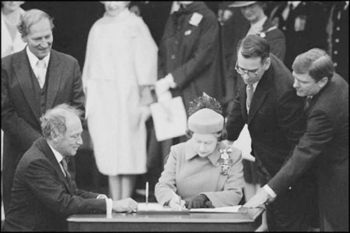 |
| Prime Minister Pierre Trudeau looks on as Queen
Elizabeth II signs the Charter. |
Hutchinson said all three have strong ties to a
Christian heritage: “In the Catholic tradition, all rights are
derived from God, and the most significant right is freedom of
religion.”
Redekop, however, stated that the only Christian
influence is really in the preamble, which recognizes that “Canada is
founded upon principles that recognize the supremacy of God and the rule of
law,” a preamble that has largely been ignored in practice.
Hutchinson said the Charter has fulfilled initial
expectations in that it “has benefitted religious rights in a number
of ways.” However, it has tended to “tie those rights to the
individual” and left “corporate religious expression with a
certain amount of legal uncertainty.” The courts have used the
Charter to protect private religious belief but have been less supportive
of “the corporate expression of religious belief in the public
arena.”
Redekop stated that when the Charter was first
proposed, another political scientist told him that Christians would be
foolish to support it because “this will work against you.”
Redekop stated, “I didn’t believe it at the time, but he was
right.”
Hutchinson said that “to some degree, we
Christians have neglected our rights” under the Charter. That is,
Christian individuals and groups have often been more reluctant than some
other groups to pursue their Charter rights through the courts. They are
misinformed about their rights, don’t take their faith seriously
enough, or don’t see it as important enough for the time and money it
would require.
Redekop stated that one of the biggest problems is that
the Liberal Party had appointed “very left-leaning, anti-Christian
judges. If the rulings had been fairer, the Charter wouldn’t have
been so consequential.” He added that “political decisions then
reinforced the bias of the courts.”
Asked whether the Charter has been good or bad for
Canada, Hutchinson said that is no longer a relevant question since the
Charter is part of the constitution. He said some Canadians almost worship
the Charter and some Canadians loathe it, but neither attitude is helpful.
Instead, Canadian Christians should focus on understanding the Charter and
learning how it can benefit them.
Redekop was more direct: “On balance, the Charter
has not been good for Canada.”
– Jim Coggins
June 2007
|