|
By Peter T. Chattaway
 GIVE the Spider-Man series points for good intentions. Ever since director
Sam Raimi first brought the web-slinging super-hero to the big screen five
years ago, he has made a point of emphasizing the character’s
humanity, indeed his fallibility. In doing so, he has shown how we, too,
can learn from our mistakes and live more virtuously. GIVE the Spider-Man series points for good intentions. Ever since director
Sam Raimi first brought the web-slinging super-hero to the big screen five
years ago, he has made a point of emphasizing the character’s
humanity, indeed his fallibility. In doing so, he has shown how we, too,
can learn from our mistakes and live more virtuously.
Even better, Raimi has given these virtues a distinctly
Christian flavour. Peter Parker (Tobey Maguire), the science student who
fights crime as Spider-Man, clearly owes his sense of right and wrong to
the uncle and aunt who raised him after the death of his parents –
and the films have depicted Aunt May (Rosemary Harris), in particular, as a
devout woman who says her prayers and thanks the angels for their help.
If only good intentions were enough. The newest film in
the series offers us more of the same – and indeed, it offers us too
much more. More villains, more battles, more special effects, more
flashbacks to the death of Peter’s Uncle Ben (Cliff Robertson)
– even a return to the love triangle between Peter, his girlfriend
Mary Jane Watson (Kirsten Dunst) and his estranged friend Harry Osborn
(James Franco).
Watching Spider-Man 3, it is impossible not to think the series has gotten stuck
in a rut that it is desperate to get out of. Like a lot of other
‘threequels,’ it recycles familiar elements from the first
movie for no better reason than a lack of inspiration – but it also
goes for shock value by bringing out the hero’s dark side, killing a
major character and subverting what we thought we knew about the earlier
films.
To make matters worse, Raimi and his writers have
thrown so many new characters and subplots into this one film that none of
them are given the attention they deserve – and to hold all these
story threads together, the film is obliged to pile coincidence upon
coincidence until you’re rolling your eyes in disbelief.
It’s a shame, because there are some beautiful
moments here. One of the new ‘bad guys’ is Flint Marko (Thomas
Haden Church), an escaped convict who runs straight into a scientific
experiment which rips his molecules apart. The scene in which Marko
reconstitutes himself and rises from the sand – as a supervillain
named The Sandman – has a haunting, even poignant beauty, and it is
remarkable for the way it suggests the frailty and vulnerability of the
character as much as his strength.
The major theme of this film is revenge and
forgiveness. Marko turns out to be the actual killer of Peter’s Uncle
Ben, and Peter – whose superhero activities have always been animated
by the guilt he feels over Uncle Ben’s death – is consumed by a
desire to settle the score. Harry, meanwhile, wants revenge against Peter
for the death of his father in the first film. And a photojournalist named
Eddie Brock (Topher Grace) wants revenge against Peter after Parker exposes
his fraudulent photos.
Continue article >>
|
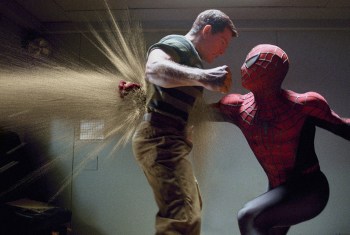 |
| Spider-Man goes a few rounds with The Sandman. |
All these vengeful inclinations are amplified by a plot
device that literally drops out of the sky: a batch of alien goo that
sticks to Peter and turns him into a selfish jerk, before he figures out
what it is doing to him and rips it off. Then the goo possesses Eddie
instead, turning him into a toothy supervillain named Venom. (This happens
after Eddie asks God to kill Peter – a form of answered prayer,
perhaps? Or is Eddie being handed over to Satan for the destruction of his
flesh, as it were?)
It is worth noting that there are limits to
Peter’s evil, even when he is possessed by the goo, whereas Eddie is
much worse because, as he admits, he likes being evil. To some degree, the
alien goo is limited by the character of its host. And that nicely points
up the need to make wise choices before temptation comes our way.
That’s a valuable lesson. But some of the
film’s other ideas are more confused, such as the way it allows
personal emotions to interfere with notions of justice. In one crucial,
climactic scene, Spider-Man lets a villain get away because he
‘forgives’ him. But what about Spider-Man’s
responsibility to the city he is supposed to protect?
Perhaps, given the circumstances, there wasn’t
much Spidey could do anyway. But the film wants us to think that what
really matters is how Peter Parker feels inside – and given
everything else that has gone on, that isn’t quite good enough.
* * *
The other mega-threequels this month have also been
pretty disappointing. Shrek the Third recycles gags from the earlier films, and none of the
new characters are all that interesting this time around. It is,
admittedly, fun to see Shrek coping with imminent fatherhood, but the film
doesn’t do much with that particular storyline.
Meanwhile, Pirates of the
Caribbean: At World’s End has to be the
most pointlessly overstuffed blockbuster ever made. That said, I do like
the bit where Barbossa (Geoffrey Rush) says it is only when you are truly
lost that you can find a place that cannot be found. I’m sure someone
will work that into a movie-based sermon.
–
filmchatblog.blogspot.com
June 2007
|