|
By Hugh Ross
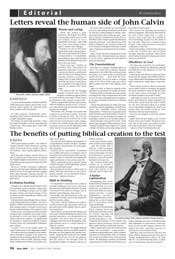
TWO anniversaries in 2009 – the 200th of Charles Darwin’s birth (February) and the 150th of his book On the Origins of Species (November) – have sparked global celebrations.
Both the man, Darwin, and his theory of life’s evolution are being touted as among the ‘brightest lights’ in the history of science. Christians may be tempted to respond in full battle
mode.
However, I’d like to propose a different response, one that opens dialogue rather than
shuts it down. It’s an approach that engages rather than alienates a group of people we sincerely
hope to draw toward our faith, not push away.
Evolution bashing
Perhaps you’ve already observed that ‘evolution bashing’ tends to backfire. Claims that creation or intelligent design must be right
because of flaws and shortcomings in the evolution scenario typically go
nowhere, and for good reason.
Scientists freely acknowledge that no theory comes forth perfect and complete.
The investigation of flaws and weaknesses is the process that propels science
forward toward more precise understandings of the natural world.
What’s more, researchers and theoreticians interpret such complaints as a smoke
screen, an attempt to cover up a lack of tangible, valid evidence for creation – or, equally bad, an attempt to shield the biblical creation scenario from any
meaningful evaluation and critique.
To gain a voice in the public arena, we cannot and need not stay ‘religiously neutral.’
We cannot ask for recognition of an unidentified intelligent designer who played
an undefined role in bringing about the observable history of life on earth.
This lack of definition will prevent us from being taken seriously as
scientists.
The way forward requires development of comprehensive creation ‘models’ (explanatory theories). These are the core of the scientific enterprise.
Creation can be – and will be – considered as a credible alternative to evolution only if and when we
creationists put forth our own testable models to describe and explain the
origin and history of the universe and life.
When creationists propose specific details of what took place ‘in the beginning,’ creation can be scientifically tested.
By providing the means to either verify or falsify (through observations and
experiments) creation, we can effectively demonstrate that “creation is science.”
Shift in thinking
It’s important to remember that a shift in scientific thinking occurs only as the
most talented and well-trained scientists become convinced of the need for
change, not as students and politicians clamor for it.
Eventually, new developments at the top research level trickle down to the
classroom and the broader culture.
These days, with the advances in communications technology, that trickle-down
can proceed much more rapidly than in previous generations.
Continue article >>
|
The boldness of my proposal springs not from naive wishful thinking but rather
from personal experience – as a scientist and as an evangelist. For more than 20 years, my colleagues and I
have been developing a radically different tactic to counter barriers to belief
in creation.
This strategy is not new. We simply returned to the biblically derived
scientific method, the same one that sparked the scientific revolution.
Applying that method to the rapidly emerging discoveries in both the physical
and life sciences has brought forth an astounding weight of evidence in favour
of biblical creation.
In an open and free competition of ideas, that evidence – and the model that it informs – makes an impact even in the context of major secular universities. We have been
allowed to present it and have received valuable feedback in the process.
Any creation model must explain in as detailed a manner as possible the origin
and entire history of the universe, and of earth’s life.
A better explanation
Recognizing that evolutionists will not abandon one model until they see a more
useful one, we endeavour to show how biblical creation indeed provides a better
explanation – one that is more comprehensive in elucidating the record of nature and in
forecasting future research findings.
The process of model building is ongoing, but as my friends and I have
discovered, by actively exposing our biblically based
creation-model-in-progress to the comment and critique of non–theistic and agnostic science professors, we have earned their respect and
provoked their interest.
Future experiments and observations will further test our model’s – or any model’s – conclusions and predictions, either confirming them or denying them. But no
Christian ever needs to be afraid of the truth found in nature. By displaying a
fearless yet humble commitment to follow the truth wherever it leads,
Christians can open conversations that lead, ultimately, to conversions. At the
very least, we can win the respect of those who oppose our views – and that’s one way we can honour our Lord Jesus Christ.
Hugh Ross, who was raised in Vancouver and holds a PhD in astronomy from the
University of Toronto, founded Reasons to Believe. He spoke May 29 – 31 at ‘If Darwin Only Knew,’ a conference at Tenth Avenue Church in Vancouver.
June 2009
|