|
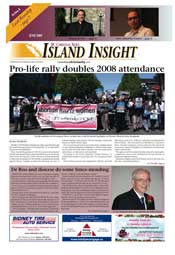
THE STORY of the Catholic Diocese of Victoria’s tangled financial and legal woes came to an end with the sale of 160 acres of land,
which the diocese bought in 1997.
But the bitterness and dissension generated by the land purchase by former
Bishop Remi De Roo has continued.
Now De Roo and incumbent Bishop Richard Gagnon hope to write the concluding
chapter to this story with a reconciliation service.
At press time, it was scheduled for Pentecost, 3 pm May 31, in St. Andrew’s Cathedral.
Not so long ago, the cathedral and all the diocese’s other properties on Vancouver Island were at risk, because of De Roo’s investment in undeveloped Washington State land.
Many Victoria Catholics hope the service will end years of wrangling between De
Roo’s critics and supporters.
“I’m very happy,” said Judy Ravai, proprietor of Koinonia Christian Book Store. “I think we need real healing in this diocese. Without it we are broken, empty.”
Grant Croswell, a former member of St. Andrew’s School Board, said the service will enable the diocese “to move forward again.” It will also allow De Roo to “live his older years” reunited with the diocese he served for 37 years.
Patrick Jamieson, who as founding editor of the independent Island Catholic News (ICN), and as Bishop De Roo’s biographer, lent him unstinting support during those years, also heartily
approved of the reconciliation service.
“I think it’s a good idea. I can see that Bishop Gagnon wants to shore up divisions in the
diocese.”
Jamieson used ICN to defend De Roo against charges of fiscal irregularities; to defend the
original land deal; and to countercharge his critics with waging a vendetta
against De Roo for ideological reasons, as well as with botching the land deal.
No one has ever accused De Roo of seeking personal gain. He has long been a
critic of the free enterprise system and an advocate of social justice.
Jamieson has argued that the financial administrators of the diocese exposed
the deal and tried to wreck it to discredit De Roo.
Now Jamieson says the service “will lead to healing the diocese.” Both Bishops Gagnon and De Roo have some fence-mending to do, says Jamieson.
The incumbent recently alienated liberal Catholics by insisting on the
dismissal of a gay staff member at a Victoria parish; and De Roo more than
upset Catholics who saw the diocese forced to sell lands because the land deal
went wrong.
Jamieson says the reconciliation began with Bishop De Roo’s recent 85th birthday party, whose guests included former B.C. NDP Premier Dave
Barrett, former Progressive Conservative senator Doug Roche and Bishop Gagnon.
It was Roche, according to Jamieson, who proposed the reconciliation service to
Gagnon. De Roo himself was delighted. He circulated a note to his supporters
urging their attendance at what he called “this joyous event . . . God willing, this will help to heal some rifts
afflicting our diocese, and free up vital energies for further spiritual
growth.”
Continue article >>
|
He also quoted from a letter sent to him recently from Muriel Clemenger, who was
the diocese’s chief financial officer at the time of the land deal. Clemenger accepted
responsibility for the fiasco, and apologized for keeping Bishop De Roo “out of the loop” as the deal went wrong.
Commented De Roo: “Personally, I consider this matter now closed – while maintaining my ‘no comment’ stance with the media, so as to avoid reopening old wounds and painful
memories. Forgiveness remains the best medicine.”
But not everyone is satisfied by this.
Gregory Hartnell, a Victoria artist and frequent blogger on diocesan and
municipal politics, perhaps spoke for many when he complained that “the truth has not been told” about Bishop De Roo’s involvement in the Washington land deal, nor the involvement of his
successors.
Until everyone comes clean, said Hartnell, real reconciliation is unlikely. “The church has not been honest and transparent.” In particular, Hartnell complained that De Roo has done no more than write a
single, short and less-than- complete apology for his role.
The deal was pitched to Clemenger and the bishop in 1997 by Washington lawyer
and businessman Joe Finley: borrow U.S. $5.5 million, secured against the
assets of the diocese; buy 160 acres of rural Washington State land; make the
payments till the land could be resold for something nearer its assessed value
of US $15 million; and split the profits.
De Roo, who had already lost the diocese $1 million on an earlier investment
with Finley, was encouraged to see this as a way to make that up before he
retired. But De Roo retired before the land could be resold.
His successor, Raymond Roussin, stopped the payments on the loan when he took
office – and following the counsel of his advisors, extricated the diocese from its
partnership with Finley, who had invested none of his own cash.
Years of legal wrangling ensued; the debt on the land grew to $13 million, which
was paid through the sale of debentures to members of the diocese. But the
diocese also had to sell $15 million in assets at fire-sale prices, netting
only $7.5 million.
Eventually, the land was sold – and the diocese’s finances secured.
– Steve Weatherbe
June 2009
|