|
By Lloyd Mackey
COULD IT BE that a prayer network involving some 2,000 people made a difference
in how the May 12 British Columbia election turned out?
Ask Tim Schindel to answer that question and he carefully suggests that “We were praying hard . . .” But he is understandably cautious about taking credit for anything that might
or might not have changed in provincial politics on election day.
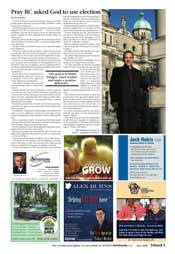
Schindel, a former Pentecostal pastor from Kamloops, moved with his family to
Victoria in 2007, to develop Leading Influence Ministries.
The idea of LIM, in the first instance, was to provide a legislative chaplaincy.
“It was to target provincial politics. There is much going on federally, but not
much provincially,” Schindel says, adding that, in due course and with the gathering of experience,
LIM’s hope is to become active in other provinces.
At the core of the chaplaincy, the idea is to provide workplace pastoral care to
members of the legislature who are interested. That care, he suggests, can be
complementary to the kind of relationship that a politician builds in the
church he or she attends back in the home constituency.
At any given time, Schindel may be working directly with up to a dozen or so
members – one of every eight to 10 of the total house membership.
And, when a chapel service was held a few months ago, close to 30 MLAs were
present.
Schindel points out that the objective of LIM is pastoral care, not advocacy
work. “If there is pressure to do advocacy work, we will cut that off, because one will
conflict with the other,” he notes, explaining that advocating on public policy issues has the potential
to create political fissures, making pastoral care less feasible.
Schindel is persuaded that “leaders need to know and experience the love, grace, wisdom and hope of Jesus
today more than ever before.”
He adds that “our goal is to build bridges, reach leaders and make a positive difference in
their lives through serving, loving and praying for them, regardless of their
political ideology.”
LIM is a registered charity. It means that Schindel spends a fair amount of his
time speaking in churches and meeting with Christian leaders and potential
donors.
But the building of these relationships became quite meaningful when the
election came along.
The election project was “labelled Pray BC. We sent out a daily email, right from the drop of the writ” to election day – a total of 29 days.
“The email included what we called a ‘cup of coffee prayer.’
“We prayed for everything. It was non-partisan, not praying for this party or
that one, but that God would use the election to fulfill God’s purposes for British Columbia.
Continue article >>
|
As one of the prayers on the Pray BC blog noted, Schindel was encouraging those
who were praying to ask that God would “grant us leaders whose hearts are soft and open to you, so that we might find
favour with you.”
Summarizing the statistics of Pray BC effort, Schindel suggests that “on average we had about 2,000 people per day praying with us.
At three minutes per day, that translates into about 6,000 minutes or about 100
hours of prayer each day of the campaign. Over 29 days, that takes us to almost
2,900 hours or about 121 solid days of prayer.”
But he is careful to say that it is still too early to point to specifics with
respect to “answers to prayer.”
Schindel said that will unfold as the legislature moves into its new mandate.
“We will be blessed because we stood in the gap, together,” he said.
At the end of the election campaign, he was specific in his request for the
premier.
“We pray especially for Premier Campbell today” he said, on the blog the day after the election, “and ask that you would put you hand upon him as he chooses a cabinet and takes
on the responsibility of leadership again. Help him to walk rightly, to do
justly and to love mercy so that British Columbia might be blessed in every
way.”
And, while he did not mention either the government or the opposition parties
specifically, he allowed that “God has heard us and has answered us by sending capable and wise men and women
to serve our province. He has chosen them and will empower them to serve with
distinction.”
In terms of building LIM for the future, Schindel says there is a fair network
developing in Alberta.
And, while he is just now becoming familiar with the term ‘Cascadia,’ he is taking note of the possibility of building relationships with legislative
chaplaincy groups in Washington, Oregon and Alaska.
June 2009
|