|
By John Cody
It's hard to underestimate Elvis Presley's influence on 1950s
culture. Arriving at a time when Perry Como and Mitch Miller ruled the charts,
he brought a sense of vitality – and danger - to the staid world of pop music.
To the kids, if felt like a clarion
call. Bob Dylan famously commented; “Hearing Elvis for the first time was like
busting out of jail.”
Like earlier icons, from Louis Armstrong
and Bing Crosby to Hank Williams and Frank Sinatra, Elvis was far more than a simple
entertainer; his amalgam of honky tonk country, black R & B and gospel
transcended racial and cultural boundaries.
In addition to a staggering 151 pop
hits, he charted 35 times on the R & B charts - and almost triple that on
the Country & Western charts.
More than half a century later, no one
has come close to equaling his impact.
This year marks the 75th
anniversary of Presley's birth, and Legacy Records has released a variety of
packages to commemorate the event.
There's a long line of reissues
stretching back to well before his death; so at this point, finding anything
interesting in the catalogue can be a challenge. For the most part, each of the
new titles consists of previously released material - but to the label's
credit, they're still well worth exploring.
At 100 songs, Elvis 75: Good Rockin' Tonight is the
obvious place to start.
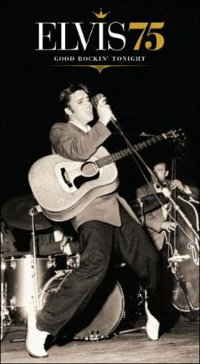 Presley meant different things to
different people, and that's exactly what the box offers; Elvis for everyone. Presley meant different things to
different people, and that's exactly what the box offers; Elvis for everyone.
From the rebel who sang ‘Blue Suede Shoes'
and ‘Hound Dog,' to the socially conscious troubadour of ‘If I Can Dream,' and
‘In the Ghetto,' and the romantic balladeer of ‘Are You Lonesome Tonight' and
‘Can't Help Falling In Love,' it's all here.
The inoffensive popster - ‘(Let Me Be
Your) Teddy Bear,' ‘Pocketful of Rainbows' - spiritually sensitive crooner -
‘(There'll Be) Peace In the Valley (For Me),' ‘Crying In the Chapel,' - patriot
(‘An American Trilogy') - even movie star Elvis - ‘King Creole,' and ‘Viva Las
Vegas' - each gets a hearing.
Later on, the comeback king of
‘Suspicious Minds' and ‘Kentucky Rain' leads into the seventies, with hits like
‘Burning Love' and ‘Always On My Mind.'
As if to show just how timeless the
catalogue really is, proceedings close with 2002's ‘A Little Less Conversation
(JXL Radio Remix Edit),' which took Presley back to the top of the charts via a
34 year old recording.
The box starts almost before the
beginning, with a July 1953 acetate of ‘My Happiness' that Presley paid $4 to
record as a gift to his mother. Not surprisingly, it sounds tentative, but even
at that point, the voice was distinctive.
Exactly a year later, he would return to
record for real.
The set-up was minimal; just guitar and
stand-up bass, but the performance - a cover of Mississippi blues guitarist
Arthur ‘Big Boy' Crudup's ‘That's All Right' - is just under two minutes of
barely-contained energy; ground zero for rock ‘n' roll.
The record's flipside, ‘Blue Moon of
Kentucky,' was a raucous take on Bill Monroe's bluegrass standard.
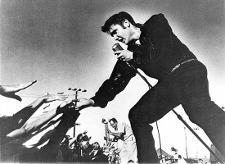 Together, they illustrate just how
divergent his sources could be. But it's what he added that was truly
remarkable; a total reinvention, taking the songs far from their origins. Together, they illustrate just how
divergent his sources could be. But it's what he added that was truly
remarkable; a total reinvention, taking the songs far from their origins.
There's no better example of the
evolution from wild and untamed to the post-Army years than ‘It's Now Or
Never.' Based on an Italian Neapolitan song (‘O Sole Mio') made famous by
operatic stalwarts Enrico Caruso and Mario Lanza, the song was perfect for the
newly mature crooner.
R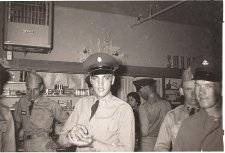 ecorded just a month after his return
from overseas duty, it topped the charts for five weeks in the summer of 1960. ecorded just a month after his return
from overseas duty, it topped the charts for five weeks in the summer of 1960.
Thankfully, he never quite abandoned his
roots; that very same session brought ‘Dirty, Dirty Feeling' and ‘Fever,' but
there's no denying he had returned – for better or worse - a more professional
entertainer.
The inclusion of material from each and
every era makes for an honest representation, but underscores the mid-sixties
slump. While the Beatles and Stones were rewriting the rules, Elvis appeared to
be hopelessly out of step, relegated to drive-in movie star status.
The voice was still there, but– due to
manager Colonel Tom Parker's machinations – material was now taken from a
decreasing pool of writers; in order to maximize profit, Parker insisted they
own a piece of the song publishing.
On the occasions where he was allowed
something decent - such as a 1966 cover of Dylan's ‘Tomorrow Is A Long Time' –
it comes as a shock. But those opportunities were few and far between.
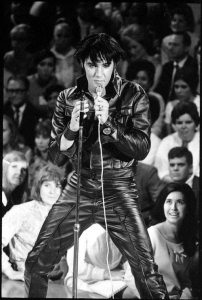 By 1968, Presley was written off by all
but is most fervent fans. That December, he surprised everyone by returning
with a vengeance. His legendary NBC Comeback Special signaled the beginning of
an incredible third act. By 1968, Presley was written off by all
but is most fervent fans. That December, he surprised everyone by returning
with a vengeance. His legendary NBC Comeback Special signaled the beginning of
an incredible third act.
The special was followed by a return to
the charts, and a lengthy run in Las Vegas. Opening night, July 31st,
1969, a lean, mean, revitalized Elvis took the stage. It was his first
performance before a live audience in eight years, and the shows were a
revelation.
Guitar ace James Burton headed up a
powerful backing band, while The Imperials - who first worked with him on How
Great Thou Art- sang backup, augmented by the Sweet Inspirations, a black
female gospel group.
Continue article >>
|
 On Stage
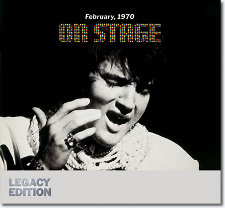
couples two live albums from the comeback years. The earlier set, recorded in
August 1969, came out just two months later, as part of a double album, From
Memphis To Vegas – From Vegas To Memphis, while On Stage February 1970
was released the following June. On Stage
couples two live albums from the comeback years. The earlier set, recorded in
August 1969, came out just two months later, as part of a double album, From
Memphis To Vegas – From Vegas To Memphis, while On Stage February 1970
was released the following June.
Brand new songs like ‘Suspicious Minds,'
and ‘In The Ghetto' sat along with earlier material, plus a few choice covers,
forming a cohesive set.
The second album's track selection was
frustrating; after a powerful opening with ‘See See Rider,' On Stage
goes directly into Engelbert Humperdinck's ‘Release Me,' followed by Neil
Diamond's ‘Sweet Caroline.' Thankfully, the new set's ten bonus tracks -
including ‘Kentucky Rain' and ‘Don't Cry Daddy' - are far better than some of
the original inclusions.
The law of diminishing returns – within
a few years he was incorporating karate kicks and punches into the act - means
this is the place to start when exploring Elvis' live recordings.
Presley boasted of knowing “practically every religious song that's
ever been written.” That might be a bit of a stretch, but there's no denying
gospel was the music closest to him.
He was raised in the Assembly of God
Church, where raucous services were the norm, and was singing at revival services
and all night gospel meetings by his teens.
The Blackwood Brothers and the Statesmen
Quartet were prime influences, and it was only after an unsuccessful attempt to
make it as a gospel singer – a failed 1954 audition with the Songfellows, an
offshoot of the Blackwood Brothers - that his spectacular ascent as the King of
rock truly began.
In a sense, he never left the music; it
remained an essential part of his vocabulary and influenced all that came
after.
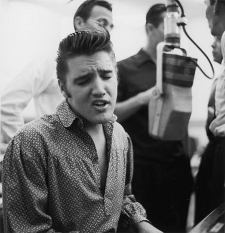 His very first sessions with vocal backing
- for RCA in January 1956 - included members of the Speer Family; and soon
after, the Jordanaires became his de facto back-up group, appearing on almost
every session for the next dozen years. Even on mainstream hits like ‘Don't Be
Cruel,' the group's gospel-flavored vocals are right out of the church. His very first sessions with vocal backing
- for RCA in January 1956 - included members of the Speer Family; and soon
after, the Jordanaires became his de facto back-up group, appearing on almost
every session for the next dozen years. Even on mainstream hits like ‘Don't Be
Cruel,' the group's gospel-flavored vocals are right out of the church.
In 1967, the already formidable back up
was augmented with a second gospel act: the Imperials, a new group led by tenor
Jake Hess, formerly of the Statesmen Quartet. From 1971 until Presley's death in
1977, J. D. Sumner - a renowned bass singer formerly with the Blackwood Brothers -
and his group the Stamps were used for all studio and live dates.
It was Presley's idea to record entire
albums of gospel music; the label was less than encouraged, and treated the
idea as a necessary indulgence of their top star. Sales figures proved there
was a bigger audience than anyone had imagined, and in all, the LPs received a
total of 5 Grammys - the only such awards Elvis received during his lifetime.
The majority of songs came from the
southern gospel tradition, but black gospel was certainly not ignored. Presley
had grown up around both, frequently sneaking into black churches to hear the
music during his teens; and even had a chance to sing with the Golden Gate
Quartet, a legendary black American gospel group that sang in the Jubilee
style, while on furlough in 1959.
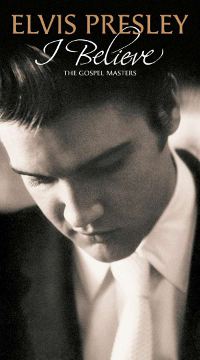 I Believe: The Gospel Masters is the fourth official anthology of Presley's gospel recordings. To
varying degrees, a single disc, double disc, and triple disc - not to mention a
slew of budget releases - have already compiled the original gospel LPs, plus
other relevant recordings. I Believe: The Gospel Masters is the fourth official anthology of Presley's gospel recordings. To
varying degrees, a single disc, double disc, and triple disc - not to mention a
slew of budget releases - have already compiled the original gospel LPs, plus
other relevant recordings.
Now comes this deluxe four disc set.
What can be added? As it turns out, not a lot. The set runs 19 tracks fewer
than the triple disc, and only 13 tracks more than the double disc, so it's not
a case of more is better. Packaging is certainly improved; this is the first to
get a box treatment, and liner notes help put this vital area of his catalogue
in context.
The first three discs compile all
Presley's ‘non-secular' masters in chronological order; while the 4th
disc pulls together stray material from live shows, soundtracks and rehearsals.
For the most part, the essentials are
included. 1957's Peace In The Valley EP, and the gospel albums – His
Hand In Mine (1960), How Great Thou Art (1967), and He Touched Me
(1971) - are included in their entirety.
For the most part, Elvis stuck to the
standard gospel repertoire, with occasional forays into more recent songs.
Thankfully, the gospel material never declined as the film music had.
There were a few exceptions – notably
‘Let Us Pray,' which begins with a grunt. It comes from Change of Habit
- in which Elvis falls for a nun, played by Mary Tyler Moore.
The song comes from the same team that
gave us such classics as ‘Signs of the Zodiac,' ‘Do The Clam,' and ‘He's Your
Uncle, Not Your Dad.' Suffice to say, it's not about to join anyone's list of
sacred classics.
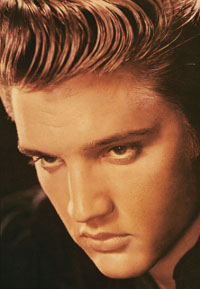 There's one track unique to this
collection; ‘I Was Born About 10,000 Years Ago.' The song originally appearing
on 1970's Elvis Country - but somehow didn't meet the criteria for past
gospel anthologies. Its previous absence is puzzling, as the number – covered
by the Golden Gate Quartet, among others - is rife with Biblical characters. There's one track unique to this
collection; ‘I Was Born About 10,000 Years Ago.' The song originally appearing
on 1970's Elvis Country - but somehow didn't meet the criteria for past
gospel anthologies. Its previous absence is puzzling, as the number – covered
by the Golden Gate Quartet, among others - is rife with Biblical characters.
Together, these three sets offer an excellent, well-rounded introduction,
but there's still much to explore. Presley recorded a total of 711 master
recordings; in a testament to his commercial longevity, nearly everything
remains in print and easily available.
June 2010
|