|
By Jim Coggins
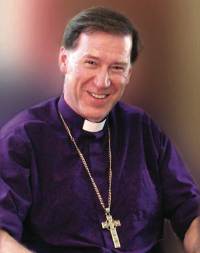 |
| Fred Hiltz, the newly elected head of the Anglican Church of Canada, is a supporter of same-sex blessings. |
A MEETING in late June, which was expected to provide a definitive answer on the question of same-sex unions, has left the Anglican Church of Canada (ACC) confused and still divided over gay-related issues.
Despite this, the ACC's newly-elected head still supports the approval of same-sex blessings by the Diocese of New Westminster. Archbishop Fred Hiltz told CBC.ca that, if there was a change in the status quo in B.C. churches, "it would create a pastoral crisis for that diocese and those parishes where authority has been granted for the blessing of same-sex relations. They've been given authority to proceed and it will be taken away for them. It would create a dilemma."
Hiltz was responding to the results of the ACC's General Synod, held June 19 - 25 in Winnipeg.
Michael Ingham, the controversial bishop of the Diocese of New Westminster - who has spearheaded the drive toward same-sex blessings - saw no real progress resulting from tttthe Synod.
"I think everyone's a loser," he told the Anglican Journal. "Traditional Christians can't take comfort in the vote," he said, adding: "And those who want to move on are held back by a small number of bishops."
Asked how he intends to respond pragmatically to the vote, Ingham told The Vancouver Sun: "We'll be making a decision in the next few weeks . . . We'll have to look at what the general synod said and what its implications are for us."
In principle, he told the Sun, "We remain strongly committed to supporting gay and lesbian members of our church and in the wider society. Our support . . . is undiminished."
The ACC's three 'houses' - lay delegates, clergy and bishops - voted separately on several resolutions relating to gays; the overall results could be seen as both endorsing and rejecting the blessing of same-sex unions.
After hours of debate, the synod voted June 24 on Resolution A186: "That this General Synod resolves that the blessing of same-sex unions is not in conflict with the core doctrine (in the sense of being credal) of the ACC."
The laity and clergy, voting together, approved the motion 152 - 97. The House of Bishops voted 21 - 19 in favour.
However, delegates then voted on Resolution A187: "That this General Synod affirm the authority and jurisdiction of any diocesan synod, with the concurrence of the diocesan bishop, and in a manner which respects the conscience of the incumbent and the will of the parish, to authorize the blessing of committed same-sex unions."
The motion would have allowed individual Anglican dioceses - regional districts presided over by a bishop - across Canada to offer blessing ceremonies to gay couples (but would not have allowed clergy to officiate at homosexual weddings).
This resolution was approved 78 - 59 by the laity, and 63 - 53 by clergy, but defeated 21 - 19 by the House of Bishops. Since approval was required by all three houses, this meant the resolution did not pass.
Resolution B001, which would have affirmed the right of eight parishes in the Diocese of New Westminster to continue offering blessings of covenanted gay unions, was then withdrawn.
However, it is expected that the diocese, under Ingham's leadership, will continue to offer the blessings.
Speaking to the Journal immediately after the vote, Edmonton bishop Victoria Matthews said: "We know that people on both sides of the issue - those who voted for, those who voted against - leave tonight with a profound sense of sadness, that the body of Christ is so broken."
Ed Hird, B.C.-based communications director of the Anglican Coalition in Canada (ACiC) - a group formed by churches which left the ACC over same-sex blessings - issued a brief statement, declaring:
"As we grieve for the significant 'walking apart' shown by the ACC General Synod, let us compassionately hold in prayer those orthodox Anglicans who are still currently within the ACC, and are being traumatized by these decisions. To many of us, the writing seems on the wall."
While some of the secular press tended to focus on the failed vote, several observers said the decision really meant "not yet."
Ron Chaplin, a member of Integrity, a gay Anglican support group, told the Anglican Journal: "I am not upset. The tide is moving. The first motion makes a theological space for gay and lesbian people in the church."
Continue article >>
|
It is unknown how the decisions made by the ACC will affect its relations with the worldwide Anglican communion, which claims about 77 million members. There is no central authority in the church.
However, a majority of the 38 national bishops recently demanded that the American branch of the communion, the Episcopal Church, cease blessing same-sex unions - or they would cut off fellowship with the U.S. body.
The worldwide Anglican communion is dominated by conservative, fast-growing national churches in the Third World, particularly Africa.
Some African bishops have begun offering 'episcopal oversight' to conservative congregations in Canada and the U.S. - in essence, making these congregations part of the African Anglican church.
About 250 congregations have left the Episcopal Church, and 14 have left the ACC. The decisions by General Synod may also cause division within the ACC.
The Canadian conservative Anglican movement is led by Anglican Essentials, which has two branches.
The Anglican Network in Canada consists of congregations which have left the Anglican Church of Canada; the Anglican Federation consists of individuals and congregations still within the ACC.
While the denomination's lukewarm endorsement of same-sex couples is unlikely to attract many gays, it is likely to drive out more conservative members. On the Anglican Essentials website, the Anglican Network stated:
"By changing the doctrine of the Church and saying that what God has called sin is not in conflict with the core doctrine of the church, this General Synod has clearly rejected the authority of the Word of God and made its decision.
"Now we and every Canadian Anglican must make theirs."
Vancouver-based Cheryl Chang, another member of Anglican Essentials, told the Canadian Press that many parishioners won't wait for their congregations to make a decision.
"People [will] leave to go to the Catholic church, the Baptist church, the Pentecostal church. That's going to happen starting next Sunday."
While one news report said the Anglican Church is Canada's "third largest denomination," the ACC does not keep membership lists.
Those christened as infants number hundreds of thousands; but attendance on some Sunday mornings may be as low as 130,000.
Another group present at General Synod was Zacchaeus Fellowship - a support group for people who have struggled with same-sex attraction, but are endeavouring to obey biblical moral standards. After the vote, Zacchaeus Fellowship issued a news release stating that it was "deeply disappointed."
Dawn MacDonald, an Anglican priest in Fort Nelson - who once served at a Vancouver parish - is chair of the group.
Before the vote was held, she told BCCN that, if the denomination endorsed same-sex blessings, "most Zacchaeus members would seriously ask whether we could stay."
She added: "The church would be saying that our faith journeys don't matter, that we were being faithful for nothing."
MacDonald expressed pastoral concern for the "silent sufferers" in the pews who are battling with same-sex attraction - but who will receive no help from a church that will only affirm their attraction.
She suggested that "the pendulum had to swing" from the time when the church merely condemned people with same-sex attraction. But now, she said, "it has gone too far."
ACiC's Ed Hird had words of comfort for ACC members alienated by the vote.
"I remember well how difficult it was for us five years ago, when we walked out from the Diocese of New Westminster Synod. We have discovered from personal experience that there is indeed a way forward."
The Anglican vote was echoed by another major denomination, which held a national meeting the same weekend, also in Winnipeg.
The Evangelical Lutheran Church in Canada (ELCIC) met to vote on whether churches would be allowed to offer a blessing ritual for gay couples. The vote against such blessings was narrow - with an estimated 52.5 percent of the delegates rejecting the concept.
- additional reporting by David F. Dawes
July 2007
|