|
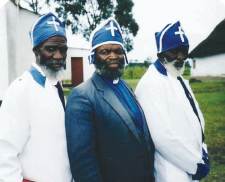 |
| Bishop Mfuwiwa (centre) of the Zion Evangelical Fellowship of Africa is seen here with two of his assistants. |
SIM (Serving in Mission) is a long-established
interdenominational faith mission which has a substantive network of
supporters on Vancouver Island.
The Island, it seems, is also a good place for SIMers
to retire, after spending their lives working in African nations.
Within the past few months, three quiet meetings have
taken place in Victoria, Nanaimo, Campbell River and elsewhere in B.C.
They were arranged by Pauline Clarke, SIM’s
interim B.C. director. Clarke, along with Keith and Cindy Frew – who
are part of Zion Evangelical Ministries of Africa – have been
involved in the meetings.
They were presenting the ‘AmaZioni
challenge,’ as part of an effort to recruit a new generation of Bible
teachers and mentors. The aim is to induce them to work with what is often
called the Zion movement, a powerful southern Africa movement which traces
its history to the work of an early missionary from Zion, Illinois.
Through most of the past century, SIM and Zion have
walked pretty far theologically. But in recent years, there has been a
melding of purpose which is reflective of contemporary Christian mission
thinking.
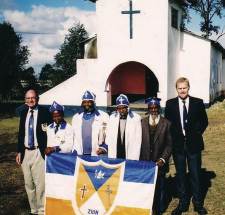 |
| SIM supporters Keith Frew (left) and Carl Brook are seen with leaders of the Zion Apostolic Catholic Christian Church of the Holy Spirit in Hluhluwe, South Africa. |
Around the beginning of the 20th century, John Dowie
– unhappy with the apparent godlessness of burgeoning Chicago –
acquired several thousand acres of rural property along Lake Michigan,
north of the city, for purposes of building a ‘city of God.’
The streets of the proposed development, to be
called Zion, were laid out in the shape of a Union Jack – the flag
reflecting his British origins.
Dowie was a contemporary of Dwight L. Moody, the famed
Chicago evangelist who laid the groundwork for what is now called Moody
Bible Institute.
History records that Moody and Dowie did not see eye to
eye. Moody was more interested in evangelism; Dowie had a theocratic bent,
leading him to plan cities which would be, in effect, branches of the
kingdom of God. Zion was built as the prototype.
Continue article >>
|
The focal point in Zion was not City Hall but the
Christian Catholic Church, which sat at the centre of the
‘flag’ street arrangement. Dowie promoted faith healing and
racial harmony; he also made headlines in 1903 for an acrimonious spiritual
debate with a Muslim leader. He ran Zion as a theocracy.
The greater growth item coming out of Zion was not, as
it turned out, in Illinois – but in southern Africa, where Dowie sent
a missionary named Daniel Bryant, in 1904. Out of this grew the Zion
movement – which today numbers some 18 million people.
In describing the present opportunity to SIM
supporters, Keith Frew speaks of two spiritual and cultural sides to
amaZioni – as the movement is affectionately known in Africa.
Zion people are among the leaders and highly-motivated
workers in South Africa and surrounding nations. Frew says their
understanding of God-motivated power structures has made them crucial to
the cultures in the area, particularly when South African blacks were
dominated by apartheid.
“The Zion groups are well-respected, have high
moral standards, are solid citizens, employers and employees,” he
says. The other side of the coin is that, as they grew, some Zion churches
became increasingly syncretic.
The result was a decreasing incidence of solid biblical
teaching, and an increasing emphasis on animistic ancestral worship culture
–which had been their pre-Christian background. “There are
about 200 Zion groups who want to increase their biblical awareness through
solid Bible teaching,” Frew notes.
He says the objective of SIM’s current initiative
is to help Zion leaders “bring biblical renewal to their own movement
. . . The fact is that there is a real hunger for it – and the
prospect[is] that the number of groups to work with could well expand
greatly beyond the present 200.”
Contact: Pauline.clarke@sim.org.
– Lloyd Mackey
July 2007
|